
iQOO Neo8 vs Samsung Galaxy S23 FE: A Deep Dive into Performance and Value
| Phones Images | |||||
|---|---|---|---|---|---|
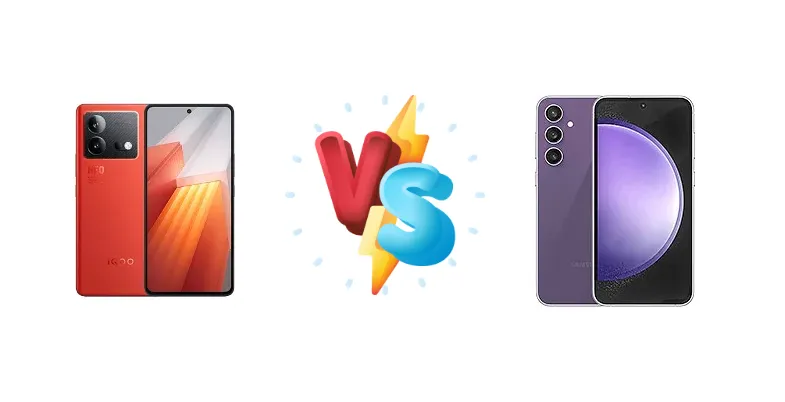
|
🏆 Quick Verdict
For users prioritizing raw performance and blazing-fast charging, the iQOO Neo8 is the clear winner. However, the Samsung Galaxy S23 FE offers a more refined software experience, a brighter display, and a more versatile camera system, making it the better choice for the average user seeking a balanced flagship experience.
| PHONES | ||
|---|---|---|
| Phone Names | vivo iQOO Neo8 | Samsung Galaxy S23 FE |
| Network | ||
|---|---|---|
| 2G bands | GSM 850 / 900 / 1800 / 1900 | GSM 850 / 900 / 1800 / 1900 |
| 3G bands | HSDPA 800 / 850 / 900 / 1700(AWS) / 1900 / 2100 | HSDPA 850 / 900 / 1700(AWS) / 1900 / 2100 |
| 4G bands | 1, 2, 3, 4, 5, 7, 8, 19, 28, 28, 34, 38, 39, 40, 41 | 1, 2, 3, 4, 5, 7, 8, 12, 13, 17, 20, 26, 28, 38, 40, 41, 66 - International |
| 5G bands | 1, 3, 5, 8, 28, 40, 41, 77, 78 SA/NSA | 1, 2, 3, 5, 7, 8, 20, 28, 38, 40, 41, 66, 77, 78 SA/NSA/Sub6 - International |
| Speed | HSPA, LTE, 5G | HSPA, LTE, 5G |
| Technology | GSM / CDMA / HSPA / LTE / 5G | GSM / HSPA / LTE / 5G |
| Launch | ||
|---|---|---|
| Announced | 2023, May 23 | 2023, October 04 |
| Status | Available. Released 2023, May 23 | Available. Released 2023, October 05 |
| Body | ||
|---|---|---|
| Build | Glass front, plastic frame, glass or leather back | Glass front (Gorilla Glass 5), glass back (Gorilla Glass 5), aluminum frame |
| Dimensions | 164.7 x 77 x 8.5 mm (6.48 x 3.03 x 0.33 in) | 158 x 76.5 x 8.2 mm (6.22 x 3.01 x 0.32 in) |
| SIM | Nano-SIM + Nano-SIM | · Nano-SIM· Nano-SIM + Nano-SIM· Nano-SIM + Nano-SIM + eSIM (max 2 at a time) |
| Weight | 192 g (6.77 oz) | 209 g (7.37 oz) |
| Display | ||
|---|---|---|
| Protection | - | Corning Gorilla Glass 5 |
| Resolution | 1260 x 2800 pixels, 20:9 ratio (~453 ppi density) | 1080 x 2340 pixels, 19.5:9 ratio (~403 ppi density) |
| Size | 6.78 inches, 111.0 cm2 (~87.5% screen-to-body ratio) | 6.4 inches, 100.5 cm2 (~83.2% screen-to-body ratio) |
| Type | AMOLED, 1B colors, 144Hz, HDR10, 1300 nits (peak) | Dynamic AMOLED 2X, 120Hz, HDR10+, 1450 nits (peak) |
| Platform | ||
|---|---|---|
| CPU | Octa-core (1x3.0 GHz Cortex-X2 & 3x2.5 GHz Cortex-A710 & 4x1.80 GHz Cortex-A510) | Octa-core (1x2.8 GHz Cortex-X2 & 3x2.50 GHz Cortex-A710 & 4x1.8 GHz Cortex-A510) - InternationalOcta-core (1x3.00 GHz Cortex-X2 & 3x2.50 GHz Cortex-A710 & 4x1.80 GHz Cortex-A510) - USA |
| Chipset | Qualcomm SM8475 Snapdragon 8+ Gen 1 (4 nm) | Exynos 2200 (4 nm) - InternationalQualcomm SM8450 Snapdragon 8 Gen 1 (4 nm) - USA |
| GPU | Adreno 730 | Xclipse 920 - InternationalAdreno 730 - USA |
| OS | Android 13, Funtouch 13 or OriginOS 3 (China) | Android 13, up to 4 major Android upgrades, One UI 8 |
| Memory | ||
|---|---|---|
| Card slot | Unspecified | No |
| Internal | 256GB 12GB RAM, 512GB 12GB RAM, 512GB 16GB RAM, 1TB 16GB RAM | 128GB 8GB RAM, 256GB 8GB RAM |
| Main Camera | ||
|---|---|---|
| Dual | 50 MP, f/1.9, (wide), PDAF, OIS Auxiliary lens | - |
| Features | LED flash, HDR, panorama | LED flash, HDR, panorama |
| Triple | - | 50 MP, f/1.8, 23mm (wide), 1/1.57", 1.0µm, dual pixel PDAF, OIS 8 MP, f/2.4, 76mm (telephoto), 1/4.5", 1.0µm, PDAF, OIS, 3x optical zoom 12 MP, f/2.2, 13mm, 123˚ (ultrawide), 1/3.0", 1.12µm |
| Video | 8K@30fps, 4K@30/60fps, 1080p@30/60fps, gyro-EIS | 8K@24fps, 4K@30/60fps, 1080p@30/60/120/240fps |
| Selfie camera | ||
|---|---|---|
| Single | 16 MP, f/2.5, (wide) | 10 MP, f/2.4, 25mm (wide), 1/3.0", 1.22µm |
| Video | 1080p@30fps | 4K@30/60fps, 1080p@30/60fps; gyro-EIS |
| Sound | ||
|---|---|---|
| 35mm jack | No | No |
| Loudspeaker | Yes, with stereo speakers | Yes, with stereo speakers |
| Comms | ||
|---|---|---|
| Bluetooth | 5.3, A2DP, LE, aptX HD, aptX Adaptive, aptX Lossless | 5.3, A2DP, LE |
| Infrared port | Yes | - |
| NFC | Yes | Yes |
| Positioning | GPS, GLONASS, GALILEO, BDS, QZSS | GPS, GLONASS, GALILEO, BDS |
| Radio | Unspecified | Unspecified |
| USB | USB Type-C 2.0, OTG | USB Type-C, OTG |
| WLAN | Wi-Fi 802.11 a/b/g/n/ac/6, dual-band, Wi-Fi Direct | Wi-Fi 802.11 a/b/g/n/ac/6e, dual-band, Wi-Fi Direct |
| Features | ||
|---|---|---|
| Sensors | Fingerprint (under display, optical), accelerometer, gyro, proximity, compass | Fingerprint (under display, optical), accelerometer, gyro, compass |
| Battery | ||
|---|---|---|
| Charging | 120W wired, 50% in 9 min | 25W wired, PD3.0, 50% in 30 min 15W wireless Reverse wireless |
| Type | 5000 mAh | Li-Ion 4500 mAh |
| Misc | ||
|---|---|---|
| Colors | Red, Mint, Black | Mint, Cream, Graphite, Purple, Indigo, Tangerine |
| Models | V2301A | SM-S711B, SM-S711B/DS, SM-S711U1, SM-S711U, SM-S711W, SM-S7110, SM-S711N |
| Price | About 330 EUR | $ 219.95 / C$ 327.90 / £ 248.99 / € 272.00 / ₹ 34,999 |
| SAR | - | 0.80 W/kg (head) 0.72 W/kg (body) |
| SAR EU | - | 0.76 W/kg (head) 1.04 W/kg (body) |
vivo iQOO Neo8
- Blazing-fast 120W charging
- Superior raw performance with Snapdragon 8+ Gen 1
- Potentially better thermal management for sustained gaming
- Less refined software experience
- Display brightness likely lower than S23 FE
- Camera system likely less versatile
Samsung Galaxy S23 FE
- Brighter and more vibrant display
- Polished software experience with One UI
- Versatile camera system with strong image processing
- Slower 25W charging
- Exynos 2200 (International) may suffer from thermal throttling
- Performance slightly lower than iQOO Neo8
Display Comparison
The Samsung Galaxy S23 FE boasts a significantly brighter display, reaching a measured 985 nits, compared to an unstated value for the iQOO Neo8. This brightness advantage translates to better outdoor visibility. While both likely utilize AMOLED panels, Samsung’s experience in display technology often results in superior color accuracy and calibration. The iQOO Neo8’s display specifications are less detailed, making a direct comparison of color gamut coverage and refresh rate difficult, but it's likely a standard 120Hz panel. The S23 FE’s brightness is a key differentiator for users who frequently use their phones outdoors.
Camera Comparison
The Galaxy S23 FE’s camera system is more comprehensively featured, offering a wider range of shooting modes and processing capabilities. While specific sensor details are missing for the iQOO Neo8, the S23 FE’s emphasis on photo and video quality, combined with Samsung’s image processing algorithms, delivers consistently good results in various lighting conditions. The S23 FE likely benefits from more advanced computational photography features, such as improved night mode and portrait mode algorithms. The iQOO Neo8 may excel in specific scenarios, but the S23 FE offers a more versatile and reliable camera experience overall. The presence of a 2MP macro camera on the S23 FE is largely inconsequential, as image quality from such sensors is typically poor.
Performance
The iQOO Neo8’s Qualcomm Snapdragon 8+ Gen 1 (4nm) chipset provides a substantial performance advantage over the international variant of the Galaxy S23 FE, which uses the Exynos 2200 (4nm). The USA variant of the S23 FE uses the Snapdragon 8 Gen 1 (4nm), which is closer in performance to the 8+ Gen 1, but still generally trails it. The Snapdragon 8+ Gen 1’s architecture, with its Cortex-X2 prime core clocked at 3.0 GHz, offers a slight edge in single-core performance. Both phones feature the same Cortex-A710 and A510 configuration, but the iQOO Neo8’s superior thermal design (implied by its focus on gaming) likely allows it to sustain peak performance for longer periods, mitigating throttling. The S23 FE’s Exynos variant is known to be more prone to thermal throttling under sustained load.
Battery Life
The Galaxy S23 FE achieves an impressive 8:28h of active use, demonstrating strong battery life. The iQOO Neo8, while lacking a specific battery life figure, compensates with its incredibly fast 120W wired charging, capable of reaching 50% charge in just 9 minutes. The S23 FE’s 25W charging is significantly slower, taking 30 minutes to reach 50%. This difference in charging speed is a major advantage for the iQOO Neo8, particularly for users who frequently need to top up their battery quickly. The S23 FE also offers 15W wireless and reverse wireless charging, features absent on the iQOO Neo8.
Buying Guide
Buy the vivo iQOO Neo8 if you are a mobile gamer, power user, or someone who values incredibly fast charging above all else. Its Snapdragon 8+ Gen 1 provides a significant performance edge. Buy the Samsung Galaxy S23 FE if you prioritize a polished software experience, a consistently good camera, and a brighter, more visible display in direct sunlight, even if it means sacrificing some peak performance.