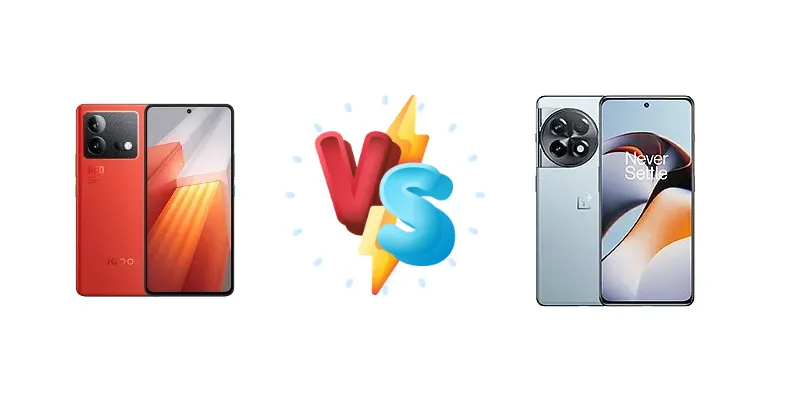
The sub-$500 smartphone market is heating up, and the vivo iQOO Neo8 and OnePlus 11R are two of the most compelling contenders. Both devices center around Qualcomm’s Snapdragon 8+ Gen 1, offering flagship-level performance at a mid-range price. However, subtle differences in charging speed and potential software approaches create a clear distinction for specific user needs.
🏆 Quick Verdict
For most users, the iQOO Neo8 emerges as the slightly better choice. Its 120W charging significantly reduces downtime, and while both phones share the same core chipset, iQOO’s history suggests a focus on maximizing performance, potentially leading to a more aggressive thermal profile and sustained performance.
| Network |
|---|
| 2G bands | GSM 850 / 900 / 1800 / 1900 | GSM 850 / 900 / 1800 / 1900 |
| 3G bands | HSDPA 800 / 850 / 900 / 1700(AWS) / 1900 / 2100 | HSDPA 850 / 900 / 1700(AWS) / 2100 |
| 4G bands | 1, 2, 3, 4, 5, 7, 8, 19, 28, 28, 34, 38, 39, 40, 41 | 1, 3, 4, 5, 8, 28, 34, 38, 39, 40, 41 |
| 5G bands | 1, 3, 5, 8, 28, 40, 41, 77, 78 SA/NSA | 1, 3, 5, 8, 28, 40, 41, 77, 78 SA/NSA |
| Speed | HSPA, LTE, 5G | HSPA, LTE (3CA), 5G |
| Technology | GSM / CDMA / HSPA / LTE / 5G | GSM / CDMA / HSPA / LTE / 5G |
| | - | CDMA 800 |
| Launch |
|---|
| Announced | 2023, May 23 | 2023, February 07 |
| Status | Available. Released 2023, May 23 | Available. Released 2023, February 21 |
| Body |
|---|
| Build | Glass front, plastic frame, glass or leather back | Glass front, glass back (Gorilla Glass 5), plastic frame |
| Dimensions | 164.7 x 77 x 8.5 mm (6.48 x 3.03 x 0.33 in) | 163.4 x 74.3 x 8.7 mm (6.43 x 2.93 x 0.34 in) |
| SIM | Nano-SIM + Nano-SIM | Nano-SIM + Nano-SIM |
| Weight | 192 g (6.77 oz) | 204 g (7.20 oz) |
| Display |
|---|
| Resolution | 1260 x 2800 pixels, 20:9 ratio (~453 ppi density) | 1240 x 2772 pixels, 20:9 ratio (~451 ppi density) |
| Size | 6.78 inches, 111.0 cm2 (~87.5% screen-to-body ratio) | 6.74 inches, 109.2 cm2 (~90.0% screen-to-body ratio) |
| Type | AMOLED, 1B colors, 144Hz, HDR10, 1300 nits (peak) | Fluid AMOLED, 1B colors, 120Hz, HDR10+, 1450 nits (peak) |
| Platform |
|---|
| CPU | Octa-core (1x3.0 GHz Cortex-X2 & 3x2.5 GHz Cortex-A710 & 4x1.80 GHz Cortex-A510) | Octa-core (1x3.0 GHz Cortex-X2 & 3x2.5 GHz Cortex-A710 & 4x1.80 GHz Cortex-A510) |
| Chipset | Qualcomm SM8475 Snapdragon 8+ Gen 1 (4 nm) | Qualcomm SM8475 Snapdragon 8+ Gen 1 (4 nm) |
| GPU | Adreno 730 | Adreno 730 |
| OS | Android 13, Funtouch 13 or OriginOS 3 (China) | Android 13, upgradable to Android 15, OxygenOS 15 |
| Memory |
|---|
| Card slot | Unspecified | No |
| Internal | 256GB 12GB RAM, 512GB 12GB RAM, 512GB 16GB RAM, 1TB 16GB RAM | 128GB 8GB RAM, 256GB 16GB RAM, 512GB 18GB RAM |
| | - | UFS 3.1 |
| Main Camera |
|---|
| Dual | 50 MP, f/1.9, (wide), PDAF, OIS
Auxiliary lens | - |
| Features | LED flash, HDR, panorama | Color spectrum sensor, LED flash, HDR, panorama |
| Single | - | 16 MP, f/2.4, 24mm (wide), 1/3.09", 1.0µm |
| Triple | - | 50 MP, f/1.8, 24mm (wide), 1/1.56", 1.0µm, multi-directional PDAF, OIS
8 MP, f/2.2, 120˚ (ultrawide), 1/4.0", 1.12µm
2 MP (macro) |
| Video | 8K@30fps, 4K@30/60fps, 1080p@30/60fps, gyro-EIS | 4K@30/60fps, 1080p@30/60/240fps, gyro-EIS |
| Selfie camera |
|---|
| Features | - | HDR |
| Single | 16 MP, f/2.5, (wide) | 16 MP, f/2.4, 24mm (wide), 1/3.09", 1.0µm |
| Video | 1080p@30fps | 1080p@30fps |
| Sound |
|---|
| 3.5mm jack | - | No |
| 35mm jack | No | No |
| Loudspeaker | Yes, with stereo speakers | Yes, with stereo speakers |
| | - | 24-bit/192kHz audio |
| Comms |
|---|
| Bluetooth | 5.3, A2DP, LE, aptX HD, aptX Adaptive, aptX Lossless | 5.3, A2DP, LE, aptX HD |
| Infrared port | Yes | Yes |
| NFC | Yes | Yes |
| Positioning | GPS, GLONASS, GALILEO, BDS, QZSS | GPS (L1+L5), GLONASS (G1), BDS (B1I+B1c+B2a), GALILEO (E1+E5a), QZSS (L1+L5) |
| Radio | Unspecified | No |
| USB | USB Type-C 2.0, OTG | USB Type-C 2.0 |
| WLAN | Wi-Fi 802.11 a/b/g/n/ac/6, dual-band, Wi-Fi Direct | Wi-Fi 802.11 a/b/g/n/ac/6, dual-band |
| Features |
|---|
| Sensors | Fingerprint (under display, optical), accelerometer, gyro, proximity, compass | Fingerprint (under display, optical), accelerometer, gyro, proximity, compass |
| Battery |
|---|
| Charging | 120W wired, 50% in 9 min | 100W wired |
| Type | 5000 mAh | Li-Po 5000 mAh |
| Misc |
|---|
| Colors | Red, Mint, Black | Galactic Silver, Sonic Black, Solar Red |
| Models | V2301A | CPH2487 |
| Price | About 330 EUR | About 600 EUR |
| SAR | - | 1.16 W/kg (head) 0.61 W/kg (body) |
vivo iQOO Neo8
- Significantly faster 120W charging
- Potential for more aggressive performance tuning
- Likely more competitive pricing
- Potentially higher peak temperatures
- Software experience may be less refined than OxygenOS
OnePlus 11R
- Refined OxygenOS software experience
- Potentially better long-term thermal stability
- Established brand reputation
- Slower 100W charging
- May prioritize battery life over sustained performance
Display Comparison
Both the iQOO Neo8 and OnePlus 11R are expected to feature AMOLED displays, though specific details like peak brightness and color accuracy aren't provided. The shared chipset suggests both can drive high refresh rates. However, the absence of LTPO technology in either device means refresh rate scaling will likely be less dynamic than on flagship models, impacting battery life during static content viewing. Bezels are likely comparable, given the similar price points and target markets.
Camera Comparison
Without detailed camera specifications, a direct comparison is difficult. However, given the price bracket, both phones will likely feature a primary sensor in the 50MP-64MP range. The presence or absence of Optical Image Stabilization (OIS) on the main sensor will be a crucial factor, with OIS providing sharper images and smoother video, especially in low light. Lens apertures will also play a role; a wider aperture (lower f-number) allows more light to reach the sensor. Expect both to include ultrawide and potentially macro lenses, though the quality of the latter is often negligible.
Performance
The core of both phones is the Qualcomm SM8475 Snapdragon 8+ Gen 1 (4nm). This means identical CPU configurations – an octa-core setup with 1x3.0 GHz Cortex-X2, 3x2.5 GHz Cortex-A710, and 4x1.80 GHz Cortex-A510 cores. Performance will be nearly indistinguishable in synthetic benchmarks. The key differentiator will be thermal management. iQOO historically prioritizes sustained performance, potentially leading to higher peak temperatures but longer periods at maximum clock speeds. OnePlus typically favors a more balanced approach. Both likely utilize LPDDR5X RAM, ensuring ample bandwidth for multitasking and gaming.
Battery Life
The iQOO Neo8’s 120W wired charging is a significant advantage over the OnePlus 11R’s 100W charging. iQOO claims 50% charge in 9 minutes, while the 11R will take longer. This difference is substantial for users who frequently need to top up their battery quickly. While battery capacity isn’t specified, the faster charging of the iQOO Neo8 effectively mitigates any potential disadvantage from a slightly smaller battery size. Both phones will likely offer all-day battery life with moderate usage.
Buying Guide
Buy the vivo iQOO Neo8 if you prioritize minimizing charging times and potentially benefit from a more performance-focused software experience. This phone is ideal for gamers and power users who demand responsiveness. Buy the OnePlus 11R if you prefer a more refined, OxygenOS software experience and value a slightly more conservative thermal approach, potentially leading to longer-term component stability. It’s a solid all-rounder for everyday use.
Frequently Asked Questions
❓ Will the Snapdragon 8+ Gen 1 in either phone struggle with demanding games like Genshin Impact?
No, the Snapdragon 8+ Gen 1 is a very capable chipset and will handle Genshin Impact and other demanding games at high settings. However, sustained performance will depend on the phone's thermal management. The iQOO Neo8 may maintain higher frame rates for longer, but potentially at the cost of higher temperatures.
❓ Does the 100W or 120W charging significantly impact battery health over the long term?
While faster charging generates more heat, modern smartphones employ sophisticated charging algorithms to minimize battery degradation. The impact on long-term battery health is likely to be minimal for both phones, but consistent use of extremely fast charging *may* slightly accelerate degradation compared to slower charging methods.
❓ Which phone is better for users who frequently record videos?
Without knowing the camera specifications, it's difficult to say definitively. However, the presence of Optical Image Stabilization (OIS) on the main camera will be crucial for stable video recording. Check reviews for video quality comparisons once available.