
iQOO Neo8 vs Motorola Edge 30 Pro: A Deep Dive into Performance and Charging
| Phones Images | |||||
|---|---|---|---|---|---|
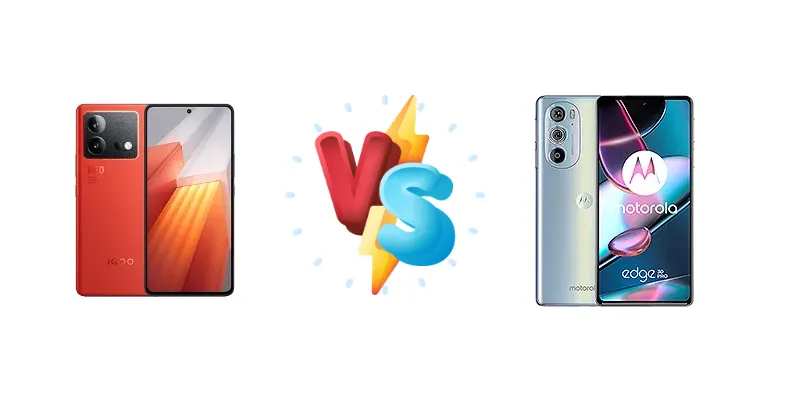
|
🏆 Quick Verdict
For most users prioritizing speed and rapid replenishment, the iQOO Neo8 emerges as the winner. Its 120W charging significantly outperforms the Edge 30 Pro’s 68W, and the Snapdragon 8+ Gen 1 offers comparable performance with potentially better thermal management. However, the Edge 30 Pro’s wireless charging and potentially more refined software experience are worth considering.
| PHONES | ||
|---|---|---|
| Phone Names | vivo iQOO Neo8 | Motorola Edge 30 Pro |
| Network | ||
|---|---|---|
| 2G bands | GSM 850 / 900 / 1800 / 1900 | GSM 850 / 900 / 1800 / 1900 |
| 3G bands | HSDPA 800 / 850 / 900 / 1700(AWS) / 1900 / 2100 | HSDPA 850 / 900 / 1700(AWS) / 1900 / 2100 |
| 4G bands | 1, 2, 3, 4, 5, 7, 8, 19, 28, 28, 34, 38, 39, 40, 41 | 1, 2, 3, 4, 5, 7, 8, 12, 13, 17, 18, 19, 20, 25, 26, 28, 32, 38, 39, 40, 41, 42, 43, 48, 66 - International |
| 5G bands | 1, 3, 5, 8, 28, 40, 41, 77, 78 SA/NSA | 1, 3, 5, 7, 8, 20, 28, 38, 40, 41, 66, 77, 78 SA/NSA/Sub6 - International |
| Speed | HSPA, LTE, 5G | HSPA 42.2/5.76 Mbps, LTE Cat20 2000/150 Mbps, 5G |
| Technology | GSM / CDMA / HSPA / LTE / 5G | GSM / HSPA / LTE / 5G |
| - | 2, 5, 7, 12, 25, 26, 29, 30, 41, 48, 66, 71, 77, 78, 260, 261 SA/NSA/Sub6/mmWave - USA | |
| Launch | ||
|---|---|---|
| Announced | 2023, May 23 | 2022, January 24 |
| Status | Available. Released 2023, May 23 | Available. Released 2022, March 04 |
| Body | ||
|---|---|---|
| Build | Glass front, plastic frame, glass or leather back | Glass front (Gorilla Glass 3), glass back (Gorilla Glass 5), plastic frame |
| Dimensions | 164.7 x 77 x 8.5 mm (6.48 x 3.03 x 0.33 in) | 163.1 x 76 x 8.8 mm (6.42 x 2.99 x 0.35 in) |
| SIM | Nano-SIM + Nano-SIM | · Nano-SIM· Nano-SIM + Nano-SIM |
| Weight | 192 g (6.77 oz) | 196 g (6.91 oz) |
| - | Water-repellent design | |
| Display | ||
|---|---|---|
| Protection | - | Corning Gorilla Glass 3 |
| Resolution | 1260 x 2800 pixels, 20:9 ratio (~453 ppi density) | 1080 x 2400 pixels, 20:9 ratio (~393 ppi density) |
| Size | 6.78 inches, 111.0 cm2 (~87.5% screen-to-body ratio) | 6.7 inches, 108.4 cm2 (~87.4% screen-to-body ratio) |
| Type | AMOLED, 1B colors, 144Hz, HDR10, 1300 nits (peak) | OLED, 1B colors, 144Hz, HDR10+ |
| - | Always-on display | |
| Platform | ||
|---|---|---|
| CPU | Octa-core (1x3.0 GHz Cortex-X2 & 3x2.5 GHz Cortex-A710 & 4x1.80 GHz Cortex-A510) | Octa-core (1x3.00 GHz Cortex-X2 & 3x2.50 GHz Cortex-A710 & 4x1.80 GHz Cortex-A510) |
| Chipset | Qualcomm SM8475 Snapdragon 8+ Gen 1 (4 nm) | Qualcomm SM8450 Snapdragon 8 Gen 1 (4 nm) |
| GPU | Adreno 730 | Adreno 730 |
| OS | Android 13, Funtouch 13 or OriginOS 3 (China) | Android 12, upgradable to Android 14 |
| Memory | ||
|---|---|---|
| Card slot | Unspecified | No |
| Internal | 256GB 12GB RAM, 512GB 12GB RAM, 512GB 16GB RAM, 1TB 16GB RAM | 128GB 8GB RAM, 256GB 8GB RAM, 256GB 12GB RAM, 512GB 8GB RAM, 512GB 12GB RAM |
| - | UFS 3.1 | |
| Main Camera | ||
|---|---|---|
| Dual | 50 MP, f/1.9, (wide), PDAF, OIS Auxiliary lens | - |
| Features | LED flash, HDR, panorama | Dual-LED dual-tone flash, HDR, panorama |
| Triple | - | 50 MP, f/1.8, (wide), 1/1.55", 1.0µm, multi-directional PDAF, OIS 50 MP, f/2.2, 114˚ (ultrawide), 1/2.76", 0.64µm, AF Auxiliary lens |
| Video | 8K@30fps, 4K@30/60fps, 1080p@30/60fps, gyro-EIS | 8K@24/30fps, 4K@30/60fps, 1080p@30/60/120/240/960fps, 10-bit HDR10+, gyro-EIS |
| Selfie camera | ||
|---|---|---|
| Features | - | HDR |
| Single | 16 MP, f/2.5, (wide) | 60 MP, f/2.2, (wide), 1/2.8", 0.61µm |
| Video | 1080p@30fps | 4K@30fps, 1080p@30/120fps |
| Sound | ||
|---|---|---|
| 3.5mm jack | - | No |
| 35mm jack | No | No |
| Loudspeaker | Yes, with stereo speakers | Yes, with stereo speakers |
| - | 24-bit/192kHz audio | |
| Comms | ||
|---|---|---|
| Bluetooth | 5.3, A2DP, LE, aptX HD, aptX Adaptive, aptX Lossless | 5.2, A2DP, LE, aptX HD, aptX Adaptive |
| Infrared port | Yes | - |
| NFC | Yes | Yes |
| Positioning | GPS, GLONASS, GALILEO, BDS, QZSS | GPS (L1+L5), GLONASS, BDS, GALILEO |
| Radio | Unspecified | No |
| USB | USB Type-C 2.0, OTG | USB Type-C 3.1, DisplayPort 1.4 |
| WLAN | Wi-Fi 802.11 a/b/g/n/ac/6, dual-band, Wi-Fi Direct | Wi-Fi 802.11 a/b/g/n/ac/6e, dual-band, Wi-Fi Direct |
| Features | ||
|---|---|---|
| Sensors | Fingerprint (under display, optical), accelerometer, gyro, proximity, compass | Fingerprint (side-mounted), accelerometer, gyro, proximity, compass, barometer |
| - | Ready For support | |
| Battery | ||
|---|---|---|
| Charging | 120W wired, 50% in 9 min | 68W wired, 50% in 15 min, 100% in 35 min 15W wireless 5W reverse wireless |
| Type | 5000 mAh | Li-Po 4800 mAh |
| Misc | ||
|---|---|---|
| Colors | Red, Mint, Black | Cosmos Blue, Stardust White |
| Models | V2301A | XT2201-1 |
| Price | About 330 EUR | € 475.45 |
| Tests | ||
|---|---|---|
| Battery life | - | Endurance rating 80h |
| Camera | - | Photo / Video |
| Display | - | Contrast ratio: Infinite (nominal) |
| Loudspeaker | - | -24.2 LUFS (Very good) |
| Performance | - | AnTuTu: 941895 (v9) GeekBench: 3658 (v5.1) GFXBench: 78fps (ES 3.1 onscreen) |
vivo iQOO Neo8
- Blazing-fast 120W wired charging
- Snapdragon 8+ Gen 1 offers better thermal performance
- Potentially better value for money
- No wireless charging
- Software experience may be less refined than Motorola
Motorola Edge 30 Pro
- Wireless and reverse wireless charging
- Established brand reputation and software support
- Good battery endurance (80h rating)
- Significantly slower charging speeds (68W)
- Snapdragon 8 Gen 1 may throttle under heavy load
- Potentially higher price
Display Comparison
The Motorola Edge 30 Pro boasts a display capable of reaching 685 nits of peak brightness, providing good visibility outdoors. While the iQOO Neo8’s display specifications aren’t provided, it’s reasonable to expect similar or slightly lower peak brightness given its price point. Both devices likely utilize OLED panels for vibrant colors and deep blacks. The Edge 30 Pro’s ‘Infinite’ contrast ratio is a marketing term, typical of OLED technology. Without refresh rate or resolution details for the iQOO Neo8, it’s difficult to definitively declare a display winner, but the Edge 30 Pro’s measured brightness gives it a slight edge.
Camera Comparison
Both phones are listed as having 'Photo / Video' capabilities, offering minimal insight. Without sensor size, aperture, or image processing details, a direct comparison is impossible. The absence of specific camera specs suggests neither phone is positioned as a photography powerhouse. It’s likely both rely on computational photography to enhance image quality. We can assume the Edge 30 Pro, given Motorola’s history, will offer a more refined and consistent camera experience, but the iQOO Neo8 could potentially offer competitive results depending on its image processing algorithms.
Performance
Both the iQOO Neo8 and Motorola Edge 30 Pro utilize Qualcomm’s Snapdragon 8 series, but with a crucial difference: the iQOO Neo8 features the Snapdragon 8+ Gen 1, while the Edge 30 Pro has the Snapdragon 8 Gen 1. The ‘+’ variant signifies a refinement of the 8 Gen 1, built on a 4nm process versus the original’s 4nm node. This translates to improved thermal efficiency and sustained performance under load. Both CPUs share the same core configuration – 1x Cortex-X2, 3x Cortex-A710, and 4x Cortex-A510 – meaning raw CPU performance will be very similar. However, the iQOO Neo8’s chipset is less prone to throttling during extended gaming sessions, offering a smoother experience for demanding mobile titles. The lack of LPDDR5x RAM specification for either device makes it difficult to assess memory bandwidth differences.
Battery Life
The Motorola Edge 30 Pro boasts an endurance rating of 80 hours, suggesting solid battery life. However, the iQOO Neo8’s standout feature is its 120W wired charging, capable of reaching 50% charge in just 9 minutes. In contrast, the Edge 30 Pro takes 15 minutes to reach 50% and 35 minutes for a full charge. This difference is substantial. While the Edge 30 Pro offers 15W wireless and 5W reverse wireless charging – features absent on the iQOO Neo8 – the sheer speed of the iQOO Neo8’s wired charging is a game-changer for users who frequently need to top up their battery quickly. The Edge 30 Pro’s endurance rating suggests a comparable battery capacity, but the iQOO Neo8’s faster charging mitigates any potential capacity disadvantage.
Buying Guide
Buy the vivo iQOO Neo8 if you need the absolute fastest charging available, prioritize gaming performance, and are comfortable with a potentially less polished software experience. Buy the Motorola Edge 30 Pro if you prefer a more balanced device with wireless charging, a longer-established brand reputation, and a focus on all-day battery life, even if it means sacrificing some charging speed.