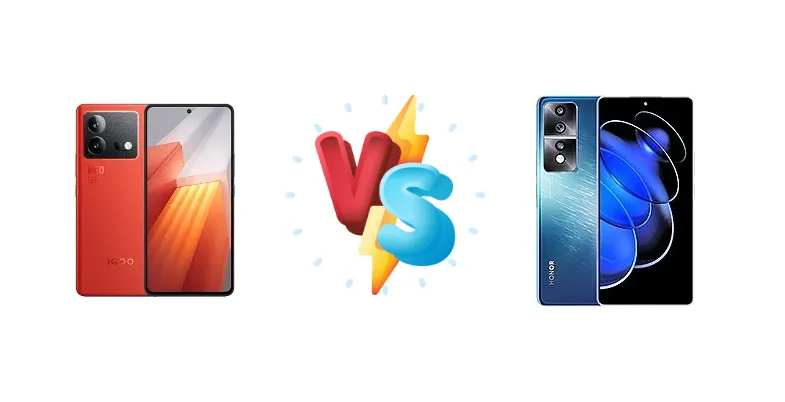
The iQOO Neo8 and Honor 80 GT represent a fascinating intersection in the smartphone market: both deliver flagship-level performance with the Snapdragon 8+ Gen 1, but target different priorities. The iQOO Neo8 aggressively focuses on charging speed, while the Honor 80 GT aims for a more balanced approach. This comparison will dissect their strengths and weaknesses to determine which phone best suits your needs.
🏆 Quick Verdict
For most users, the iQOO Neo8 emerges as the stronger choice. Its 120W charging is a game-changer, significantly reducing downtime. While the Honor 80 GT is a capable device, the iQOO Neo8’s faster charging and competitive pricing offer a more compelling overall package.
| Network |
|---|
| 2G bands | GSM 850 / 900 / 1800 / 1900 | GSM 850 / 900 / 1800 / 1900 |
| 3G bands | HSDPA 800 / 850 / 900 / 1700(AWS) / 1900 / 2100 | HSDPA 800 / 850 / 900 / 1700(AWS) / 2100 |
| 4G bands | 1, 2, 3, 4, 5, 7, 8, 19, 28, 28, 34, 38, 39, 40, 41 | 1, 3, 4, 5, 8, 19, 28, 34, 38, 39, 40, 41 |
| 5G bands | 1, 3, 5, 8, 28, 40, 41, 77, 78 SA/NSA | 1, 5, 8, 28, 41, 77, 78 SA/NSA |
| Speed | HSPA, LTE, 5G | HSPA, LTE, 5G |
| Technology | GSM / CDMA / HSPA / LTE / 5G | GSM / CDMA / HSPA / CDMA2000 / LTE / 5G |
| | - | CDMA2000 1x |
| Launch |
|---|
| Announced | 2023, May 23 | 2022, December 26 |
| Status | Available. Released 2023, May 23 | Available. Released 2022, December 26 |
| Body |
|---|
| Build | Glass front, plastic frame, glass or leather back | - |
| Dimensions | 164.7 x 77 x 8.5 mm (6.48 x 3.03 x 0.33 in) | 162.5 x 75.3 x 7.9 mm (6.40 x 2.96 x 0.31 in) |
| SIM | Nano-SIM + Nano-SIM | Nano-SIM + Nano-SIM |
| Weight | 192 g (6.77 oz) | 187 g or 195 g (6.60 oz) |
| Display |
|---|
| Resolution | 1260 x 2800 pixels, 20:9 ratio (~453 ppi density) | 1080 x 2400 pixels, 20:9 ratio (~395 ppi density) |
| Size | 6.78 inches, 111.0 cm2 (~87.5% screen-to-body ratio) | 6.67 inches, 107.4 cm2 (~87.8% screen-to-body ratio) |
| Type | AMOLED, 1B colors, 144Hz, HDR10, 1300 nits (peak) | AMOLED, 1B colors, 120Hz, HDR10, 1400 nits (peak) |
| Platform |
|---|
| CPU | Octa-core (1x3.0 GHz Cortex-X2 & 3x2.5 GHz Cortex-A710 & 4x1.80 GHz Cortex-A510) | Octa-core (1x3.0 GHz Cortex-X2 & 3x2.5 GHz Cortex-A710 & 4x1.80 GHz Cortex-A510) |
| Chipset | Qualcomm SM8475 Snapdragon 8+ Gen 1 (4 nm) | Qualcomm SM8475 Snapdragon 8+ Gen 1 (4 nm) |
| GPU | Adreno 730 | Adreno 730 |
| OS | Android 13, Funtouch 13 or OriginOS 3 (China) | Android 12, MagicOS 7 |
| Memory |
|---|
| Card slot | Unspecified | No |
| Internal | 256GB 12GB RAM, 512GB 12GB RAM, 512GB 16GB RAM, 1TB 16GB RAM | 256GB 12GB RAM, 256GB 16GB RAM, 512GB 12GB RAM |
| Main Camera |
|---|
| Dual | 50 MP, f/1.9, (wide), PDAF, OIS
Auxiliary lens | - |
| Features | LED flash, HDR, panorama | LED flash, HDR, panorama |
| Single | - | 16 MP, f/2.4, (wide) |
| Triple | - | 54 MP, f/1.9, (wide), 1/1.49", PDAF
8 MP, f/2.2, (ultrawide)
2 MP (macro) |
| Video | 8K@30fps, 4K@30/60fps, 1080p@30/60fps, gyro-EIS | 4K@30fps, 1080p@30/60fps, gyro-EIS |
| Selfie camera |
|---|
| Single | 16 MP, f/2.5, (wide) | 16 MP, f/2.4, (wide) |
| Video | 1080p@30fps | 1080p@30fps, gyro-EIS |
| Sound |
|---|
| 3.5mm jack | - | No |
| 35mm jack | No | No |
| Loudspeaker | Yes, with stereo speakers | Yes |
| Comms |
|---|
| Bluetooth | 5.3, A2DP, LE, aptX HD, aptX Adaptive, aptX Lossless | 5.2, A2DP, LE, aptX HD |
| Infrared port | Yes | Yes |
| NFC | Yes | Yes |
| Positioning | GPS, GLONASS, GALILEO, BDS, QZSS | GPS, GALILEO, GLONASS, BDS, QZSS |
| Radio | Unspecified | No |
| USB | USB Type-C 2.0, OTG | USB Type-C 2.0, OTG |
| WLAN | Wi-Fi 802.11 a/b/g/n/ac/6, dual-band, Wi-Fi Direct | Wi-Fi 802.11 a/b/g/n/ac/6, dual-band, Wi-Fi Direct |
| Features |
|---|
| Sensors | Fingerprint (under display, optical), accelerometer, gyro, proximity, compass | Fingerprint (under display, optical), accelerometer, gyro, compass |
| | - | Virtual proximity sensing |
| Battery |
|---|
| Charging | 120W wired, 50% in 9 min | 66W wired, 3-50% in 15 min
5W reverse wired |
| Type | 5000 mAh | Li-Po 4800 mAh |
| Misc |
|---|
| Colors | Red, Mint, Black | Black, Blue, White |
| Models | V2301A | AGT-AN00 |
| Price | About 330 EUR | About 450 EUR |
vivo iQOO Neo8
- Blazing-fast 120W charging
- Identical Snapdragon 8+ Gen 1 performance
- Potentially better thermal management for sustained gaming
- Lacks reverse wireless charging
- Software experience may be less refined than Honor
Honor 80 GT
- 66W fast charging with reverse wired capability
- Identical Snapdragon 8+ Gen 1 performance
- Honor’s Magic UI may appeal to some users
- Significantly slower charging than iQOO Neo8
- Potential for more aggressive power saving features impacting performance
Display Comparison
Both devices are expected to feature high refresh rate AMOLED displays, though specific details like peak brightness and color accuracy are not provided. Given the market segment, we can anticipate both will offer vibrant colors and smooth scrolling. The absence of LTPO technology in either device suggests a trade-off in power efficiency compared to higher-end flagships. Bezels are likely to be minimal, but a direct comparison requires hands-on testing. The display quality will likely be similar, making it a non-differentiating factor.
Camera Comparison
Without detailed camera specifications, a direct comparison is challenging. However, both phones likely feature a multi-camera setup with a primary sensor. The absence of information regarding sensor size, OIS, or lens apertures makes it difficult to assess image quality. It’s reasonable to assume both will offer competent camera performance for everyday use, but neither is likely to compete with dedicated camera-focused flagships. We can expect similar image processing styles, leaning towards vibrant colors and enhanced details, typical of Chinese smartphone brands.
Performance
Both the iQOO Neo8 and Honor 80 GT are powered by the Qualcomm SM8475 Snapdragon 8+ Gen 1 (4 nm) chipset, featuring the same CPU configuration: 1x3.0 GHz Cortex-X2, 3x2.5 GHz Cortex-A710, and 4x1.80 GHz Cortex-A510. This means raw processing power will be virtually identical. Performance differences will likely stem from thermal management and RAM optimization. While RAM speed isn't specified, both are expected to utilize LPDDR5X for fast memory access. The iQOO brand historically prioritizes sustained performance, suggesting potentially more aggressive cooling solutions to mitigate throttling during extended gaming sessions.
Battery Life
The iQOO Neo8’s 120W wired charging is its standout feature, capable of charging 50% in just 9 minutes. This is a significant advantage over the Honor 80 GT’s 66W charging, which takes 15 minutes to reach 30-50%. While the Honor 80 GT offers 5W reverse wired charging, a feature absent in the iQOO Neo8, the speed difference in primary charging is substantial. The actual battery capacity isn’t specified, but the faster charging of the iQOO Neo8 effectively mitigates any potential disadvantage from a slightly smaller battery size.
Buying Guide
Buy the vivo iQOO Neo8 if you prioritize minimizing charging time and frequently engage in power-intensive activities like gaming or video recording. Its 120W charging is unmatched in this price bracket. Buy the Honor 80 GT if you value a slightly more refined software experience (based on Honor’s brand history) and prefer a more conservative approach to charging, potentially prioritizing long-term battery health over absolute speed.
Frequently Asked Questions
❓ Will the iQOO Neo8’s 120W charging degrade the battery faster over time?
While faster charging generates more heat, modern smartphones employ sophisticated charging management systems to mitigate battery degradation. The iQOO Neo8 likely utilizes these technologies, and the convenience of rapid charging often outweighs the potential for slightly accelerated long-term battery wear. However, users concerned about maximizing battery lifespan can opt for slower charging speeds if available.
❓ Does the Snapdragon 8+ Gen 1 in the Honor 80 GT throttle under sustained load, like during long gaming sessions?
The Snapdragon 8+ Gen 1 is known to generate heat under prolonged stress. While both phones share the same chipset, Honor’s thermal management implementation will determine the extent of throttling. Historically, iQOO has prioritized cooling, suggesting the Neo8 might maintain higher sustained performance. Real-world testing is needed to confirm this.
❓ Is the 5W reverse charging on the Honor 80 GT useful for topping up accessories like earbuds?
The 5W reverse charging is primarily intended for emergency top-ups of small accessories like wireless earbuds or smartwatches. It's not a substitute for a dedicated charger and will be a slow charging process, but it can be a convenient feature in a pinch.