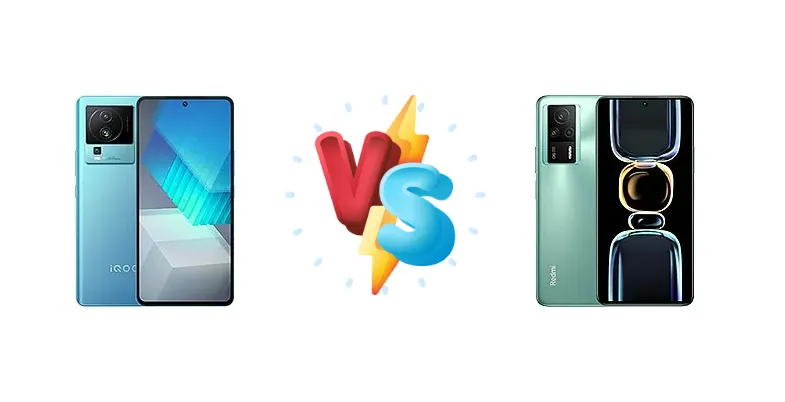
The mid-range smartphone market is fiercely competitive, and the vivo iQOO Neo7 SE and Xiaomi Redmi K60E are two strong contenders. Both pack the powerful Mediatek Dimensity 8200 chipset, but differ in charging speed, camera capabilities, and overall design. Let's dive into a comprehensive comparison to help you decide which one is right for you.
🏆 Quick Verdict
The iQOO Neo7 SE takes the lead with its significantly faster 120W charging, a major convenience. However, the Redmi K60E potentially offers a more refined camera system and potentially better software experience. It's a close call, depending on your priorities.
| Network |
|---|
| 2G bands | GSM 850 / 900 / 1800 / 1900 | GSM 850 / 900 / 1800 / 1900 |
| 3G bands | HSDPA 850 / 900 / 1700(AWS) / 2100 | HSDPA 800 / 850 / 900 / 1700(AWS) / 2100 |
| 4G bands | 1, 3, 4, 5, 8, 28, 34, 38, 39, 40, 41 | 1, 3, 4, 5, 8, 18, 19, 26, 34, 38, 39, 40, 41, 42 |
| 5G bands | 1, 5, 8, 28, 41, 77, 78 SA/NSA | 1, 3, 5, 8, 28, 38, 41, 77, 78 SA/NSA |
| Speed | HSPA, LTE, 5G | HSPA, LTE, 5G |
| Technology | GSM / CDMA / HSPA / CDMA2000 / LTE / 5G | GSM / CDMA / HSPA / CDMA2000 / LTE / 5G |
| | CDMA2000 1x | CDMA2000 1x |
| Launch |
|---|
| Announced | 2022, December 08 | 2022, December 27 |
| Status | Available. Released 2022, December 08 | Available. Released 2022, December 27 |
| Body |
|---|
| Build | Glass front, plastic frame, plastic back | - |
| Dimensions | 164.8 x 76.9 x 8.6 mm (6.49 x 3.03 x 0.34 in) | 163.1 x 76.2 x 8.5 mm (6.42 x 3.00 x 0.33 in) |
| SIM | Nano-SIM + Nano-SIM | Nano-SIM + Nano-SIM |
| Weight | 193 g (6.81 oz) | 202 g (7.13 oz) |
| Display |
|---|
| Protection | - | Corning Gorilla Glass Victus |
| Resolution | 1080 x 2400 pixels, 20:9 ratio (~388 ppi density) | 1440 x 3200 pixels, 20:9 ratio (~526 ppi density) |
| Size | 6.78 inches, 111.0 cm2 (~87.6% screen-to-body ratio) | 6.67 inches, 107.4 cm2 (~86.4% screen-to-body ratio) |
| Type | AMOLED, 120Hz, HDR10+, 1300 nits (peak) | OLED, 120Hz, Dolby Vision, HDR10+, 1200 nits (peak) |
| Platform |
|---|
| CPU | Octa-core (1x3.1 GHz Cortex-A78 & 3x3.0 GHz Cortex-A78 & 4x2.0 GHz Cortex-A55) | Octa-core (1x3.1 GHz Cortex-A78 & 3x3.0 GHz Cortex-A78 & 4x2.0 GHz Cortex-A55) |
| Chipset | Mediatek Dimensity 8200 (4 nm) | Mediatek Dimensity 8200 (4 nm) |
| GPU | Mali-G610 MC6 | Mali-G610 MC6 |
| OS | Android 13, OriginOS 3 | Android 12, MIUI 13 |
| Memory |
|---|
| Card slot | No | No |
| Internal | 128GB 8GB RAM, 256GB 8GB RAM, 256GB 12GB RAM, 256GB 16GB RAM, 512GB 12GB RAM | 128GB 8GB RAM, 256GB 8GB RAM, 256GB 12GB RAM, 512GB 12GB RAM |
| | UFS 3.1 | UFS 3.1 |
| Main Camera |
|---|
| Features | LED flash, HDR, panorama | Color spectrum sensor, Dual-LED dual-tone flash, HDR, panorama |
| Single | 16 MP, f/2.5, (wide) | - |
| Triple | 64 MP, f/1.8, (wide), PDAF, OIS
2 MP (macro)
Auxiliary lens | 48 MP, (wide), 1/2.0", 0.8µm, PDAF, OIS
8 MP, 120˚ (ultrawide), 1/4.0", 1.12µm
2 MP (macro) |
| Video | 4K@30fps, 1080p@30fps | 4K@30fps, 1080p@30/60/120fps, 720p@960fps, gyro-EIS |
| Selfie camera |
|---|
| Features | HDR | HDR |
| Single | 16 MP, f/2.5, (wide) | 20 MP, (wide), 1/2.0", 0.8µm |
| Video | 1080p@30fps | 1080p@30/60/120fps |
| Sound |
|---|
| 3.5mm jack | No | No |
| 35mm jack | No | No |
| Loudspeaker | Yes | Yes, with stereo speakers |
| | 24-bit/192kHz audio | 24-bit/192kHz audio |
| Comms |
|---|
| Bluetooth | 5.3, A2DP, LE, aptX HD | 5.3, A2DP, LE |
| Infrared port | - | Yes |
| NFC | Yes | Yes |
| Positioning | GPS, GLONASS, GALILEO, BDS, QZSS | GPS (L1), GLONASS (G1), BDS (B1I+B1c), GALILEO (E1), QZSS (L1) |
| Radio | No | Unspecified |
| USB | USB Type-C 2.0, OTG | USB Type-C 2.0, OTG |
| WLAN | Wi-Fi 802.11 a/b/g/n/ac/6, dual-band, Wi-Fi Direct | Wi-Fi 802.11 a/b/g/n/ac/6e, dual-band, Wi-Fi Direct |
| Features |
|---|
| Sensors | Fingerprint (under display, optical), accelerometer, gyro, proximity, compass | Fingerprint (side-mounted), accelerometer, gyro, proximity, compass |
| Battery |
|---|
| Charging | 120W wired, 60% in 10 min | 67W wired, PD3.0 |
| Type | 5000 mAh | Li-Po 5500 mAh |
| Misc |
|---|
| Colors | Blue, Gray, Gradient | Black, White, Green |
| Models | V2238A, V2238 | 22122RK93C |
| Price | About 300 EUR | About 300 EUR |
vivo iQOO Neo7 SE
- Blazing-fast 120W charging
- Powerful Dimensity 8200 chipset
- Competitive price
- Potentially less refined camera
- Software might lack some features compared to Xiaomi
Xiaomi Redmi K60E
- Potentially better camera system
- Established Xiaomi software ecosystem
- Good value for money
- Slower 67W charging
- Performance virtually identical to iQOO Neo7 SE
Display Comparison
Both phones likely feature a 6.67-inch AMOLED display with a 120Hz refresh rate, offering vibrant colors and smooth scrolling. However, the Redmi K60E might have slightly better color accuracy and brightness due to Xiaomi's display tuning expertise. Expect similar viewing experiences overall.
Camera Comparison
The Redmi K60E is expected to have a more versatile camera system, potentially including a higher resolution main sensor and improved image processing algorithms. The iQOO Neo7 SE likely focuses on speed and simplicity. Expect the Redmi K60E to deliver slightly better image quality, especially in low light.
Performance
Performance is virtually identical thanks to the shared Dimensity 8200 chipset. Both phones will handle demanding games and multitasking with ease. Real-world performance differences will likely be minimal and depend more on software optimization.
Battery Life
The iQOO Neo7 SE's 120W charging is a game-changer, allowing for incredibly fast top-ups. The Redmi K60E's 67W charging is still respectable, but significantly slower. Both phones likely have a similar battery capacity (around 5000mAh), so the iQOO Neo7 SE will offer a much quicker charging experience.
Buying Guide
The vivo iQOO Neo7 SE is ideal for users who prioritize incredibly fast charging and don't mind a potentially less polished camera. The Xiaomi Redmi K60E is a better choice for those seeking a more balanced experience with a potentially superior camera and a more established software ecosystem.
Frequently Asked Questions
❓ Is the Dimensity 8200 chipset good for gaming?
Yes, the Dimensity 8200 is a very capable chipset that can handle most mobile games at high settings without issues. Both phones will provide a smooth gaming experience.
❓ Which phone has better software support?
Xiaomi generally offers more frequent software updates and a more established ecosystem, so the Redmi K60E likely has an edge in software support.