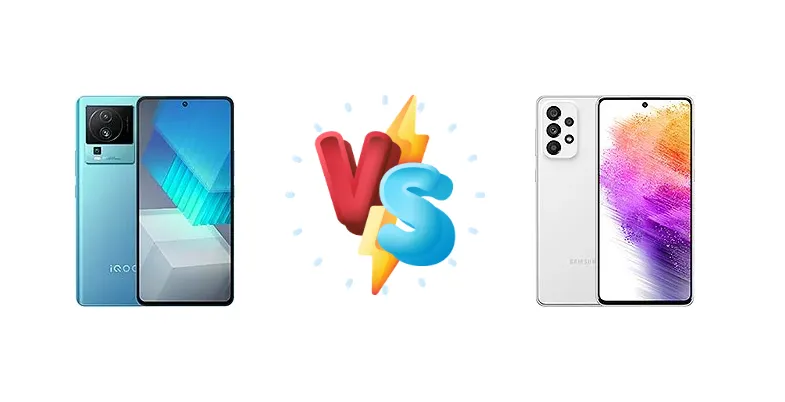
The iQOO Neo7 SE and Samsung Galaxy A73 5G represent distinct approaches to the mid-range smartphone market. The iQOO prioritizes raw performance and incredibly fast charging, while the Galaxy A73 5G focuses on a more refined software experience and Samsung’s established ecosystem. This comparison dissects their key differences to determine which device best suits your needs.
🏆 Quick Verdict
For users prioritizing performance and charging speed, the iQOO Neo7 SE is the clear winner. Its Dimensity 8200 chipset and 120W charging significantly outperform the Galaxy A73 5G’s Snapdragon 778G and 25W charging. However, Samsung’s software and brand recognition may appeal to those seeking a more polished, familiar experience.
| Network |
|---|
| 2G bands | GSM 850 / 900 / 1800 / 1900 | GSM 850 / 900 / 1800 / 1900 |
| 3G bands | HSDPA 850 / 900 / 1700(AWS) / 2100 | HSDPA 850 / 900 / 1700(AWS) / 1900 / 2100 |
| 4G bands | 1, 3, 4, 5, 8, 28, 34, 38, 39, 40, 41 | 1, 2, 3, 4, 5, 7, 8, 12, 13, 17, 20, 26, 28, 32, 38, 40, 41, 66 |
| 5G bands | 1, 5, 8, 28, 41, 77, 78 SA/NSA | 1, 3, 5, 7, 28, 40, 41, 66, 78 SA/NSA/Sub6 |
| Speed | HSPA, LTE, 5G | HSPA, LTE, 5G |
| Technology | GSM / CDMA / HSPA / CDMA2000 / LTE / 5G | GSM / HSPA / LTE / 5G |
| | CDMA2000 1x | - |
| Launch |
|---|
| Announced | 2022, December 08 | 2022, March 17 |
| Status | Available. Released 2022, December 08 | Available. Released 2022, April 22 |
| Body |
|---|
| Build | Glass front, plastic frame, plastic back | - |
| Dimensions | 164.8 x 76.9 x 8.6 mm (6.49 x 3.03 x 0.34 in) | 163.7 x 76.1 x 7.6 mm (6.44 x 3.00 x 0.30 in) |
| SIM | Nano-SIM + Nano-SIM | · Nano-SIM· Nano-SIM + Nano-SIM |
| Weight | 193 g (6.81 oz) | 181 g (6.38 oz) |
| | - | IP67 dust/water resistant (up to 1m for 30 min) |
| Display |
|---|
| Protection | - | Corning Gorilla Glass 5 |
| Resolution | 1080 x 2400 pixels, 20:9 ratio (~388 ppi density) | 1080 x 2400 pixels, 20:9 ratio (~393 ppi density) |
| Size | 6.78 inches, 111.0 cm2 (~87.6% screen-to-body ratio) | 6.7 inches, 108.4 cm2 (~87.0% screen-to-body ratio) |
| Type | AMOLED, 120Hz, HDR10+, 1300 nits (peak) | Super AMOLED Plus, 120Hz, 800 nits (HBM) |
| Platform |
|---|
| CPU | Octa-core (1x3.1 GHz Cortex-A78 & 3x3.0 GHz Cortex-A78 & 4x2.0 GHz Cortex-A55) | Octa-core (1x2.4 GHz Cortex-A78 & 3x2.2 GHz Cortex-A78 & 4x1.9 GHz Cortex-A55) |
| Chipset | Mediatek Dimensity 8200 (4 nm) | Qualcomm SM7325 Snapdragon 778G 5G (6 nm) |
| GPU | Mali-G610 MC6 | Adreno 642L |
| OS | Android 13, OriginOS 3 | Android 12, up to 4 major Android upgrades, One UI 6.1 |
| Memory |
|---|
| Card slot | No | microSDXC (uses shared SIM slot) |
| Internal | 128GB 8GB RAM, 256GB 8GB RAM, 256GB 12GB RAM, 256GB 16GB RAM, 512GB 12GB RAM | 128GB 6GB RAM, 128GB 8GB RAM, 256GB 8GB RAM |
| | UFS 3.1 | - |
| Main Camera |
|---|
| Features | LED flash, HDR, panorama | LED flash, panorama, HDR |
| Quad | - | 108 MP, f/1.8, (wide), PDAF, OIS
12 MP, f/2.2, (ultrawide)
5 MP (macro)
Auxiliary lens |
| Single | 16 MP, f/2.5, (wide) | 32 MP, f/2.2, 26mm (wide), 1/2.8", 0.8µm |
| Triple | 64 MP, f/1.8, (wide), PDAF, OIS
2 MP (macro)
Auxiliary lens | - |
| Video | 4K@30fps, 1080p@30fps | 4K@30fps, 1080p@30/60fps; gyro-EIS |
| Selfie camera |
|---|
| Features | HDR | HDR |
| Single | 16 MP, f/2.5, (wide) | 32 MP, f/2.2, 26mm (wide), 1/2.8", 0.8µm |
| Video | 1080p@30fps | 4K@30fps, 1080p@30fps |
| Sound |
|---|
| 3.5mm jack | No | No |
| 35mm jack | No | No |
| Loudspeaker | Yes | Yes, with stereo speakers |
| | 24-bit/192kHz audio | - |
| Comms |
|---|
| Bluetooth | 5.3, A2DP, LE, aptX HD | 5.0, A2DP, LE |
| NFC | Yes | Yes (market/region dependent) |
| Positioning | GPS, GLONASS, GALILEO, BDS, QZSS | GPS, GLONASS, GALILEO, BDS, QZSS |
| Radio | No | Unspecified |
| USB | USB Type-C 2.0, OTG | USB Type-C 2.0, OTG |
| WLAN | Wi-Fi 802.11 a/b/g/n/ac/6, dual-band, Wi-Fi Direct | Wi-Fi 802.11 a/b/g/n/ac/6, dual-band, Wi-Fi Direct |
| Features |
|---|
| Sensors | Fingerprint (under display, optical), accelerometer, gyro, proximity, compass | Fingerprint (under display, optical), accelerometer, gyro, proximity, compass |
| Battery |
|---|
| Charging | 120W wired, 60% in 10 min | 25W wired |
| Type | 5000 mAh | Li-Po 5000 mAh |
| Misc |
|---|
| Colors | Blue, Gray, Gradient | Gray, Mint, White |
| Models | V2238A, V2238 | SM-A736B, SM-A736B/DS |
| Price | About 300 EUR | About 600 EUR |
| SAR | - | 1.14 W/kg (head) |
| SAR EU | - | 1.28 W/kg (head) 1.42 W/kg (body) |
vivo iQOO Neo7 SE
- Significantly faster 120W charging
- More powerful Dimensity 8200 chipset
- Potentially better thermal management due to 4nm process
- Software experience may not be as refined as Samsung’s One UI
- Brand recognition is lower than Samsung
Samsung Galaxy A73 5G
- Refined One UI software experience
- Established Samsung brand and ecosystem
- Potentially better display calibration
- Slower 25W charging
- Less powerful Snapdragon 778G chipset
- 6nm process may lead to more thermal throttling
Display Comparison
While both phones likely feature AMOLED panels (based on market segment), specific details like peak brightness and refresh rates are missing. However, the core difference lies in the processing power driving them. The iQOO Neo7 SE, with its more powerful chipset, is better equipped to handle high refresh rate gaming without frame drops. Samsung’s Galaxy A73 5G likely benefits from Samsung’s display calibration expertise, potentially offering more accurate colors out of the box, but this is speculative without direct testing.
Camera Comparison
Without detailed camera specs, a direct comparison is limited. However, the chipset’s image signal processor (ISP) plays a crucial role. The Dimensity 8200’s ISP is likely more advanced than the Snapdragon 778G’s, enabling better noise reduction, dynamic range, and image processing capabilities. Samsung typically excels in image processing, but the iQOO Neo7 SE’s superior processing power could allow it to compete effectively, especially in challenging lighting conditions. The presence of OIS on either device would be a significant advantage, but is unknown without further specs.
Performance
The iQOO Neo7 SE’s Mediatek Dimensity 8200 (4nm) is a significant step up from the Galaxy A73 5G’s Qualcomm Snapdragon 778G 5G (6nm). The 4nm process node inherently offers better power efficiency and thermal performance, translating to sustained performance during extended gaming sessions. The Dimensity 8200’s CPU configuration – a 1x3.1 GHz Cortex-A78, 3x3.0 GHz Cortex-A78, and 4x2.0 GHz Cortex-A55 – provides a noticeable advantage over the Snapdragon 778G’s 1x2.4 GHz Cortex-A78, 3x2.2 GHz Cortex-A78, and 4x1.9 GHz Cortex-A55. This means faster app loading times, smoother multitasking, and a more responsive overall experience on the iQOO.
Battery Life
The iQOO Neo7 SE’s 120W wired charging is a game-changer. Claimed 60% charge in 10 minutes drastically reduces downtime compared to the Galaxy A73 5G’s 25W charging. While battery capacity isn’t specified, the faster charging speed effectively mitigates any potential capacity disadvantage. The Dimensity 8200’s 4nm efficiency also contributes to better battery life, potentially offsetting a smaller battery size compared to the A73 5G.
Buying Guide
Buy the vivo iQOO Neo7 SE if you need a phone for demanding mobile gaming, frequently transfer large files, or value minimizing downtime with incredibly fast charging. Buy the Samsung Galaxy A73 5G if you prefer a more established brand with a refined One UI experience, prioritize consistent software updates, and don't require the absolute fastest performance or charging speeds.
Frequently Asked Questions
❓ Will the iQOO Neo7 SE overheat during prolonged gaming sessions?
The Dimensity 8200’s 4nm process node is designed for improved thermal efficiency. While some throttling is inevitable, it should be less pronounced than on the Galaxy A73 5G with its 6nm Snapdragon 778G, allowing for longer, more consistent gaming performance.
❓ Is the 25W charging on the Galaxy A73 5G slow compared to the iQOO Neo7 SE?
Yes, 25W charging is considerably slower than the iQOO Neo7 SE’s 120W charging. The iQOO can reach 60% charge in just 10 minutes, while the Galaxy A73 5G will take significantly longer to fully charge, impacting convenience for users who frequently need to top up their battery.
❓ Does the iQOO Neo7 SE support high frame rates in popular games like PUBG Mobile?
The Dimensity 8200 chipset is capable of handling high frame rates in PUBG Mobile. While specific frame rate settings will depend on the game’s optimization, the iQOO Neo7 SE should be able to achieve 60fps or even higher with optimized settings, providing a smoother gaming experience.
❓ How does Samsung's One UI compare to vivo's Funtouch OS in terms of user experience?
Samsung's One UI is known for its feature-richness and polished interface, while vivo's Funtouch OS has historically been more customized. Recent iterations of Funtouch OS have become more streamlined, but One UI generally offers a more refined and consistent user experience, particularly for those already familiar with the Samsung ecosystem.