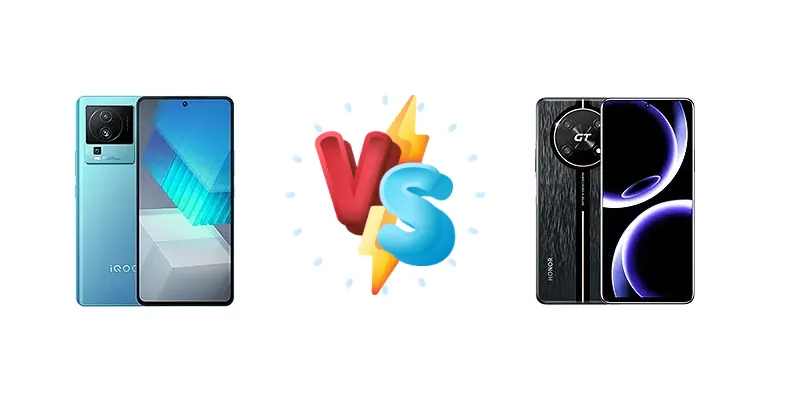
The iQOO Neo7 SE and Honor X40 GT Racing represent compelling options in the increasingly competitive mid-range smartphone market. The iQOO Neo7 SE arrives with a focus on raw performance thanks to its Mediatek Dimensity 8200, while the Honor X40 GT Racing aims to balance performance with a more streamlined user experience and a focus on fast charging, albeit at a lower wattage. This comparison will dissect their key differences to determine which device best suits your needs.
🏆 Quick Verdict
For users prioritizing peak gaming performance and the fastest possible charging, the iQOO Neo7 SE is the clear winner. Its Dimensity 8200 chipset and 120W charging significantly outperform the Honor X40 GT Racing, making it ideal for demanding mobile gamers. However, the Honor X40 GT Racing offers a solid experience for everyday tasks and a respectable charging speed.
| Network |
|---|
| 2G bands | GSM 850 / 900 / 1800 / 1900 | GSM 850 / 900 / 1800 / 1900 |
| 3G bands | HSDPA 850 / 900 / 1700(AWS) / 2100 | HSDPA 850 / 900 / 1700(AWS) / 1900 / 2100 |
| 4G bands | 1, 3, 4, 5, 8, 28, 34, 38, 39, 40, 41 | LTE |
| 5G bands | 1, 5, 8, 28, 41, 77, 78 SA/NSA | SA/NSA |
| Speed | HSPA, LTE, 5G | HSPA, LTE, 5G |
| Technology | GSM / CDMA / HSPA / CDMA2000 / LTE / 5G | GSM / CDMA / HSPA / EVDO / LTE / 5G |
| | CDMA2000 1x | - |
| Launch |
|---|
| Announced | 2022, December 08 | 2023, September 19 |
| Status | Available. Released 2022, December 08 | Available. Released 2023, September 22 |
| Body |
|---|
| Build | Glass front, plastic frame, plastic back | - |
| Dimensions | 164.8 x 76.9 x 8.6 mm (6.49 x 3.03 x 0.34 in) | 166.1 x 75.8 x 8.5 mm (6.54 x 2.98 x 0.33 in) |
| SIM | Nano-SIM + Nano-SIM | Nano-SIM + Nano-SIM |
| Weight | 193 g (6.81 oz) | 199.5 g (7.05 oz) |
| Display |
|---|
| Resolution | 1080 x 2400 pixels, 20:9 ratio (~388 ppi density) | 1080 x 2388 pixels (~385 ppi density) |
| Size | 6.78 inches, 111.0 cm2 (~87.6% screen-to-body ratio) | 6.81 inches, 112.3 cm2 (~89.2% screen-to-body ratio) |
| Type | AMOLED, 120Hz, HDR10+, 1300 nits (peak) | IPS LCD, 144Hz |
| Platform |
|---|
| CPU | Octa-core (1x3.1 GHz Cortex-A78 & 3x3.0 GHz Cortex-A78 & 4x2.0 GHz Cortex-A55) | Octa-core |
| Chipset | Mediatek Dimensity 8200 (4 nm) | - |
| GPU | Mali-G610 MC6 | - |
| OS | Android 13, OriginOS 3 | Android 13, Magic OS 7.1 |
| Memory |
|---|
| Card slot | No | No |
| Internal | 128GB 8GB RAM, 256GB 8GB RAM, 256GB 12GB RAM, 256GB 16GB RAM, 512GB 12GB RAM | 256GB 12GB RAM, 512GB 12GB RAM |
| | UFS 3.1 | - |
| Main Camera |
|---|
| Features | LED flash, HDR, panorama | LED flash, panorama, HDR |
| Single | 16 MP, f/2.5, (wide) | - |
| Triple | 64 MP, f/1.8, (wide), PDAF, OIS
2 MP (macro)
Auxiliary lens | 50 MP, f/1.8, (wide), PDAF
2 MP (macro)
Auxiliary lens |
| Video | 4K@30fps, 1080p@30fps | 4K@30fps, 1080p@30fps; gyro-EIS |
| Selfie camera |
|---|
| Features | HDR | - |
| Single | 16 MP, f/2.5, (wide) | 16 MP, f/2.5 |
| Video | 1080p@30fps | 1080p@30fps |
| Sound |
|---|
| 3.5mm jack | No | - |
| 35mm jack | No | No |
| Loudspeaker | Yes | Yes |
| | 24-bit/192kHz audio | - |
| Comms |
|---|
| Bluetooth | 5.3, A2DP, LE, aptX HD | 5.2, A2DP, LE, aptX HD |
| NFC | Yes | Yes |
| Positioning | GPS, GLONASS, GALILEO, BDS, QZSS | GPS, GLONASS, GALILEO, BDS |
| Radio | No | No |
| USB | USB Type-C 2.0, OTG | USB Type-C 2.0, OTG |
| WLAN | Wi-Fi 802.11 a/b/g/n/ac/6, dual-band, Wi-Fi Direct | Wi-Fi 802.11 a/b/g/n/ac/6, dual-band, Wi-Fi Direct |
| Features |
|---|
| Sensors | Fingerprint (under display, optical), accelerometer, gyro, proximity, compass | Fingerprint (side-mounted), accelerometer, gyro, compass |
| Battery |
|---|
| Charging | 120W wired, 60% in 10 min | 66W wired, 90% in 30 min
5W reverse wired |
| Type | 5000 mAh | Li-Po 4800 mAh |
| Misc |
|---|
| Colors | Blue, Gray, Gradient | Black, Silver |
| Models | V2238A, V2238 | - |
| Price | About 300 EUR | About 300 EUR |
vivo iQOO Neo7 SE
- Significantly faster 120W charging
- More powerful Mediatek Dimensity 8200 chipset
- Potentially higher refresh rate display for smoother gaming
- Software experience may be more aggressive
- No reverse wireless charging
Honor X40 GT Racing
- 5W reverse wired charging for accessories
- Potentially cleaner software experience
- Balanced performance for everyday tasks
- Slower 66W charging
- Less powerful CPU and GPU
Display Comparison
Detailed display specifications are missing for both devices. However, given the market positioning, we can infer both likely utilize AMOLED panels. The iQOO Neo7 SE, being marketed towards gamers, may prioritize a higher refresh rate (likely 120Hz or 144Hz) for smoother visuals. The Honor X40 GT Racing, while geared towards gaming, may focus on color accuracy and viewing angles. Without specific nit brightness data, it's difficult to determine which offers a better outdoor visibility experience.
Camera Comparison
Camera details are limited. Both phones likely feature multi-camera setups, but without sensor size or aperture information, a direct comparison is difficult. The iQOO Neo7 SE, given its gaming focus, may prioritize image processing for vibrant colors and dynamic range, appealing to social media users. The Honor X40 GT Racing may lean towards a more natural color profile. The absence of details regarding Optical Image Stabilization (OIS) makes it impossible to assess low-light performance differences.
Performance
The iQOO Neo7 SE’s Mediatek Dimensity 8200 (4nm) chipset is the clear performance leader. Its octa-core configuration, featuring a high-clocked Cortex-A78 prime core at 3.1 GHz, provides a substantial advantage in CPU-intensive tasks and gaming compared to the Honor X40 GT Racing’s unspecified CPU. The 4nm process node of the Dimensity 8200 also translates to improved thermal efficiency, reducing the likelihood of performance throttling during extended gaming sessions. While the Honor X40 GT Racing’s octa-core CPU is capable, it likely utilizes a less powerful core configuration and a potentially larger process node, resulting in lower overall performance. The iQOO Neo7 SE’s superior chipset will benefit gamers, content creators, and users who frequently multitask.
Battery Life
The iQOO Neo7 SE’s 120W wired charging is a game-changer, capable of charging the battery to 60% in just 10 minutes. This is significantly faster than the Honor X40 GT Racing’s 66W charging, which takes 30 minutes to reach 90%. While the Honor X40 GT Racing offers 5W reverse wired charging, a feature absent on the iQOO Neo7 SE, the speed difference in primary charging is substantial. The iQOO Neo7 SE’s faster charging is a major benefit for users who need to quickly top up their battery before gaming or during short breaks. Battery capacity is not specified for either device, but the charging speed advantage of the iQOO Neo7 SE is a significant differentiator.
Buying Guide
Buy the vivo iQOO Neo7 SE if you need uncompromising gaming performance, exceptionally fast charging, and don't mind a potentially more aggressive software experience. Buy the Honor X40 GT Racing if you prefer a more balanced smartphone experience, value a cleaner software interface, and prioritize a slightly more efficient charging cycle, even if it takes longer to fully charge.
Frequently Asked Questions
❓ Does the Mediatek Dimensity 8200 in the iQOO Neo7 SE get hot during prolonged gaming sessions?
The Dimensity 8200 is built on a 4nm process, which inherently improves thermal efficiency compared to older nodes. While some heat generation is inevitable during intense gaming, the iQOO Neo7 SE likely incorporates cooling solutions (like vapor chambers) to mitigate throttling and maintain consistent performance. However, sustained high frame rates in demanding titles will still generate heat.
❓ How much faster is the 120W charging on the iQOO Neo7 SE compared to the 66W charging on the Honor X40 GT Racing in real-world use?
The iQOO Neo7 SE’s 120W charging is substantially faster. While the Honor X40 GT Racing reaches 90% charge in 30 minutes, the iQOO Neo7 SE can reach 60% in just 10 minutes. This means a quick top-up during a short break is far more effective with the iQOO Neo7 SE, and a full charge will be completed much faster overall.
❓ Is the 5W reverse wired charging on the Honor X40 GT Racing useful for charging accessories like earbuds?
Yes, the 5W reverse wired charging is a convenient feature for topping up small accessories like wireless earbuds or a smartwatch. While it's not a fast charging solution, it can provide a small boost when you're away from a power outlet. It's a niche feature, but valuable for users who frequently use Bluetooth accessories.