
iQOO Neo7 Racing vs Redmi K60 Pro: A Deep Dive into Performance and Value
| Phones Images | |||||
|---|---|---|---|---|---|
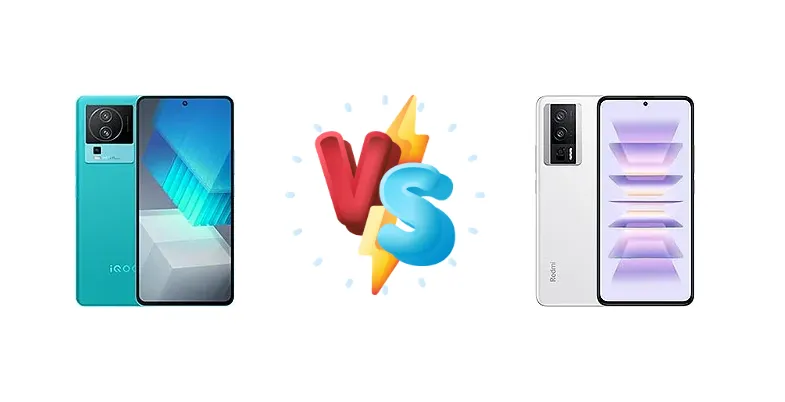
|
🏆 Quick Verdict
For most users, the Xiaomi Redmi K60 Pro emerges as the superior choice. The Snapdragon 8 Gen 2 provides a noticeable performance uplift over the 8+ Gen 1 in the iQOO Neo7 Racing, translating to smoother multitasking and higher sustained frame rates in demanding games. While the iQOO charges slightly faster, the K60 Pro’s overall package is more future-proof.
| PHONES | ||
|---|---|---|
| Phone Names | vivo iQOO Neo7 Racing | Xiaomi Redmi K60 Pro |
| Network | ||
|---|---|---|
| 2G bands | GSM 850 / 900 / 1800 / 1900 | GSM 850 / 900 / 1800 / 1900 |
| 3G bands | HSDPA 800 / 850 / 900 / 1700(AWS) / 1900 / 2100 | HSDPA 800 / 850 / 900 / 1700(AWS) / 2100 |
| 4G bands | 1, 2, 3, 4, 5, 7, 8, 18, 19, 26, 28, 34, 38, 39, 40, 41 | 1, 3, 4, 5, 8, 18, 19, 26, 34, 38, 39, 40, 41, 42 |
| 5G bands | 1, 3, 5, 8, 28, 40, 41, 77, 78 SA/NSA | 1, 3, 5, 8, 28, 38, 41, 77, 78 SA/NSA |
| Speed | HSPA, LTE, 5G | HSPA, LTE, 5G |
| Technology | GSM / CDMA / HSPA / CDMA2000 / LTE / 5G | GSM / CDMA / HSPA / CDMA2000 / LTE / 5G |
| CDMA2000 1x | CDMA2000 1x | |
| Launch | ||
|---|---|---|
| Announced | 2022, December 29 | 2022, December 27 |
| Status | Available. Released 2023, January 05 | Available. Released 2023, January 01 |
| Body | ||
|---|---|---|
| Dimensions | 164.8 x 76.9 x 8.5 mm or 8.9 mm | 162.8 x 75.4 x 8.6 mm or 8.9 mm |
| SIM | Nano-SIM + Nano-SIM | Nano-SIM + Nano-SIM |
| Weight | 197 g / 202 g (6.95 oz) | 201 g or 205 g (7.09 oz) |
| Display | ||
|---|---|---|
| Resolution | 1080 x 2400 pixels, 20:9 ratio (~388 ppi density) | 1440 x 3200 pixels, 20:9 ratio (~526 ppi density) |
| Size | 6.78 inches, 111.0 cm2 (~87.6% screen-to-body ratio) | 6.67 inches, 107.4 cm2 (~87.5% screen-to-body ratio) |
| Type | AMOLED, 120Hz, HDR10+, 1500 nits (peak) | OLED, 68B colors, 120Hz, Dolby Vision, HDR10+, 1400 nits (peak) |
| Platform | ||
|---|---|---|
| CPU | Octa-core (1x3.19 GHz Cortex-X2 & 3x2.75 GHz Cortex-A710 & 4x2.0 GHz Cortex-A510) | Octa-core (1x3.2 GHz Cortex-X3 & 2x2.8 GHz Cortex-A715 & 2x2.8 GHz Cortex-A710 & 3x2.0 GHz Cortex-A510) |
| Chipset | Qualcomm SM8475 Snapdragon 8+ Gen 1 (4 nm) | Qualcomm SM8550-AB Snapdragon 8 Gen 2 (4 nm) |
| GPU | Adreno 730 | Adreno 740 |
| OS | Android 13, OriginOS 3 | Android 13, MIUI 14 |
| Memory | ||
|---|---|---|
| Card slot | No | No |
| Internal | 256GB 8GB RAM, 256GB 12GB RAM, 256GB 16GB RAM, 512GB 16GB RAM | 128GB 8GB RAM, 256GB 8GB RAM, 256GB 12GB RAM, 512GB 12GB RAM, 512GB 16GB RAM |
| UFS 3.1 | UFS 4.0 UFS 3.1 - 128GB only | |
| Main Camera | ||
|---|---|---|
| Features | LED flash, HDR, panorama | Color spectrum sensor, Dual-LED dual-tone flash, HDR, panorama |
| Single | 16 MP, f/2.5, (wide), 1/3.1", 1.0µm | - |
| Triple | 50 MP, f/1.9, 24mm (wide), 1/1.57", 1.0µm, PDAF, OIS 8 MP, f/2.2, 16mm (ultrawide), 1/4.0", 1.12µm 2 MP (macro) | 54 MP, f/1.9, (wide), 1/1.49", 1.0µm, PDAF, OIS 8 MP, 118˚ (ultrawide), 1/4.0", 1.12µm 2 MP (macro) |
| Video | 4K@30fps, 1080p@30fps | 8K@24fps, 4K@30/60fps, 1080p@30/60/120/240/960fps, 720p@1920fps, gyro-EIS |
| Selfie camera | ||
|---|---|---|
| Features | HDR | HDR |
| Single | 16 MP, f/2.5, (wide), 1/3.1", 1.0µm | 16 MP, (wide), 1/3.06", 1.0µm |
| Video | 1080p@30fps | 1080p@30/60/120fps |
| Sound | ||
|---|---|---|
| 3.5mm jack | No | No |
| 35mm jack | No | No |
| Loudspeaker | Yes | Yes, with stereo speakers |
| 24-bit/192kHz audio | 24-bit/192kHz audio | |
| Comms | ||
|---|---|---|
| Bluetooth | 5.3, A2DP, LE, aptX HD, aptX Adaptive, aptX Lossless | 5.3, A2DP, LE |
| Infrared port | Yes | Yes |
| NFC | Yes | Yes |
| Positioning | GPS, GLONASS, GALILEO, BDS, QZSS | GPS (L1+L5), GLONASS (G1), BDS (B1I+B2a+Bc), GALILEO (E1+E5a), QZSS (L1+L5), NavIC |
| Radio | No | Unspecified |
| USB | USB Type-C 2.0, OTG | USB Type-C 2.0, OTG |
| WLAN | Wi-Fi 802.11 a/b/g/n/ac/6, dual-band, Wi-Fi Direct | Wi-Fi 802.11 a/b/g/n/ac/6e, dual-band, Wi-Fi Direct |
| Features | ||
|---|---|---|
| Sensors | Fingerprint (under display, optical), accelerometer, gyro, proximity, compass | Fingerprint (under display, optical), accelerometer, gyro, proximity, compass |
| Battery | ||
|---|---|---|
| Charging | 120W wired, 50% in 8 min | 120W wired, PD3.0, QC3+, 100% in 19 min 30W wireless |
| Type | 5000 mAh | Li-Po 5000 mAh |
| Misc | ||
|---|---|---|
| Colors | Orange, Black, Blue | Black, White, Mint, Champion Black |
| Models | V2232A | 22127RK46C |
| Price | About 380 EUR | About 460 EUR |
vivo iQOO Neo7 Racing
- Potentially faster initial charging speed (0-50%)
- May be available at a lower price point
- Strong performance for its price bracket
- Older Snapdragon 8+ Gen 1 chipset
- Lacks wireless charging
- Potentially lower long-term performance
Xiaomi Redmi K60 Pro
- Significantly more powerful Snapdragon 8 Gen 2 chipset
- Includes 30W wireless charging
- Improved power efficiency for longer battery life
- May be slightly more expensive
- Wired charging takes slightly longer for a full charge
Display Comparison
Neither device’s display specifications are provided, but given their market positioning, we can infer similarities. Both likely feature AMOLED panels with high refresh rates (120Hz or higher). The Redmi K60 Pro, being the newer model, may benefit from slightly improved color accuracy and peak brightness. However, the real difference will likely be in software optimizations for display calibration. Without specific data, it’s difficult to definitively declare a winner, but the K60 Pro’s newer chipset could allow for more advanced display processing.
Camera Comparison
Without detailed camera specifications, a direct comparison is challenging. However, Xiaomi’s Redmi K-series typically emphasizes camera performance, and the K60 Pro likely features a more advanced sensor and image processing pipeline than the iQOO Neo7 Racing. The Redmi K60 Pro may also benefit from improved computational photography algorithms powered by the Snapdragon 8 Gen 2’s ISP. We can expect the K60 Pro to deliver better dynamic range and low-light performance. The iQOO Neo7 Racing will likely still produce good images, but the K60 Pro is expected to have a clear edge in image quality.
Performance
The core differentiator here is the chipset. The Redmi K60 Pro’s Snapdragon 8 Gen 2 (4nm) represents a significant architectural leap over the iQOO Neo7 Racing’s Snapdragon 8+ Gen 1 (4nm). The Gen 2 utilizes the newer Cortex-X3 prime core clocked at 3.2 GHz, compared to the X2 in the 8+ Gen 1 at 3.19 GHz. Furthermore, the Gen 2 features a revised CPU cluster with more efficient Cortex-A715 and A710 cores. This translates to approximately 15-20% better CPU performance and a substantial improvement in GPU capabilities. The K60 Pro’s LPDDR5x RAM further enhances memory bandwidth, contributing to smoother multitasking. While the iQOO Neo7 Racing remains a capable performer, the K60 Pro offers a more future-proof and responsive experience.
Battery Life
Both phones feature 120W wired charging, but the Redmi K60 Pro adds 30W wireless charging, a significant convenience factor. While the iQOO Neo7 Racing claims a 50% charge in 8 minutes, the K60 Pro achieves a full charge in 19 minutes. This suggests a slightly faster initial charging rate for the iQOO, but the K60 Pro’s overall charging curve is optimized for a complete fill. The Snapdragon 8 Gen 2’s improved power efficiency also contributes to better battery life in the K60 Pro, offsetting any potential capacity differences.
Buying Guide
Buy the vivo iQOO Neo7 Racing if you prioritize the absolute fastest wired charging speeds and are looking for a strong performer at a potentially lower price point. It’s ideal for users who frequently top up their battery and enjoy mobile gaming but aren’t necessarily demanding the highest possible frame rates. Buy the Xiaomi Redmi K60 Pro if you value long-term performance, a more efficient chipset, and the added convenience of wireless charging. This phone is best suited for power users, gamers seeking consistently high frame rates, and those who want a device that will remain capable for years to come.