
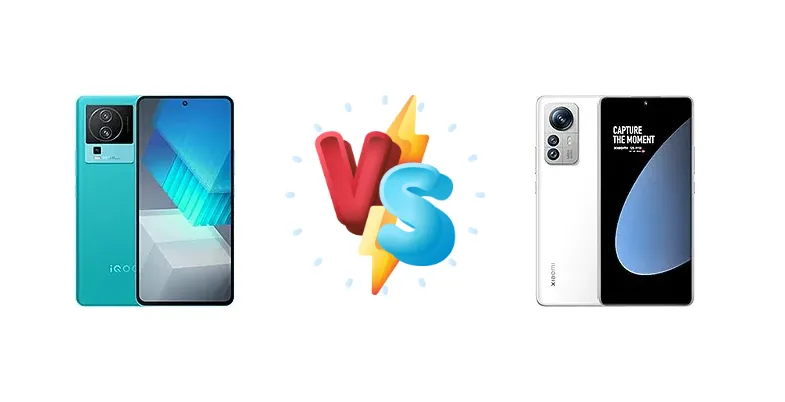
iQOO Neo7 vs Xiaomi 12S Pro: A Head-to-Head Battle of China's Flagship Power
| Phones Images | |||||
|---|---|---|---|---|---|
|
🏆 Quick Verdict
For the average user prioritizing raw gaming performance and slightly faster charging, the Xiaomi 12S Pro edges out the iQOO Neo7. However, the iQOO Neo7 offers a compelling alternative with a similarly powerful chipset and competitive features, potentially at a lower price point, making it a strong contender.
| PHONES | ||
|---|---|---|
| Phone Names | vivo iQOO Neo7 (China) | Xiaomi 12S Pro |
| Network | ||
|---|---|---|
| 2G bands | GSM 850 / 900 / 1800 / 1900 | GSM 850 / 900 / 1800 / 1900 |
| 3G bands | HSDPA 800 / 850 / 900 / 1700(AWS) / 1900 / 2100 | HSDPA 800 / 850 / 900 / 1700(AWS) / 1900 / 2100 |
| 4G bands | 1, 2, 3, 4, 5, 7, 8, 18, 19, 26, 28, 34, 38, 39, 40, 41 | 1, 2, 3, 4, 5, 7, 8, 12, 17, 18, 19, 26, 34, 38, 39, 40, 41, 42 |
| 5G bands | 1, 3, 5, 8, 28, 40, 41, 77, 78 SA/NSA | 1, 3, 5, 8, 28, 38, 40, 41, 77, 78, 79 SA/NSA |
| Speed | HSPA, LTE, 5G | HSPA, LTE, 5G |
| Technology | GSM / CDMA / HSPA / CDMA2000 / LTE / 5G | GSM / CDMA / HSPA / EVDO / LTE / 5G |
| CDMA2000 1x | CDMA2000 1xEV-DO | |
| Launch | ||
|---|---|---|
| Announced | 2022, October 20 | 2022, July 04 |
| Status | Available. Released 2022, October 31 | Available. Released 2022, July 07 |
| Body | ||
|---|---|---|
| Build | - | Glass front (Gorilla Glass Victus), glass back or eco leather back, aluminum frame |
| Dimensions | 164.8 x 76.9 x 8.5 mm or 8.9 mm | 163.6 x 74.6 x 8.2 mm or 8.7 mm |
| SIM | Nano-SIM + Nano-SIM | Nano-SIM + Nano-SIM |
| Weight | 197 g / 202 g (6.95 oz) | 203 g / 204 g (7.16 oz) |
| Display | ||
|---|---|---|
| Protection | - | Corning Gorilla Glass Victus |
| Resolution | 1080 x 2400 pixels, 20:9 ratio (~388 ppi density) | 1440 x 3200 pixels, 20:9 ratio (~521 ppi density) |
| Size | 6.78 inches, 111.0 cm2 (~87.6% screen-to-body ratio) | 6.73 inches, 109.4 cm2 (~89.6% screen-to-body ratio) |
| Type | AMOLED, 120Hz, HDR10+, 1500 nits (peak) | LTPO AMOLED, 1B colors, 120Hz, Dolby Vision, HDR10+, 1000 nits (HBM), 1500 nits (peak) |
| Platform | ||
|---|---|---|
| CPU | Octa-core (1x3.20 GHz Cortex-X2 & 3x2.85 GHz Cortex-A710 & 4x1.80 GHz Cortex-A510) | Octa-core (1x3.19 GHz Cortex-X2 & 3x2.75 GHz Cortex-A710 & 4x1.80 GHz Cortex-A510) |
| Chipset | Mediatek Dimensity 9000+ (4 nm) | Qualcomm SM8475 Snapdragon 8+ Gen 1 (4 nm) |
| GPU | Mali-G710 MC10 | Adreno 730 |
| OS | Android 13, OriginOS Ocean | Android 12, MIUI 13 |
| Memory | ||
|---|---|---|
| Card slot | No | No |
| Internal | 128GB 8GB RAM, 256GB 8GB RAM, 256GB 12GB RAM, 512GB 12GB RAM | 128GB 8GB RAM, 256GB 8GB RAM, 256GB 12GB RAM, 512GB 12GB RAM |
| UFS 3.1 | UFS 3.1 | |
| Main Camera | ||
|---|---|---|
| Features | LED flash, HDR, panorama | Leica lens, color spectrum sensor, Dual-LED dual-tone flash, HDR, panorama |
| Single | 16 MP, f/2.5, (wide), 1/3.1", 1.0µm | 32 MP, f/2.5, 26mm (wide), 0.7µm |
| Triple | 50 MP, f/1.9, 24mm (wide), 1/1.56", 1.0µm, PDAF, OIS 8 MP, f/2.2, 16mm (ultrawide), 1/4.0", 1.12µm 2 MP (macro) | 50 MP, f/1.9, 24mm (wide), 1/1.28", 1.22µm, dual pixel PDAF, OIS 50 MP, f/1.9, 50mm (telephoto), PDAF, 2x optical zoom 50 MP, f/2.2, 115˚ (ultrawide) |
| Video | 4K@30fps, 1080p@30fps | 8K@24fps (HDR), 4K@30/60fps (HDR10+), 1080p@30/120/240/960fps, 720p@1920fps, gyro-EIS |
| Selfie camera | ||
|---|---|---|
| Features | HDR | HDR, panorama |
| Single | 16 MP, f/2.5, (wide), 1/3.1", 1.0µm | 32 MP, f/2.5, 26mm (wide), 0.7µm |
| Video | 1080p@30fps | 1080p@30/60fps, 720p@120fps, HDR10+ |
| Sound | ||
|---|---|---|
| 3.5mm jack | No | No |
| 35mm jack | No | No |
| Loudspeaker | Yes | Yes, with stereo speakers |
| 24-bit/192kHz audio | 24-bit/192kHz audio Tuned by Harman Kardon | |
| Comms | ||
|---|---|---|
| Bluetooth | 5.3, A2DP, LE, aptX HD | 5.2, A2DP, LE, aptX HD, aptX Adaptive |
| Infrared port | Yes | Yes |
| NFC | Yes | Yes |
| Positioning | GPS, GLONASS, GALILEO, BDS, QZSS | GPS (L1+L5), GLONASS (L1), BDS (B1I+B1c+B2a), GALILEO (E1+E5a), QZSS (L1+L5), NavIC (L5) |
| Radio | No | No |
| USB | USB Type-C 2.0, OTG | USB Type-C 2.0, OTG |
| WLAN | Wi-Fi 802.11 a/b/g/n/ac/6, dual-band, Wi-Fi Direct | Wi-Fi 802.11 a/b/g/n/ac/6e, dual-band, Wi-Fi Direct |
| Features | ||
|---|---|---|
| Sensors | Fingerprint (under display, optical), accelerometer, gyro, proximity, compass | Fingerprint (under display, optical), accelerometer, gyro, compass |
| - | Virtual proximity sensing | |
| Battery | ||
|---|---|---|
| Charging | 120W wired, 50% in 9 min | 120W wired, PD3.0, QC4, 100% in 19 min 50W wireless, 100% in 42 min 10W reverse wireless |
| Type | 5000 mAh | Li-Po 4600 mAh |
| Misc | ||
|---|---|---|
| Colors | Orange, Black, Blue | Gray, White, Purple, Green |
| Models | V2231A | 2206122SC |
| Price | About 380 EUR | About 670 EUR |
vivo iQOO Neo7 (China)
- Potentially higher single-core CPU performance due to Dimensity 9000+ clock speeds.
- Competitive 120W wired charging.
- Likely more affordable price point (depending on region).
- Lacks wireless charging capabilities.
- Software ecosystem may be less refined than Xiaomi's.
Xiaomi 12S Pro
- Superior thermal management and sustained performance with Snapdragon 8+ Gen 1.
- 50W wireless charging and 10W reverse wireless charging.
- Refined software experience and broader ecosystem support.
- Potentially higher price point.
- Slightly lower peak CPU clock speed compared to iQOO Neo7.
Display Comparison
While both phones likely feature high-refresh-rate AMOLED displays (specs not provided), the core difference lies in the underlying chipsets impacting power draw and potential for sustained peak brightness. The 4nm fabrication process of both the Dimensity 9000+ and Snapdragon 8+ Gen 1 contributes to improved efficiency, but the Snapdragon's architecture is generally considered slightly more efficient. Without specific display specs, it's difficult to declare a clear winner, but the Snapdragon's efficiency could translate to slightly better battery life during display-intensive tasks.
Camera Comparison
Detailed camera specs are missing, but the Xiaomi 12S Pro benefits from Xiaomi's established image processing pipeline, often praised for its color science and dynamic range. The Snapdragon 8+ Gen 1's ISP (Image Signal Processor) is also highly capable. Without knowing sensor sizes or lens apertures, it's difficult to make a definitive judgment. However, Xiaomi's history suggests a greater emphasis on camera features and software optimization, potentially giving it an edge in image quality. The iQOO Neo7, while likely capable, may prioritize performance over camera refinement.
Performance
The iQOO Neo7 utilizes the Mediatek Dimensity 9000+, featuring a 1x3.20 GHz Cortex-X2 prime core, while the Xiaomi 12S Pro employs the Qualcomm Snapdragon 8+ Gen 1 with a 1x3.19 GHz Cortex-X2. The Dimensity 9000+ boasts slightly higher clock speeds on its prime core and utilizes a different CPU architecture, potentially offering a marginal advantage in single-core performance. However, the Snapdragon 8+ Gen 1 is renowned for its optimized thermal management and sustained performance, meaning it's less likely to throttle under prolonged heavy loads. Both phones utilize LPDDR5X RAM, ensuring ample memory bandwidth for demanding applications.
Battery Life
Both devices support 120W wired charging, but the Xiaomi 12S Pro claims a full charge in 19 minutes, while the iQOO Neo7 reaches 50% in 9 minutes (full charge time unspecified). This suggests the Xiaomi 12S Pro's charging implementation is more efficient. Furthermore, the Xiaomi 12S Pro adds 50W wireless charging and 10W reverse wireless charging, features absent in the iQOO Neo7. While battery capacity isn't specified, the Xiaomi 12S Pro's charging versatility provides a significant advantage for users who value convenience and wireless charging options.
Buying Guide
Buy the vivo iQOO Neo7 (China) if you need a high-performance gaming phone with incredibly fast charging and are comfortable with the China-specific software ecosystem. Buy the Xiaomi 12S Pro if you prefer a more refined software experience, potentially better camera image processing, and the broader ecosystem benefits of the Xiaomi brand, even if it means a slightly longer full charge time.