
iQOO Neo6 SE vs Xiaomi Redmi Note 12 Pro+: A Detailed Showdown
| Phones Images | |||||
|---|---|---|---|---|---|
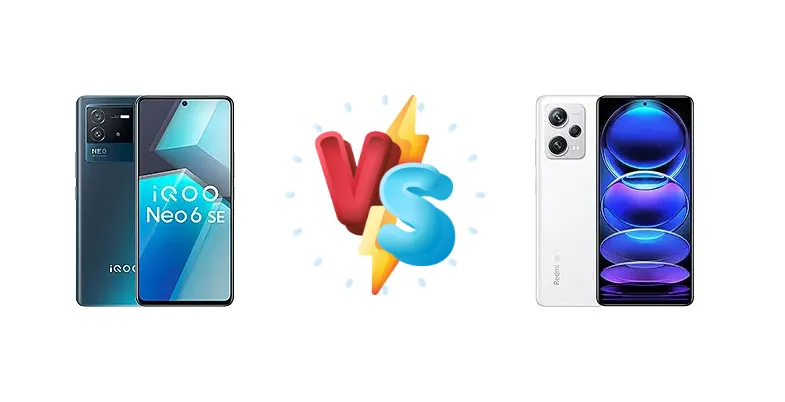
|
🏆 Quick Verdict
The Redmi Note 12 Pro+ boasts significantly faster charging and a potentially better camera system. However, the iQOO Neo6 SE’s Snapdragon 870 offers a slight edge in raw performance. Ultimately, the choice depends on your priorities: speed and camera vs. overall processing power.
| PHONES | ||
|---|---|---|
| Phone Names | vivo iQOO Neo6 SE | Xiaomi Redmi Note 12 Pro+ |
| Network | ||
|---|---|---|
| 2G bands | GSM 850 / 900 / 1800 / 1900 | GSM 850 / 900 / 1800 / 1900 - SIM 1 & SIM 2 |
| 3G bands | HSDPA 850 / 900 / 1700(AWS) / 2100 | HSDPA 800 / 850 / 900 / 1900 / 2100 |
| 4G bands | 1, 3, 4, 5, 8, 28, 34, 38, 39, 40, 41 | 1, 3, 5, 8, 19, 34, 38, 39, 40, 41 - International, China |
| 5G bands | 1, 5, 8, 28, 41, 77, 78 SA/NSA | 1, 3, 5, 8, 28, 38, 40, 41, 77, 78 SA/NSA - International |
| Speed | HSPA, LTE, 5G | HSPA, LTE-A (CA), 5G |
| Technology | GSM / CDMA / HSPA / CDMA2000 / LTE / 5G | GSM / CDMA / HSPA / EVDO / LTE / 5G |
| CDMA2000 1x | 1, 3, 5, 8, 28, 38, 41, 77, 78 SA/NSA - China | |
| Launch | ||
|---|---|---|
| Announced | 2022, May 06 | 2022, October 27 |
| Status | Available. Released 2022, May 11 | Available. Released 2022, November 01 |
| Body | ||
|---|---|---|
| Build | Glass front, plastic frame, plastic back | Glass front (Gorilla Glass 5), glass back |
| Dimensions | 163 x 76.2 x 8.5 mm (6.42 x 3.00 x 0.33 in) | 162.9 x 76 x 8.9 mm (6.41 x 2.99 x 0.35 in) |
| SIM | Nano-SIM + Nano-SIM | Dual SIM (Nano-SIM, dual stand-by) |
| Weight | 190 g (6.70 oz) | 208.4 g (7.34 oz) |
| - | IP53, dust and splash resistant | |
| Display | ||
|---|---|---|
| Protection | - | Corning Gorilla Glass 5 |
| Resolution | 1080 x 2400 pixels, 20:9 ratio (~398 ppi density) | 1080 x 2400 pixels, 20:9 ratio (~395 ppi density) |
| Size | 6.62 inches, 105.8 cm2 (~85.2% screen-to-body ratio) | 6.67 inches, 107.4 cm2 (~86.8% screen-to-body ratio) |
| Type | AMOLED, 120Hz, HDR10+, 500 nits (typ), 800 nits (HBM), 1300 nits (peak) | OLED, 1B colors, 120Hz, Dolby Vision, HDR10+, 500 nits (typ), 900 nits (HBM) |
| Platform | ||
|---|---|---|
| CPU | Octa-core (1x3.2 GHz Kryo 585 & 3x2.42 GHz Kryo 585 & 4x1.80 GHz Kryo 585) | Octa-core (2x2.6 GHz Cortex-A78 & 6x2.0 GHz Cortex-A55) |
| Chipset | Qualcomm SM8250-AC Snapdragon 870 5G (7 nm) | Mediatek MT6877V Dimensity 1080 (6 nm) |
| GPU | Adreno 650 | Mali-G68 MC4 |
| OS | Android 12, OriginOS Ocean | Android 12, MIUI 13 |
| Memory | ||
|---|---|---|
| Card slot | No | No |
| Internal | 128GB 8GB RAM, 256GB 8GB RAM, 256GB 12GB RAM, 512GB 12GB RAM | 256GB 8GB RAM, 256GB 12GB RAM |
| UFS 3.1 | UFS 2.2 | |
| Main Camera | ||
|---|---|---|
| Features | LED flash, HDR, panorama | Dual-LED dual-tone flash, HDR, panorama |
| Single | 16 MP, f/2.0, (wide), 1/3.1", 1.0µm | - |
| Triple | 64 MP, f/1.9, (wide), 1/1.72", 0.8µm, PDAF, OIS 8 MP, f/2.2, 116˚ (ultrawide), 1/4.0", 1.12µm 2 MP (macro) | 200 MP, f/1.7, 24mm (wide), 1/1.4", 0.56µm, PDAF, OIS 8 MP, f/2.2, 120˚ (ultrawide), 1/4", 1.12µm 2 MP, f/2.4, (macro) |
| Video | 4K@30fps, 1080p@30fps | 4K@30fps, 1080p@30/60/120fps, 720p@960fps |
| Selfie camera | ||
|---|---|---|
| Features | HDR | HDR |
| Single | 16 MP, f/2.0, (wide), 1/3.1", 1.0µm | 16 MP, f/2.5, (wide), 1/3.06", 1.0µm |
| Video | 1080p@30fps | 1080p@30/60fps |
| Sound | ||
|---|---|---|
| 3.5mm jack | No | Yes |
| 35mm jack | No | - |
| Loudspeaker | Yes, with stereo speakers | Yes, with stereo speakers |
| 24-bit/192kHz audio | 24-bit/192kHz audio | |
| Comms | ||
|---|---|---|
| Bluetooth | 5.2, A2DP, LE, aptX HD, aptX Adaptive | 5.2, A2DP, LE |
| Infrared port | - | Yes |
| NFC | Yes | Yes (market/region dependent) |
| Positioning | GPS, GLONASS, GALILEO, BDS, QZSS | GPS (L1), GLONASS (G1), BDS (B1I+B1c), GALILEO (E1), QZSS (L1) |
| Radio | No | No |
| USB | USB Type-C 2.0, OTG | USB Type-C 2.0, OTG |
| WLAN | Wi-Fi 802.11 a/b/g/n/ac/6, dual-band, Wi-Fi Direct | Wi-Fi 802.11 a/b/g/n/ac/6, dual-band, Wi-Fi Direct |
| Features | ||
|---|---|---|
| Sensors | Fingerprint (under display, optical), accelerometer, gyro, proximity, compass | Fingerprint (side-mounted), accelerometer, proximity, gyro, compass |
| Battery | ||
|---|---|---|
| Charging | 80W wired, 50% in 12 min, 100% in 32 min | 120W wired, PD3.0, 100% in 19 min (advertised) |
| Type | 4700 mAh | Li-Po 5000 mAh, non-removable |
| Misc | ||
|---|---|---|
| Colors | Blue, Orange, Gradient | Arctic White, Iceberg Blue, Obsidian Black, Trend edition |
| Models | V2199A | 22101316UCP, 22101316UG |
| Price | About 290 EUR | $ 348.00 / £ 439.00 / € 399.00 / ₹ 29,949 |
| Tests | ||
|---|---|---|
| Battery life | - | Endurance rating 88h |
| Camera | - | Photo / Video |
| Display | - | Contrast ratio: Infinite (nominal) |
| Loudspeaker | - | -26.7 LUFS (Good) |
| Performance | - | AnTuTu: 498710 (v9) GeekBench: 2208 (v5.1), 2372 (v6) GFXBench: 22fps (ES 3.1 onscreen) |
vivo iQOO Neo6 SE
- Excellent performance with Snapdragon 870
- Fast 80W charging
- Smooth display (likely 120Hz)
- Competitive price
- Camera may not be as advanced as the Redmi
- Charging speed slower than the Redmi
- Design might be less premium
Xiaomi Redmi Note 12 Pro+
- Incredibly fast 120W charging
- Potentially superior camera system
- Long battery life (88h endurance rating)
- Vibrant AMOLED display
- Dimensity 1080 slightly less powerful than Snapdragon 870
- Software experience can be polarizing
- Price may be slightly higher
Display Comparison
Both phones feature AMOLED displays, offering vibrant colors and deep blacks. The Redmi Note 12 Pro+ advertises an 'infinite' contrast ratio, suggesting excellent image quality, though this is a nominal term. The iQOO Neo6 SE likely has a slightly higher refresh rate (120Hz vs potentially 120Hz on the Redmi), contributing to smoother scrolling and animations. Screen size is likely similar, around 6.6-6.7 inches.
Camera Comparison
The Redmi Note 12 Pro+ is expected to have a more advanced camera system, potentially featuring a higher resolution main sensor (likely 200MP) and improved image processing. The iQOO Neo6 SE likely has a competent camera setup, but it may not match the Redmi's capabilities in low-light conditions or overall image quality. Video recording capabilities are likely comparable.
Performance
The iQOO Neo6 SE’s Snapdragon 870 is a proven performer, known for its excellent balance of power and efficiency. While the Dimensity 1080 in the Redmi Note 12 Pro+ is a capable chip, the Snapdragon 870 generally offers a slight edge in raw processing power, particularly in demanding games. Expect smooth multitasking and app loading on both devices.
Battery Life
The Redmi Note 12 Pro+ takes a commanding lead in this category with its 120W charging, capable of reaching 100% in around 19 minutes. The iQOO Neo6 SE’s 80W charging is still fast, but slower. Both phones likely have similar battery capacities (around 5000mAh), and the Redmi's charging advantage should translate to quicker top-ups and less downtime.
Buying Guide
The vivo iQOO Neo6 SE is ideal for gamers and users prioritizing smooth performance and a reliable chipset. The Xiaomi Redmi Note 12 Pro+ is a better fit for those who value incredibly fast charging, a potentially superior camera, and a long-lasting battery.