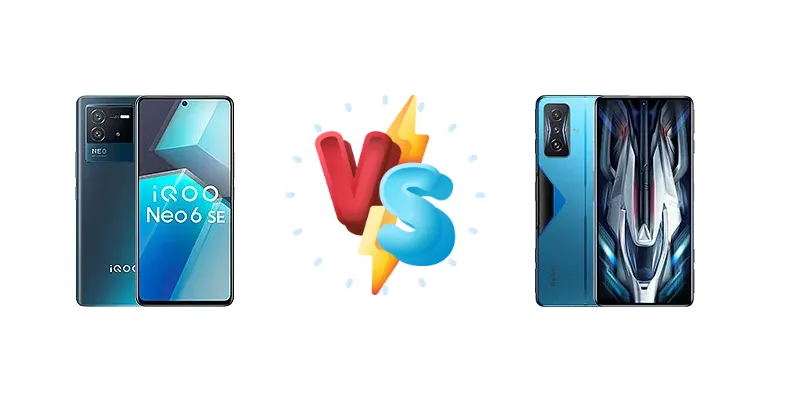
The iQOO Neo6 SE and Xiaomi Redmi K50 Gaming represent distinct approaches to the mid-range gaming market. The iQOO leverages the refined efficiency of the Snapdragon 870, while the Redmi K50 Gaming throws down with the flagship Snapdragon 8 Gen 1. This comparison dissects their strengths and weaknesses to determine which device delivers the best gaming experience for your money.
🏆 Quick Verdict
For most users, the Xiaomi Redmi K50 Gaming emerges as the stronger choice. Its Snapdragon 8 Gen 1 offers a significant performance uplift, and the blazing-fast 120W charging is a game-changer. However, the iQOO Neo6 SE remains a compelling option for those prioritizing efficiency and a potentially cooler gaming experience.
| Network |
|---|
| 2G bands | GSM 850 / 900 / 1800 / 1900 | GSM 850 / 900 / 1800 / 1900 |
| 3G bands | HSDPA 850 / 900 / 1700(AWS) / 2100 | HSDPA 850 / 900 / 1700(AWS) / 1900 / 2100 |
| 4G bands | 1, 3, 4, 5, 8, 28, 34, 38, 39, 40, 41 | 1, 2, 3, 4, 5, 7, 8, 18, 19, 26, 34, 38, 39, 40, 41, 42 |
| 5G bands | 1, 5, 8, 28, 41, 77, 78 SA/NSA | 1, 3, 5, 8, 28, 38, 40, 41, 77, 78 SA/NSA/Sub6 |
| Speed | HSPA, LTE, 5G | HSPA, LTE, 5G |
| Technology | GSM / CDMA / HSPA / CDMA2000 / LTE / 5G | GSM / CDMA / HSPA / CDMA2000 / LTE / 5G |
| | CDMA2000 1x | CDMA2000 1x |
| Launch |
|---|
| Announced | 2022, May 06 | 2022, February 16 |
| Status | Available. Released 2022, May 11 | Available. Released 2022, February 18 |
| Body |
|---|
| Build | Glass front, plastic frame, plastic back | Glass front (Gorilla Glass Victus), glass back, aluminum frame |
| Dimensions | 163 x 76.2 x 8.5 mm (6.42 x 3.00 x 0.33 in) | 162.5 x 76.7 x 8.5 mm (6.40 x 3.02 x 0.33 in) |
| SIM | Nano-SIM + Nano-SIM | Nano-SIM + Nano-SIM |
| Weight | 190 g (6.70 oz) | 210 g (7.41 oz) |
| | - | Physical magnetic pop-up gaming triggers |
| Display |
|---|
| Protection | - | Corning Gorilla Glass Victus |
| Resolution | 1080 x 2400 pixels, 20:9 ratio (~398 ppi density) | 1080 x 2400 pixels, 20:9 ratio (~395 ppi density) |
| Size | 6.62 inches, 105.8 cm2 (~85.2% screen-to-body ratio) | 6.67 inches, 107.4 cm2 (~86.2% screen-to-body ratio) |
| Type | AMOLED, 120Hz, HDR10+, 500 nits (typ), 800 nits (HBM), 1300 nits (peak) | OLED, 1B colors, 120Hz, HDR10+, 800 nits (HBM) |
| Platform |
|---|
| CPU | Octa-core (1x3.2 GHz Kryo 585 & 3x2.42 GHz Kryo 585 & 4x1.80 GHz Kryo 585) | Octa-core (1x3.00 GHz Cortex-X2 & 3x2.50 GHz Cortex-A710 & 4x1.80 GHz Cortex-A510) |
| Chipset | Qualcomm SM8250-AC Snapdragon 870 5G (7 nm) | Qualcomm SM8450 Snapdragon 8 Gen 1 (4 nm) |
| GPU | Adreno 650 | Adreno 730 |
| OS | Android 12, OriginOS Ocean | Android 12, MIUI 13 |
| Memory |
|---|
| Card slot | No | No |
| Internal | 128GB 8GB RAM, 256GB 8GB RAM, 256GB 12GB RAM, 512GB 12GB RAM | 128GB 8GB RAM, 128GB 12GB RAM, 256GB 12GB RAM |
| | UFS 3.1 | UFS 3.1 |
| Main Camera |
|---|
| Features | LED flash, HDR, panorama | Color spectrum sensor, Dual-LED flash, HDR, panorama |
| Single | 16 MP, f/2.0, (wide), 1/3.1", 1.0µm | 20 MP, f/2.4, (wide), 1/2.0", 0.8µm |
| Triple | 64 MP, f/1.9, (wide), 1/1.72", 0.8µm, PDAF, OIS
8 MP, f/2.2, 116˚ (ultrawide), 1/4.0", 1.12µm
2 MP (macro) | 64 MP, f/1.9, 26mm (wide), 1/1.73", 0.8µm, PDAF
8 MP, f/2.2, 120˚ (ultrawide)
2 MP (macro) |
| Video | 4K@30fps, 1080p@30fps | 4K@30/60fps, 1080p@30/60/120fps, 720p@960fps, HDR |
| Selfie camera |
|---|
| Features | HDR | HDR |
| Single | 16 MP, f/2.0, (wide), 1/3.1", 1.0µm | 20 MP, f/2.4, (wide), 1/2.0", 0.8µm |
| Video | 1080p@30fps | 1080p@30/60fps, 720p@120fps, HDR |
| Sound |
|---|
| 3.5mm jack | No | No |
| 35mm jack | No | No |
| Loudspeaker | Yes, with stereo speakers | Yes, with stereo speakers (4 speakers) |
| | 24-bit/192kHz audio | 24-bit/192kHz audio
Tuned by JBL |
| Comms |
|---|
| Bluetooth | 5.2, A2DP, LE, aptX HD, aptX Adaptive | 5.2, A2DP, LE, aptX HD, aptX Adaptive |
| Infrared port | - | Yes |
| NFC | Yes | Yes |
| Positioning | GPS, GLONASS, GALILEO, BDS, QZSS | GPS (L1+L5), GLONASS (L1), BDS (B1I+B1c+B2a), GALILEO (E1+E5a), QZSS (L1+L5), NavIC (L5) |
| Radio | No | No |
| USB | USB Type-C 2.0, OTG | USB Type-C 2.0, OTG |
| WLAN | Wi-Fi 802.11 a/b/g/n/ac/6, dual-band, Wi-Fi Direct | Wi-Fi 802.11 a/b/g/n/ac/6e, dual-band, Wi-Fi Direct |
| Features |
|---|
| Sensors | Fingerprint (under display, optical), accelerometer, gyro, proximity, compass | Fingerprint (side-mounted), accelerometer, gyro, compass |
| | - | Virtual proximity sensing |
| Battery |
|---|
| Charging | 80W wired, 50% in 12 min, 100% in 32 min | 120W wired, PD3.0, QC3, 100% in 17 min |
| Type | 4700 mAh | Li-Po 4700 mAh |
| Misc |
|---|
| Colors | Blue, Orange, Gradient | Black, Gray, Blue, AMG |
| Models | V2199A | 21121210C |
| Price | About 290 EUR | About 460 EUR |
vivo iQOO Neo6 SE
- More efficient Snapdragon 870 chipset
- Potentially better thermal management
- Respectable 80W fast charging
- Less raw processing power than the 8 Gen 1
- Slower charging compared to the Redmi K50 Gaming
Xiaomi Redmi K50 Gaming
- Significantly more powerful Snapdragon 8 Gen 1
- Blazing-fast 120W charging
- Likely more advanced display features
- Potential for thermal throttling under sustained load
- Higher power consumption
Display Comparison
While both devices likely feature high refresh rate displays (data not provided), the core difference lies in the processing power driving them. The Redmi K50 Gaming, with its Snapdragon 8 Gen 1, will benefit more from pushing higher frame rates in demanding titles. The Snapdragon 870 in the iQOO Neo6 SE is still capable, but will encounter limitations sooner. We expect both to have similar color accuracy given the brands' typical calibration, but the Redmi K50 Gaming's chipset allows for more advanced display features if implemented.
Camera Comparison
Without detailed camera specifications, it’s difficult to make a definitive judgment. However, given the gaming focus of both devices, camera performance is likely secondary. We can assume both will offer competent camera systems for social media and casual photography. The Redmi K50 Gaming, being a newer device, *may* benefit from more advanced image processing algorithms, but this is speculative. The chipset's ISP (Image Signal Processor) in the 8 Gen 1 is more capable, potentially leading to better dynamic range and low-light performance, but sensor size and lens quality are equally crucial factors.
Performance
The Snapdragon 8 Gen 1 (4nm) in the Redmi K50 Gaming represents a generational leap over the Snapdragon 870 (7nm) found in the iQOO Neo6 SE. The 8 Gen 1’s Cortex-X2 prime core, clocked at 3.00 GHz, provides a substantial single-core performance advantage. However, the 7nm process of the 870 is more mature and thermally efficient. The Redmi K50 Gaming’s CPU configuration (1x3.00 GHz Cortex-X2, 3x2.50 GHz Cortex-A710, 4x1.80 GHz Cortex-A510) is designed for peak performance, while the iQOO Neo6 SE’s (1x3.2 GHz Kryo 585, 3x2.42 GHz Kryo 585, 4x1.80 GHz Kryo 585) prioritizes a balance between power and efficiency. This translates to potentially more sustained performance from the iQOO Neo6 SE under heavy load, avoiding the throttling often associated with the 8 Gen 1.
Battery Life
The Redmi K50 Gaming’s 120W charging is a clear advantage, achieving a full charge in just 17 minutes. This is significantly faster than the iQOO Neo6 SE’s 80W charging, which takes 32 minutes for a complete cycle. While battery capacity isn’t specified, the faster charging of the Redmi K50 Gaming mitigates any potential disadvantage from a smaller battery. The 80W charging on the iQOO Neo6 SE is still respectable, reaching 50% in 12 minutes, but the Redmi K50 Gaming’s speed is a substantial convenience factor.
Buying Guide
Buy the vivo iQOO Neo6 SE if you need a consistently smooth gaming experience without worrying about aggressive thermal throttling, and value a more balanced power profile. Buy the Xiaomi Redmi K50 Gaming if you prioritize raw performance, demand the fastest possible charging speeds, and are willing to accept potentially higher temperatures during extended gaming sessions.
Frequently Asked Questions
❓ Will the Redmi K50 Gaming overheat during prolonged gaming sessions?
The Snapdragon 8 Gen 1 is known to generate significant heat. While Xiaomi likely implemented cooling solutions, extended gaming at maximum settings *may* lead to thermal throttling, reducing performance to maintain safe temperatures. The iQOO Neo6 SE, with its Snapdragon 870, is less prone to this issue.
❓ Is the 80W charging on the iQOO Neo6 SE fast enough for daily use?
Yes, 80W charging is still very fast, topping up the battery to 50% in just 12 minutes. While not as rapid as the Redmi K50 Gaming’s 120W, it’s more than sufficient for most users and provides a convenient charging experience.
❓ Does the Snapdragon 870 in the iQOO Neo6 SE still hold up for demanding games like Genshin Impact?
The Snapdragon 870 is still a very capable chipset and can run Genshin Impact, but you may need to lower graphics settings to maintain a stable frame rate. The Redmi K50 Gaming’s Snapdragon 8 Gen 1 will provide a smoother experience at higher settings.