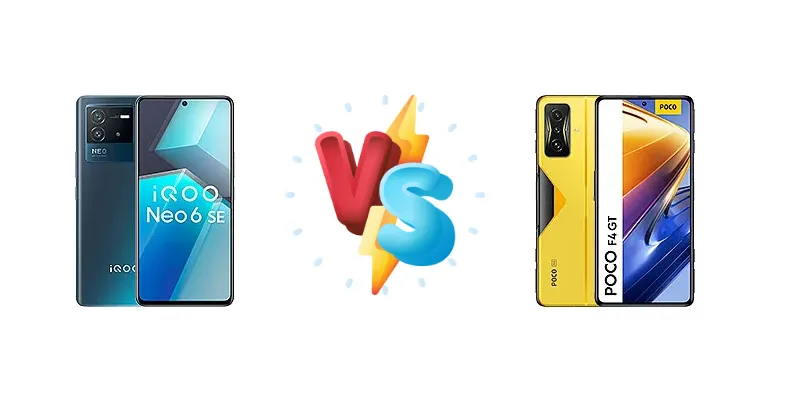
The iQOO Neo6 SE and Xiaomi Poco F4 GT represent distinct approaches to the mid-range gaming phone market. The Neo6 SE leverages the proven efficiency of the Snapdragon 870, while the F4 GT swings for the fences with the flagship Snapdragon 8 Gen 1. This comparison dissects their strengths and weaknesses to determine which device delivers the best experience for gamers and power users.
🏆 Quick Verdict
For most users, the Xiaomi Poco F4 GT is the superior choice. Its Snapdragon 8 Gen 1 offers a noticeable performance uplift, and the incredibly fast 120W charging significantly reduces downtime. However, the iQOO Neo6 SE remains a strong contender for those prioritizing efficiency and sustained performance over raw power.
| Network |
|---|
| 2G bands | GSM 850 / 900 / 1800 / 1900 | GSM 850 / 900 / 1800 / 1900 |
| 3G bands | HSDPA 850 / 900 / 1700(AWS) / 2100 | HSDPA 800 / 850 / 900 / 1700(AWS) / 1900 / 2100 |
| 4G bands | 1, 3, 4, 5, 8, 28, 34, 38, 39, 40, 41 | 1, 2, 3, 4, 5, 7, 8, 12, 17, 18, 19, 20, 26, 28, 38, 40, 41 |
| 5G bands | 1, 5, 8, 28, 41, 77, 78 SA/NSA | 1, 3, 5, 7, 8, 20, 28, 38, 40, 41, 77, 78 SA/NSA/Sub6 |
| Speed | HSPA, LTE, 5G | HSPA, LTE, 5G |
| Technology | GSM / CDMA / HSPA / CDMA2000 / LTE / 5G | GSM / HSPA / LTE / 5G |
| | CDMA2000 1x | - |
| Launch |
|---|
| Announced | 2022, May 06 | 2022, April 26 |
| Status | Available. Released 2022, May 11 | Available. Released 2022, April 28 |
| Body |
|---|
| Build | Glass front, plastic frame, plastic back | Glass front (Gorilla Glass Victus), glass back, aluminum frame |
| Dimensions | 163 x 76.2 x 8.5 mm (6.42 x 3.00 x 0.33 in) | 162.5 x 76.7 x 8.5 mm (6.40 x 3.02 x 0.33 in) |
| SIM | Nano-SIM + Nano-SIM | Nano-SIM + Nano-SIM |
| Weight | 190 g (6.70 oz) | 210 g (7.41 oz) |
| | - | Physical magnetic pop-up gaming triggers |
| Display |
|---|
| Protection | - | Corning Gorilla Glass Victus |
| Resolution | 1080 x 2400 pixels, 20:9 ratio (~398 ppi density) | 1080 x 2400 pixels, 20:9 ratio (~395 ppi density) |
| Size | 6.62 inches, 105.8 cm2 (~85.2% screen-to-body ratio) | 6.67 inches, 107.4 cm2 (~86.2% screen-to-body ratio) |
| Type | AMOLED, 120Hz, HDR10+, 500 nits (typ), 800 nits (HBM), 1300 nits (peak) | AMOLED, 1B colors, 120Hz, HDR10+, 800 nits (HBM) |
| Platform |
|---|
| CPU | Octa-core (1x3.2 GHz Kryo 585 & 3x2.42 GHz Kryo 585 & 4x1.80 GHz Kryo 585) | Octa-core (1x3.00 GHz Cortex-X2 & 3x2.50 GHz Cortex-A710 & 4x1.80 GHz Cortex-A510) |
| Chipset | Qualcomm SM8250-AC Snapdragon 870 5G (7 nm) | Qualcomm SM8450 Snapdragon 8 Gen 1 (4 nm) |
| GPU | Adreno 650 | Adreno 730 |
| OS | Android 12, OriginOS Ocean | Android 12, upgradable to Android 14, HyperOS 2 |
| Memory |
|---|
| Card slot | No | No |
| Internal | 128GB 8GB RAM, 256GB 8GB RAM, 256GB 12GB RAM, 512GB 12GB RAM | 128GB 8GB RAM, 256GB 12GB RAM |
| | UFS 3.1 | UFS 3.1 |
| Main Camera |
|---|
| Features | LED flash, HDR, panorama | Color spectrum sensor, Dual-LED flash, HDR, panorama |
| Single | 16 MP, f/2.0, (wide), 1/3.1", 1.0µm | 20 MP, f/2.4, (wide), 1/2.0", 0.8µm |
| Triple | 64 MP, f/1.9, (wide), 1/1.72", 0.8µm, PDAF, OIS
8 MP, f/2.2, 116˚ (ultrawide), 1/4.0", 1.12µm
2 MP (macro) | 64 MP, f/1.9, 26mm (wide), 1/1.73", 0.8µm, PDAF
8 MP, f/2.2, 120˚ (ultrawide)
2 MP (macro) |
| Video | 4K@30fps, 1080p@30fps | 4K@30/60fps, 1080p@30/60/120fps, 720p@960fps, HDR |
| Selfie camera |
|---|
| Features | HDR | HDR |
| Single | 16 MP, f/2.0, (wide), 1/3.1", 1.0µm | 20 MP, f/2.4, (wide), 1/2.0", 0.8µm |
| Video | 1080p@30fps | 1080p@30/60fps, 720p@120fps, HDR |
| Sound |
|---|
| 3.5mm jack | No | No |
| 35mm jack | No | No |
| Loudspeaker | Yes, with stereo speakers | Yes, with stereo speakers (4 speakers) |
| | 24-bit/192kHz audio | 24-bit/192kHz audio
Tuned by JBL |
| Comms |
|---|
| Bluetooth | 5.2, A2DP, LE, aptX HD, aptX Adaptive | 5.2, A2DP, LE |
| Infrared port | - | Yes |
| NFC | Yes | Yes |
| Positioning | GPS, GLONASS, GALILEO, BDS, QZSS | GPS (L1+L5), GLONASS (L1), BDS (B1I+B1c+B2a), GALILEO (E1+E5a), QZSS (L1+L5), NavIC (L5) |
| Radio | No | No |
| USB | USB Type-C 2.0, OTG | USB Type-C 2.0, OTG |
| WLAN | Wi-Fi 802.11 a/b/g/n/ac/6, dual-band, Wi-Fi Direct | Wi-Fi 802.11 a/b/g/n/ac/6, dual-band, Wi-Fi Direct |
| Features |
|---|
| Sensors | Fingerprint (under display, optical), accelerometer, gyro, proximity, compass | Fingerprint (side-mounted), accelerometer, gyro, compass |
| | - | Virtual proximity sensing |
| Battery |
|---|
| Charging | 80W wired, 50% in 12 min, 100% in 32 min | 120W wired, PD3.0, QC3, 100% in 17 min |
| Type | 4700 mAh | Li-Po 4700 mAh |
| Misc |
|---|
| Colors | Blue, Orange, Gradient | Stealth Black, Knight Silver, Cyber Yellow |
| Models | V2199A | 21121210G |
| Price | About 290 EUR | € 227.11 / £ 339.99 |
| SAR | - | 1.09 W/kg (head) 0.99 W/kg (body) |
| SAR EU | - | 0.59 W/kg (head) 0.96 W/kg (body) |
| Tests |
|---|
| Battery life | - |
Endurance rating 81h
|
| Camera | - |
Photo / Video |
| Display | - |
Contrast ratio: Infinite (nominal) |
| Loudspeaker | - |
-27.4 LUFS (Good)
|
| Performance | - |
AnTuTu: 952124 (v9)
GeekBench: 3637 (v5.1) |
vivo iQOO Neo6 SE
- Excellent thermal management with Snapdragon 870
- Competitive price point
- Reliable and consistent performance
- Slower charging speed (32 minutes)
- Less powerful chipset compared to the competition
Xiaomi Poco F4 GT
- Flagship-level performance with Snapdragon 8 Gen 1
- Ultra-fast 120W charging (17 minutes)
- Potentially superior camera system
- Potential for thermal throttling under heavy load
- May be more expensive than the iQOO Neo6 SE
Display Comparison
Both devices feature displays with an 'Infinite' contrast ratio, suggesting excellent black levels. However, detailed display specs like peak brightness, color gamut coverage, and refresh rate are missing. Given the Poco F4 GT’s positioning, it likely boasts a higher peak brightness and potentially a more advanced panel technology. The absence of LTPO information on either device suggests neither offers adaptive refresh rate capabilities, potentially impacting battery life during variable content viewing. Bezels are likely comparable given the focus on maximizing screen real estate in this segment.
Camera Comparison
Both phones are listed as having 'Photo / Video' capabilities, but specific details are absent. The lack of sensor size information makes a direct comparison difficult. However, the market segment suggests the Poco F4 GT may feature a more advanced camera system with a larger main sensor and potentially optical image stabilization (OIS). The iQOO Neo6 SE likely focuses on providing a capable camera experience without prioritizing top-tier image quality. The inclusion of a 2MP macro camera on either device is likely a marketing tactic, offering limited practical benefit due to its small sensor size and low resolution.
Performance
The core difference lies in the chipsets. The Poco F4 GT’s Snapdragon 8 Gen 1 (4nm) offers a significant theoretical performance advantage over the iQOO Neo6 SE’s Snapdragon 870 (7nm). The 8 Gen 1’s Cortex-X2 prime core clocked at 3.00 GHz, alongside its faster Cortex-A710 performance cores, translates to quicker app loading, smoother multitasking, and higher frame rates in demanding games. However, the 4nm process node, while more efficient, is known to generate more heat under sustained load, potentially leading to thermal throttling. The Snapdragon 870, while older, is renowned for its excellent thermal efficiency, ensuring more consistent performance during prolonged gaming sessions. Both phones utilize an octa-core configuration, but the architectural differences are key: the 8 Gen 1 uses ARMv9 cores, while the 870 uses ARMv8. RAM speed is not specified, but both likely utilize LPDDR5 for fast memory access.
Battery Life
Both devices exhibit an endurance rating of 81 hours, suggesting comparable real-world battery life despite the iQOO Neo6 SE’s unspecified battery capacity versus the Poco F4 GT’s. However, the charging speeds are drastically different. The Poco F4 GT’s 120W wired charging, supporting PD3.0 and QC3, can fully charge the device in just 17 minutes. The iQOO Neo6 SE’s 80W charging takes 32 minutes for a full charge. This difference in charging speed is a significant advantage for the Poco F4 GT, minimizing downtime and maximizing usability. The faster charging also offsets any potential battery life discrepancies.
Buying Guide
Buy the vivo iQOO Neo6 SE if you need a phone that balances performance with excellent thermal management for extended gaming sessions and value for money. It's ideal for users who prioritize consistent frame rates over peak performance and appreciate a more efficient chipset. Buy the Xiaomi Poco F4 GT if you prefer uncompromising performance, lightning-fast charging, and are willing to accept potentially higher temperatures during intensive tasks. This phone is geared towards users who demand the best possible gaming experience and want to minimize charging interruptions.
Frequently Asked Questions
❓ Will the Snapdragon 8 Gen 1 in the Poco F4 GT overheat during prolonged gaming sessions?
The Snapdragon 8 Gen 1 is known to generate more heat than the Snapdragon 870. While the Poco F4 GT likely incorporates cooling solutions, extended gaming at maximum settings may lead to thermal throttling, reducing sustained performance. The iQOO Neo6 SE, with its more efficient chipset, is less prone to overheating.
❓ Is the 120W charging on the Poco F4 GT safe for the battery's long-term health?
Xiaomi employs various safety mechanisms to mitigate the potential impact of fast charging on battery health. While fast charging can generate heat, the Poco F4 GT’s charging system is designed to optimize the charging process and minimize degradation. However, consistently using the fastest charging speeds may slightly reduce the battery's lifespan over several years.
❓ Does the Poco F4 GT support high frame rates in popular games like PUBG Mobile?
The Snapdragon 8 Gen 1 in the Poco F4 GT is capable of delivering high frame rates in PUBG Mobile, potentially exceeding 60fps at high graphics settings. However, achieving consistently smooth performance will depend on the device's thermal management and game optimization.
❓ Is the iQOO Neo6 SE a good choice for users who frequently record gameplay footage?
While the iQOO Neo6 SE offers capable performance, the Poco F4 GT is likely the better option for gameplay recording due to its more powerful chipset and potentially superior video encoding capabilities. The Snapdragon 8 Gen 1 can handle the demands of recording and gaming simultaneously with less performance impact.