
iQOO Neo6 vs Redmi K50 Ultra: A Deep Dive into Snapdragon Power and Charging Speed
| Phones Images | |||||
|---|---|---|---|---|---|
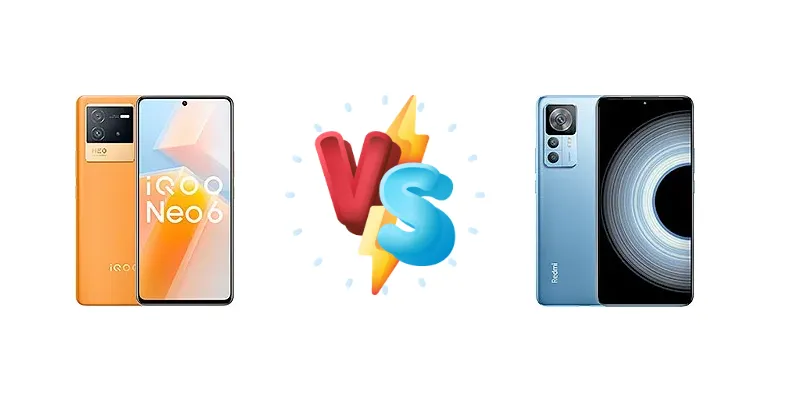
|
🏆 Quick Verdict
For most users, the Xiaomi Redmi K50 Ultra emerges as the superior choice. The Snapdragon 8+ Gen 1 offers a noticeable efficiency and performance advantage over the Snapdragon 8 Gen 1 in the iQOO Neo6, coupled with significantly faster 120W charging. While the iQOO Neo6 remains a capable device, the K50 Ultra delivers a more refined and future-proof experience.
| PHONES | ||
|---|---|---|
| Phone Names | vivo iQOO Neo6 (China) | Xiaomi Redmi K50 Ultra |
| Network | ||
|---|---|---|
| 2G bands | GSM 850 / 900 / 1800 / 1900 | GSM 850 / 900 / 1800 / 1900 |
| 3G bands | HSDPA 800 / 850 / 900 / 1700(AWS) / 1900 / 2100 | HSDPA 850 / 900 / 1700(AWS) / 1900 / 2100 |
| 4G bands | 1, 2, 3, 4, 5, 7, 8, 18, 19, 26, 28, 34, 38, 39, 40, 41 | 1, 3, 4, 5, 8, 18, 19, 26, 34, 38, 39, 40, 41, 42 |
| 5G bands | 1, 3, 5, 8, 28, 41, 77, 78 SA/NSA | 1, 3, 5, 8, 28, 38, 40, 41, 77, 78 SA/NSA |
| Speed | HSPA, LTE, 5G | HSPA, LTE, 5G |
| Technology | GSM / CDMA / HSPA / CDMA2000 / LTE / 5G | GSM / CDMA / HSPA / CDMA2000 / LTE / 5G |
| CDMA2000 1x | CDMA2000 1x | |
| Launch | ||
|---|---|---|
| Announced | 2022, April 13 | 2022, August 11 |
| Status | Available. Released 2022, April 20 | Available. Released 2022, August 25 |
| Body | ||
|---|---|---|
| Dimensions | 163 x 76.2 x 8.5 mm or 8.9 mm | 163.1 x 75.9 x 8.6 mm (6.42 x 2.99 x 0.34 in) |
| SIM | Nano-SIM + Nano-SIM | Nano-SIM + Nano-SIM |
| Weight | 194 / 197.2 g (6.84 oz) | 202 g (7.13 oz) |
| Display | ||
|---|---|---|
| Resolution | 1080 x 2400 pixels, 20:9 ratio (~398 ppi density) | 1220 x 2712 pixels, 20:9 ratio (~446 ppi density) |
| Size | 6.62 inches, 105.8 cm2 (~85.2% screen-to-body ratio) | 6.67 inches, 107.4 cm2 (~86.7% screen-to-body ratio) |
| Type | AMOLED, 120Hz, HDR10+, 1300 nits (peak) | OLED, 68B colors, 144Hz, HDR10+, Dolby Vision |
| Platform | ||
|---|---|---|
| CPU | Octa-core (1x3.00 GHz Cortex-X2 & 3x2.50 GHz Cortex-A710 & 4x1.80 GHz Cortex-A510) | Octa-core (1x3.19 GHz Cortex-X2 & 3x2.75 GHz Cortex-A710 & 4x1.80 GHz Cortex-A510) |
| Chipset | Qualcomm SM8450 Snapdragon 8 Gen 1 (4 nm) | Qualcomm SM8475 Snapdragon 8+ Gen 1 (4 nm) |
| GPU | Adreno 730 | Adreno 730 |
| OS | Android 12, OriginOS Ocean | Android 12, MIUI 13 |
| Memory | ||
|---|---|---|
| Card slot | No | No |
| Internal | 128GB 8GB RAM, 256GB 8GB RAM, 256GB 12GB RAM | 128GB 8GB RAM, 256GB 8GB RAM, 256GB 12GB RAM, 512GB 12GB RAM |
| UFS 3.1 | UFS 3.1 | |
| Main Camera | ||
|---|---|---|
| Features | LED flash, HDR, panorama | Color spectrum sensor, LED flash, HDR, panorama |
| Single | 16 MP, f/2.0, (wide) | - |
| Triple | 64 MP, f/1.9, 25mm (wide), PDAF, OIS 12 MP, f/2.2, 16mm (ultrawide) Auxiliary lens | 108 MP, f/1.6, (wide), 1/1.67", PDAF, OIS 8 MP, f/2.2, 120˚, (ultrawide) 2 MP (macro) |
| Video | 4K@30fps, 1080p@30fps | 4K@30/60fps, 1080p@30/60/120/240/960fps |
| Selfie camera | ||
|---|---|---|
| Features | HDR | HDR |
| Single | 16 MP, f/2.0, (wide) | 20 MP, (wide) |
| Video | 1080p@30fps | 1080p@30/60fps, 720p@120fps |
| Sound | ||
|---|---|---|
| 3.5mm jack | No | No |
| 35mm jack | No | No |
| Loudspeaker | Yes | Yes, with stereo speakers |
| 24-bit/192kHz audio | 24-bit/192kHz audio | |
| Comms | ||
|---|---|---|
| Bluetooth | 5.2, A2DP, LE, aptX HD, aptX Adaptive | 5.2, A2DP, LE, aptX HD, aptX Adaptive |
| Infrared port | - | Yes |
| NFC | Yes | Yes |
| Positioning | GPS, GLONASS, GALILEO, BDS, QZSS | GPS (L1+L5), GLONASS (L1), BDS (B1I+B1c+B2a), GALILEO (E1+E5a), QZSS (L1+L5), NavIC (L5) |
| Radio | No | No |
| USB | USB Type-C 2.0, OTG | USB Type-C 2.0, OTG |
| WLAN | Wi-Fi 802.11 a/b/g/n/ac/6, dual-band, Wi-Fi Direct | Wi-Fi 802.11 a/b/g/n/ac/6e, dual-band, Wi-Fi Direct |
| Features | ||
|---|---|---|
| Sensors | Fingerprint (under display, optical), accelerometer, gyro, proximity, compass | Fingerprint (under display, optical), accelerometer, gyro, proximity, compass |
| Battery | ||
|---|---|---|
| Charging | 80W wired, 20-80% in 19 min | 120W wired, PD3.0, 100% in 19 min |
| Type | 4700 mAh | Li-Po 5000 mAh |
| Misc | ||
|---|---|---|
| Colors | Black, Blue, Orange | Black, Gray, Blue, Mercedes AMG |
| Models | V2196A | 22081212C |
| Price | About 400 EUR | About 430 EUR |
vivo iQOO Neo6 (China)
- Potentially lower price point.
- Capable Snapdragon 8 Gen 1 performance.
- 80W fast charging is still very quick.
- Snapdragon 8 Gen 1 is prone to thermal throttling.
- Slower charging compared to the K50 Ultra.
Xiaomi Redmi K50 Ultra
- More efficient Snapdragon 8+ Gen 1.
- Significantly faster 120W charging.
- Superior sustained performance.
- Likely a higher price tag.
- May not offer a drastically different camera experience.
Display Comparison
While specific display details are absent, both phones likely feature high refresh rate AMOLED panels common in this price bracket. However, the K50 Ultra’s superior processing power allows for potentially more complex display features like variable refresh rate (VRR) implementation. The Snapdragon 8+ Gen 1’s improved ISP could also translate to more accurate color calibration. Bezels are expected to be minimal on both, but the K50 Ultra’s more recent release suggests a slight edge in maximizing screen-to-body ratio.
Camera Comparison
Without detailed camera specs, it’s difficult to make definitive claims. However, Xiaomi generally prioritizes camera performance, and the K50 Ultra, being a newer device, likely benefits from improved image processing algorithms powered by the Snapdragon 8+ Gen 1’s enhanced ISP. The 8+ Gen 1’s superior image signal processing capabilities will result in better dynamic range and noise reduction, particularly in low-light conditions. We can assume both phones will feature a multi-camera setup, but the K50 Ultra is more likely to have a larger main sensor and more advanced features.
Performance
The core difference lies in the chipsets. The Redmi K50 Ultra’s Snapdragon 8+ Gen 1 (4nm) is a direct upgrade over the iQOO Neo6’s Snapdragon 8 Gen 1 (4nm). The 8+ Gen 1 boasts a higher peak CPU clock speed (3.19 GHz vs 3.00 GHz) and, crucially, a more efficient manufacturing process. This translates to sustained performance under load, reducing thermal throttling. The K50 Ultra’s CPU configuration – 1x Cortex-X2, 3x Cortex-A710, and 4x Cortex-A510 – mirrors the Neo6, but benefits from the architectural improvements of the 8+ Gen 1. Both likely utilize LPDDR5X RAM, but the K50 Ultra’s chipset will better leverage its bandwidth.
Battery Life
The Redmi K50 Ultra’s 120W charging is a game-changer. While the iQOO Neo6’s 80W charging is fast, the K50 Ultra promises a full charge in just 19 minutes, compared to the Neo6’s 20-80% in 19 minutes. This difference is significant for users who prioritize minimizing downtime. While battery capacity isn’t specified, the 8+ Gen 1’s efficiency means the K50 Ultra will likely achieve comparable or better battery life despite potentially having a similar or smaller battery size. The K50 Ultra also supports PD3.0, offering wider compatibility with chargers.
Buying Guide
Buy the vivo iQOO Neo6 (China) if you prioritize a slightly lower price point and are comfortable with potentially more aggressive thermal throttling during extended gaming sessions. Buy the Xiaomi Redmi K50 Ultra if you demand the best possible performance, faster charging speeds, and a more efficient chipset that will maintain peak performance for longer periods, even under heavy load.