
iQOO Neo6 (China) vs Xiaomi 12X: A Head-to-Head Performance and Value Showdown
| Phones Images | |||||
|---|---|---|---|---|---|
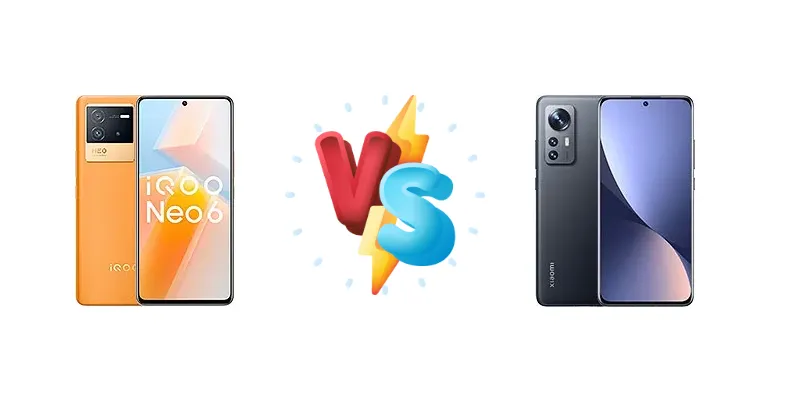
|
🏆 Quick Verdict
For users prioritizing peak performance and rapid charging, the iQOO Neo6 (China) is the clear winner. Its Snapdragon 8 Gen 1 offers a substantial performance uplift. However, the Xiaomi 12X provides a more balanced experience with excellent efficiency and a respectable 67W charging solution, making it ideal for everyday users.
| PHONES | ||
|---|---|---|
| Phone Names | vivo iQOO Neo6 (China) | Xiaomi 12X |
| Network | ||
|---|---|---|
| 2G bands | GSM 850 / 900 / 1800 / 1900 | GSM 850 / 900 / 1800 / 1900 |
| 3G bands | HSDPA 800 / 850 / 900 / 1700(AWS) / 1900 / 2100 | HSDPA 800 / 850 / 900 / 1700(AWS) / 1900 / 2100 |
| 4G bands | 1, 2, 3, 4, 5, 7, 8, 18, 19, 26, 28, 34, 38, 39, 40, 41 | 1, 2, 3, 4, 5, 7, 8, 12, 13, 17, 18, 19, 20, 26, 28, 32, 38, 39, 40, 41, 42, 48, 66 - International |
| 5G bands | 1, 3, 5, 8, 28, 41, 77, 78 SA/NSA | 1, 3, 5, 7, 8, 20, 28, 38, 40, 41, 66, 77, 78 SA/NSA - International |
| Speed | HSPA, LTE, 5G | HSPA, LTE, 5G |
| Technology | GSM / CDMA / HSPA / CDMA2000 / LTE / 5G | GSM / CDMA / HSPA / EVDO / LTE / 5G |
| CDMA2000 1x | 1, 3, 5, 8, 28, 38, 40, 41, 77, 78 SA/NSA - China | |
| Launch | ||
|---|---|---|
| Announced | 2022, April 13 | 2021, December 28 |
| Status | Available. Released 2022, April 20 | Available. Released 2021, December 31 |
| Body | ||
|---|---|---|
| Dimensions | 163 x 76.2 x 8.5 mm or 8.9 mm | 152.7 x 69.9 x 8.2 mm (6.01 x 2.75 x 0.32 in) |
| SIM | Nano-SIM + Nano-SIM | Nano-SIM + Nano-SIM |
| Weight | 194 / 197.2 g (6.84 oz) | 176 g (6.21 oz) |
| Display | ||
|---|---|---|
| Protection | - | Corning Gorilla Glass Victus |
| Resolution | 1080 x 2400 pixels, 20:9 ratio (~398 ppi density) | 1080 x 2400 pixels, 20:9 ratio (~419 ppi density) |
| Size | 6.62 inches, 105.8 cm2 (~85.2% screen-to-body ratio) | 6.28 inches, 95.2 cm2 (~89.2% screen-to-body ratio) |
| Type | AMOLED, 120Hz, HDR10+, 1300 nits (peak) | AMOLED, 68B colors, 120Hz, Dolby Vision, HDR10+, 1100 nits (peak) |
| Platform | ||
|---|---|---|
| CPU | Octa-core (1x3.00 GHz Cortex-X2 & 3x2.50 GHz Cortex-A710 & 4x1.80 GHz Cortex-A510) | Octa-core (1x3.2 GHz Kryo 585 & 3x2.42 GHz Kryo 585 & 4x1.80 GHz Kryo 585) |
| Chipset | Qualcomm SM8450 Snapdragon 8 Gen 1 (4 nm) | Qualcomm SM8250-AC Snapdragon 870 5G (7 nm) |
| GPU | Adreno 730 | Adreno 650 |
| OS | Android 12, OriginOS Ocean | Android 11, MIUI 13 |
| Memory | ||
|---|---|---|
| Card slot | No | No |
| Internal | 128GB 8GB RAM, 256GB 8GB RAM, 256GB 12GB RAM | 128GB 8GB RAM, 256GB 8GB RAM, 256GB 12GB RAM |
| UFS 3.1 | UFS 3.1 | |
| Main Camera | ||
|---|---|---|
| Features | LED flash, HDR, panorama | Dual-LED dual-tone flash, HDR, panorama |
| Single | 16 MP, f/2.0, (wide) | 32 MP, f/2.5, 26mm (wide), 0.7µm |
| Triple | 64 MP, f/1.9, 25mm (wide), PDAF, OIS 12 MP, f/2.2, 16mm (ultrawide) Auxiliary lens | 50 MP, f/1.9, 26mm (wide), 1/1.56", 1.0µm, PDAF, OIS 13 MP, f/2.4, 12mm, 123˚ (ultrawide), 1/3.06", 1.12µm 5 MP, f/2.4, 50mm (telephoto macro), AF |
| Video | 4K@30fps, 1080p@30fps | 8K@24fps, 4K@30/60fps, 1080p@30/120/240/960fps, gyro-EIS |
| Selfie camera | ||
|---|---|---|
| Features | HDR | HDR, panorama |
| Single | 16 MP, f/2.0, (wide) | 32 MP, f/2.5, 26mm (wide), 0.7µm |
| Video | 1080p@30fps | 1080p@30/60fps, 720p@120fps, HDR |
| Sound | ||
|---|---|---|
| 3.5mm jack | No | No |
| 35mm jack | No | No |
| Loudspeaker | Yes | Yes, with stereo speakers |
| 24-bit/192kHz audio | 24-bit/192kHz audio Tuned by Harman Kardon | |
| Comms | ||
|---|---|---|
| Bluetooth | 5.2, A2DP, LE, aptX HD, aptX Adaptive | 5.1 / 5.2, A2DP, LE |
| Infrared port | - | Yes |
| NFC | Yes | Yes (market/region dependent) |
| Positioning | GPS, GLONASS, GALILEO, BDS, QZSS | GPS (L1+L5), GLONASS (L1), BDS (B1I+B1c+B2a), GALILEO (E1+E5a), QZSS (L1+L5), NavIC (L5) |
| Radio | No | No |
| USB | USB Type-C 2.0, OTG | USB Type-C 2.0, OTG |
| WLAN | Wi-Fi 802.11 a/b/g/n/ac/6, dual-band, Wi-Fi Direct | Wi-Fi 802.11 a/b/g/n/ac, Wi-Fi 6 (market dependent), dual-band, Wi-Fi Direct |
| Features | ||
|---|---|---|
| Sensors | Fingerprint (under display, optical), accelerometer, gyro, proximity, compass | Fingerprint (under display, optical), accelerometer, proximity, gyro, compass |
| Battery | ||
|---|---|---|
| Charging | 80W wired, 20-80% in 19 min | 67W wired, PD3.0, QC4, 100% in 39 min |
| Type | 4700 mAh | Li-Po 4500 mAh |
| Misc | ||
|---|---|---|
| Colors | Black, Blue, Orange | Gray, Blue, Purple |
| Models | V2196A | 2112123AC, 2112123AG |
| Price | About 400 EUR | About 180 EUR |
| SAR EU | - | 0.59 W/kg (head) 1.00 W/kg (body) |
| Tests | ||
|---|---|---|
| Battery life | - | Endurance rating 105h |
| Camera | - | Photo / Video |
| Display | - | Contrast ratio: Infinite (nominal) |
| Loudspeaker | - | -25.6 LUFS (Very good) |
| Performance | - | AnTuTu: 598003 (v8), 690298 (v9) GeekBench: 3168 (v5.1) GFXBench: 47fps (ES 3.1 onscreen) |
vivo iQOO Neo6 (China)
- Significantly faster processor with Snapdragon 8 Gen 1
- Ultra-fast 80W wired charging
- Potential for higher refresh rate display (unconfirmed)
- Snapdragon 8 Gen 1 can run hot and throttle under sustained load
- Battery capacity and display details are unknown
Xiaomi 12X
- Efficient Snapdragon 870 processor
- Excellent battery life (105h endurance rating)
- Compact and ergonomic design
- Slower charging speed (39 minutes to 100%)
- Less powerful processor compared to the iQOO Neo6
Display Comparison
Both devices feature displays with an 'Infinite' contrast ratio, suggesting excellent black levels. However, detailed display specs like peak brightness and refresh rate are missing for the iQOO Neo6. The Xiaomi 12X, being a flagship-focused device, likely benefits from superior color accuracy and calibration. The iQOO Neo6’s potential for higher refresh rates (common in gaming phones) could be a differentiator, but remains unconfirmed. The Xiaomi 12X’s compact size is a key advantage for users preferring one-handed operation.
Camera Comparison
Both phones offer photo and video capabilities, but specific details are lacking. The iQOO Neo6’s camera system is likely geared towards delivering vibrant, social media-ready images, typical of vivo’s image processing. The Xiaomi 12X, as a former flagship, likely features a more balanced and natural image processing style. Without sensor size or aperture information, it’s difficult to assess low-light performance. The absence of details suggests neither phone prioritizes a groundbreaking camera experience, focusing instead on overall value.
Performance
The iQOO Neo6’s Snapdragon 8 Gen 1 (4nm) is a significant leap over the Xiaomi 12X’s Snapdragon 870 (7nm). The 8 Gen 1’s Cortex-X2 prime core, clocked at 3.00 GHz, provides a substantial performance advantage in CPU-intensive tasks. While the 870’s Kryo 585 cores are still capable, they are architecturally older and less efficient. The 4nm process node of the 8 Gen 1 also contributes to better thermal efficiency, potentially mitigating throttling during sustained workloads. However, the 8 Gen 1 is known to run hotter, so the iQOO Neo6’s cooling solution will be critical. The Xiaomi 12X benefits from a mature chipset with well-optimized drivers.
Battery Life
The Xiaomi 12X boasts an endurance rating of 105 hours, indicating solid battery life. The iQOO Neo6’s battery capacity is unknown, but its 80W wired charging is a major advantage, achieving a 20-80% charge in just 19 minutes. The Xiaomi 12X’s 67W charging, while supporting PD3.0 and QC4, takes 39 minutes for a full charge. The iQOO Neo6’s faster charging is crucial for users who frequently need to top up their battery quickly, offsetting any potential capacity disadvantage.
Buying Guide
Buy the vivo iQOO Neo6 (China) if you are a power user, mobile gamer, or frequently engage in demanding tasks like video editing and need the fastest possible processing speeds. Buy the Xiaomi 12X if you value a more refined, efficient experience with a focus on battery life and a compact form factor, and don't require the absolute highest performance.