
iQOO Neo6 (China) vs Samsung Galaxy A73 5G: A Deep Dive into Performance and Value
| Phones Images | |||||
|---|---|---|---|---|---|
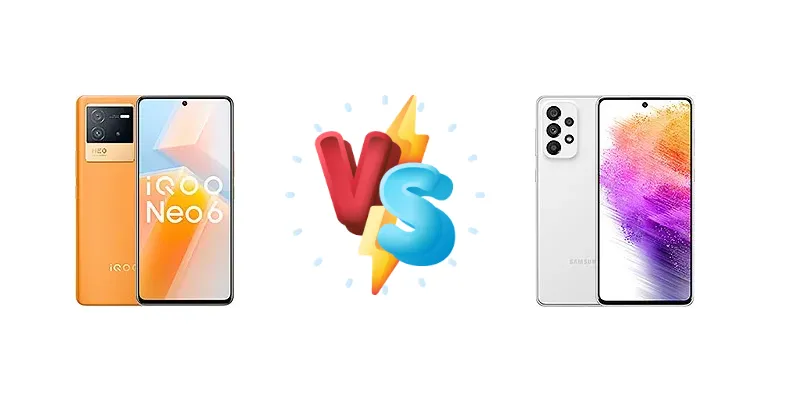
|
🏆 Quick Verdict
For users prioritizing gaming and demanding tasks, the iQOO Neo6 (China) is the clear winner thanks to its significantly more powerful Snapdragon 8 Gen 1. However, the Galaxy A73 5G provides a more balanced package with better efficiency and a more refined software experience, making it ideal for everyday users.
| PHONES | ||
|---|---|---|
| Phone Names | vivo iQOO Neo6 (China) | Samsung Galaxy A73 5G |
| Network | ||
|---|---|---|
| 2G bands | GSM 850 / 900 / 1800 / 1900 | GSM 850 / 900 / 1800 / 1900 |
| 3G bands | HSDPA 800 / 850 / 900 / 1700(AWS) / 1900 / 2100 | HSDPA 850 / 900 / 1700(AWS) / 1900 / 2100 |
| 4G bands | 1, 2, 3, 4, 5, 7, 8, 18, 19, 26, 28, 34, 38, 39, 40, 41 | 1, 2, 3, 4, 5, 7, 8, 12, 13, 17, 20, 26, 28, 32, 38, 40, 41, 66 |
| 5G bands | 1, 3, 5, 8, 28, 41, 77, 78 SA/NSA | 1, 3, 5, 7, 28, 40, 41, 66, 78 SA/NSA/Sub6 |
| Speed | HSPA, LTE, 5G | HSPA, LTE, 5G |
| Technology | GSM / CDMA / HSPA / CDMA2000 / LTE / 5G | GSM / HSPA / LTE / 5G |
| CDMA2000 1x | - | |
| Launch | ||
|---|---|---|
| Announced | 2022, April 13 | 2022, March 17 |
| Status | Available. Released 2022, April 20 | Available. Released 2022, April 22 |
| Body | ||
|---|---|---|
| Dimensions | 163 x 76.2 x 8.5 mm or 8.9 mm | 163.7 x 76.1 x 7.6 mm (6.44 x 3.00 x 0.30 in) |
| SIM | Nano-SIM + Nano-SIM | · Nano-SIM· Nano-SIM + Nano-SIM |
| Weight | 194 / 197.2 g (6.84 oz) | 181 g (6.38 oz) |
| - | IP67 dust/water resistant (up to 1m for 30 min) | |
| Display | ||
|---|---|---|
| Protection | - | Corning Gorilla Glass 5 |
| Resolution | 1080 x 2400 pixels, 20:9 ratio (~398 ppi density) | 1080 x 2400 pixels, 20:9 ratio (~393 ppi density) |
| Size | 6.62 inches, 105.8 cm2 (~85.2% screen-to-body ratio) | 6.7 inches, 108.4 cm2 (~87.0% screen-to-body ratio) |
| Type | AMOLED, 120Hz, HDR10+, 1300 nits (peak) | Super AMOLED Plus, 120Hz, 800 nits (HBM) |
| Platform | ||
|---|---|---|
| CPU | Octa-core (1x3.00 GHz Cortex-X2 & 3x2.50 GHz Cortex-A710 & 4x1.80 GHz Cortex-A510) | Octa-core (1x2.4 GHz Cortex-A78 & 3x2.2 GHz Cortex-A78 & 4x1.9 GHz Cortex-A55) |
| Chipset | Qualcomm SM8450 Snapdragon 8 Gen 1 (4 nm) | Qualcomm SM7325 Snapdragon 778G 5G (6 nm) |
| GPU | Adreno 730 | Adreno 642L |
| OS | Android 12, OriginOS Ocean | Android 12, up to 4 major Android upgrades, One UI 6.1 |
| Memory | ||
|---|---|---|
| Card slot | No | microSDXC (uses shared SIM slot) |
| Internal | 128GB 8GB RAM, 256GB 8GB RAM, 256GB 12GB RAM | 128GB 6GB RAM, 128GB 8GB RAM, 256GB 8GB RAM |
| UFS 3.1 | - | |
| Main Camera | ||
|---|---|---|
| Features | LED flash, HDR, panorama | LED flash, panorama, HDR |
| Quad | - | 108 MP, f/1.8, (wide), PDAF, OIS 12 MP, f/2.2, (ultrawide) 5 MP (macro) Auxiliary lens |
| Single | 16 MP, f/2.0, (wide) | 32 MP, f/2.2, 26mm (wide), 1/2.8", 0.8µm |
| Triple | 64 MP, f/1.9, 25mm (wide), PDAF, OIS 12 MP, f/2.2, 16mm (ultrawide) Auxiliary lens | - |
| Video | 4K@30fps, 1080p@30fps | 4K@30fps, 1080p@30/60fps; gyro-EIS |
| Selfie camera | ||
|---|---|---|
| Features | HDR | HDR |
| Single | 16 MP, f/2.0, (wide) | 32 MP, f/2.2, 26mm (wide), 1/2.8", 0.8µm |
| Video | 1080p@30fps | 4K@30fps, 1080p@30fps |
| Sound | ||
|---|---|---|
| 3.5mm jack | No | No |
| 35mm jack | No | No |
| Loudspeaker | Yes | Yes, with stereo speakers |
| 24-bit/192kHz audio | - | |
| Comms | ||
|---|---|---|
| Bluetooth | 5.2, A2DP, LE, aptX HD, aptX Adaptive | 5.0, A2DP, LE |
| NFC | Yes | Yes (market/region dependent) |
| Positioning | GPS, GLONASS, GALILEO, BDS, QZSS | GPS, GLONASS, GALILEO, BDS, QZSS |
| Radio | No | Unspecified |
| USB | USB Type-C 2.0, OTG | USB Type-C 2.0, OTG |
| WLAN | Wi-Fi 802.11 a/b/g/n/ac/6, dual-band, Wi-Fi Direct | Wi-Fi 802.11 a/b/g/n/ac/6, dual-band, Wi-Fi Direct |
| Features | ||
|---|---|---|
| Sensors | Fingerprint (under display, optical), accelerometer, gyro, proximity, compass | Fingerprint (under display, optical), accelerometer, gyro, proximity, compass |
| Battery | ||
|---|---|---|
| Charging | 80W wired, 20-80% in 19 min | 25W wired |
| Type | 4700 mAh | Li-Po 5000 mAh |
| Misc | ||
|---|---|---|
| Colors | Black, Blue, Orange | Gray, Mint, White |
| Models | V2196A | SM-A736B, SM-A736B/DS |
| Price | About 400 EUR | About 600 EUR |
| SAR | - | 1.14 W/kg (head) |
| SAR EU | - | 1.28 W/kg (head) 1.42 W/kg (body) |
vivo iQOO Neo6 (China)
- Significantly faster processor (Snapdragon 8 Gen 1)
- Ultra-fast 80W charging
- Likely higher refresh rate display
- Potential for thermal throttling
- Software experience may be less refined than Samsung’s One UI
Samsung Galaxy A73 5G
- More efficient processor (Snapdragon 778G)
- Polished software experience with One UI
- Potentially better battery life during typical use
- Slower processor compared to the iQOO Neo6
- Slower 25W charging
Display Comparison
While both devices likely feature AMOLED panels (based on market segment), the specifics are not provided. The iQOO Neo6’s performance focus suggests a higher refresh rate is probable, potentially 120Hz or higher, to complement the Snapdragon 8 Gen 1. The Galaxy A73 5G, being a more mainstream device, may prioritize power efficiency over peak display performance. Without specific brightness data, it’s difficult to assess which offers a better outdoor visibility experience, but Samsung typically excels in display calibration and color accuracy.
Camera Comparison
Without detailed sensor information, a direct comparison is challenging. However, the iQOO Neo6’s focus on performance suggests a camera system geared towards speed and processing capabilities. The Galaxy A73 5G, as a Samsung device, likely benefits from Samsung’s well-regarded image processing algorithms and potentially a larger main sensor. The A73 5G likely includes OIS (Optical Image Stabilization) on its primary lens, a feature that enhances low-light photography and video stabilization. The presence of a 2MP macro camera on the A73 5G is unlikely to be a significant selling point, as these sensors typically lack detail and dynamic range.
Performance
The core difference lies in the chipsets. The iQOO Neo6’s Snapdragon 8 Gen 1 (4nm) is a significant leap over the Galaxy A73 5G’s Snapdragon 778G 5G (6nm). The 8 Gen 1’s Cortex-X2 prime core clocked at 3.00 GHz provides substantially higher peak performance. The 6nm process of the 778G offers better efficiency, but the 8 Gen 1’s architectural advantages (newer CPU cores, faster GPU) translate to a more responsive experience in demanding applications. The iQOO Neo6 likely benefits from faster LPDDR5x RAM, further enhancing performance, while the A73 5G likely uses LPDDR5. Thermal management will be crucial for the iQOO Neo6; the 8 Gen 1 is known to run hot, potentially leading to throttling under sustained load.
Battery Life
The iQOO Neo6’s 80W wired charging is a game-changer, capable of charging from 20-80% in just 19 minutes. This significantly reduces downtime compared to the Galaxy A73 5G’s 25W charging. While the A73 5G may have a slightly larger battery capacity (spec not provided), the iQOO Neo6’s faster charging mitigates any potential capacity disadvantage. The Snapdragon 778G’s efficiency in the A73 5G will contribute to longer battery life during typical usage, but the iQOO Neo6’s rapid charging allows for quick top-ups when needed.
Buying Guide
Buy the vivo iQOO Neo6 (China) if you absolutely need the fastest possible performance for gaming, video editing, or other resource-intensive applications and are comfortable with a potentially more aggressive thermal profile. Buy the Samsung Galaxy A73 5G if you prioritize all-day battery life, a versatile camera system, and a polished software experience with Samsung’s One UI, even if it means sacrificing some raw processing power.