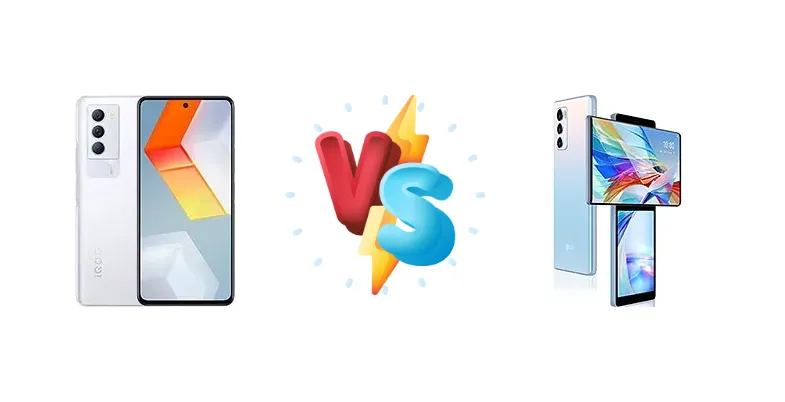
The smartphone market is brimming with options, but two stand out for different reasons: the vivo iQOO Neo5 SE, a performance-focused mid-ranger, and the LG Wing 5G, a truly unique device with its rotating dual-screen design. This comparison dives deep into their specs, features, and overall value to help you decide which one is right for you.
🏆 Quick Verdict
The iQOO Neo5 SE takes the crown for raw performance and value, boasting a Snapdragon 870 chipset and faster charging. However, the LG Wing 5G offers a groundbreaking, albeit niche, dual-screen experience that's unmatched, making it a compelling choice for those seeking innovation over pure power.
| Network |
|---|
| 2G bands | GSM 850 / 900 / 1800 / 1900 | GSM 850 / 900 / 1800 / 1900 |
| 3G bands | HSDPA 850 / 900 / 2100 | HSDPA 850 / 900 / 1900 / 2100 |
| 4G bands | 1, 3, 5, 8, 28, 34, 38, 39, 40, 41 | 2, 3, 4, 5, 7, 12, 13, 20, 28, 46, 48, 66 - USA |
| 5G bands | 1, 5, 8, 28, 41, 77, 78 SA/NSA | 2, 5, 66, 260, 261 Sub6, mmWave - USA |
| Speed | HSPA, LTE, 5G | HSPA, LTE, 5G |
| Technology | GSM / CDMA / HSPA / CDMA2000 / LTE / 5G | GSM / CDMA / HSPA / LTE / 5G |
| | CDMA2000 1x | CDMA 800 / 1900 |
| Launch |
|---|
| Announced | 2021, December 20 | 2020, September 14. Released 2020, October 15 |
| Status | Available. Released 2021, December 29 | Discontinued |
| Body |
|---|
| Build | - | Glass front (Gorilla Glass 5), glass back (Gorilla Glass 5), aluminum frame |
| Dimensions | 164.7 x 76.7 x 8.5 mm (6.48 x 3.02 x 0.33 in) | 169.5 x 74.5 x 10.9 mm (6.67 x 2.93 x 0.43 in) |
| SIM | Nano-SIM + Nano-SIM | Nano-SIM + Nano-SIM |
| Weight | 189 g (6.67 oz) | 260 g (9.17 oz) |
| | - | IP54, dust and water resistant
Water-repellent coating
MIL-STD-810G compliant*
*does not guarantee ruggedness or use in extreme conditions |
| Display |
|---|
| Protection | - | Corning Gorilla Glass 5 |
| Resolution | 1080 x 2400 pixels, 20:9 ratio (~395 ppi density) | 1080 x 2460 pixels (~395 ppi density) |
| Size | 6.67 inches, 107.4 cm2 (~85.0% screen-to-body ratio) | 6.8 inches, 109.8 cm2 (~87.0% screen-to-body ratio) |
| Type | IPS LCD, 144Hz, HDR10, 650 nits (typ) | Rotating P-OLED |
| | - | Always-on display
Secondary display: G-OLED, 1080 x 1240 pixels, 3.9 inches |
| Platform |
|---|
| CPU | Octa-core (1x3.2 GHz Kryo 585 & 3x2.42 GHz Kryo 585 & 4x1.80 GHz Kryo 585) | Octa-core (1x2.4 GHz Kryo 475 Prime & 1x2.2 GHz Kryo 475 Gold & 6x1.8 GHz Kryo 475 Silver) |
| Chipset | Qualcomm SM8250-AC Snapdragon 870 5G (7 nm) | Qualcomm SM7250 Snapdragon 765G 5G (7 nm) |
| GPU | Adreno 650 | Adreno 620 |
| OS | Android 11, OriginOS Ocean | Android 10, upgradable to Android 12 |
| Memory |
|---|
| Card slot | No | microSDXC (uses shared SIM slot) |
| Internal | 128GB 8GB RAM, 256GB 8GB RAM, 256GB 12GB RAM | 128GB 8GB RAM, 256GB 8GB RAM |
| | UFS 3.1 | UFS 2.1 |
| Main Camera |
|---|
| Dual | 50 MP, f/1.8, (wide), PDAF
8 MP, f/2.2, 120˚ (ultrawide)
2 MP (macro) | - |
| Features | Dual-LED flash, HDR, panorama | LED flash, panorama, HDR |
| Single | 16 MP, f/2.5, (wide) | - |
| Triple | - | 64 MP, f/1.8, 25mm (wide), 1/1.72", 0.8µm, PDAF, OIS
13 MP, f/1.9, 117˚, (ultrawide), 1/3.4", 1.0µm
12 MP, f/2.2, 120˚, (ultrawide), 1/2.55", 1.4µm |
| Video | 4K@30fps, 1080p@30fps | 4K@30/60fps, 1080p@30/60fps, gyro-EIS |
| Selfie camera |
|---|
| Features | HDR | HDR |
| Single | 16 MP, f/2.5, (wide) | Motorized pop-up 32 MP, f/1.9, 26mm (wide), 1/2.8", 0.8µm |
| Video | 1080p@30fps | 1080p@30fps |
| Sound |
|---|
| 3.5mm jack | Yes | No |
| 35mm jack | Yes | No |
| Loudspeaker | Yes, with stereo speakers | Yes |
| | 24-bit/192kHz audio | - |
| Comms |
|---|
| Bluetooth | 5.2, A2DP, LE, aptX HD, aptX Adaptive | 5.1, A2DP, LE, aptX |
| NFC | Yes | Yes |
| Positioning | GPS, GLONASS, GALILEO, BDS, QZSS | GPS (L1+L5), GLONASS, BDS, GALILEO, QZSS |
| Radio | No | FM radio |
| USB | USB Type-C 2.0, OTG | USB Type-C 3.1, OTG |
| WLAN | Wi-Fi 802.11 a/b/g/n/ac/6, dual-band, Wi-Fi Direct | Wi-Fi 802.11 a/b/g/n/ac, dual-band, Wi-Fi Direct, DLNA |
| Features |
|---|
| Sensors | Fingerprint (side-mounted), accelerometer, gyro, proximity, compass | Fingerprint (under display, optical), accelerometer, gyro, proximity, compass |
| Battery |
|---|
| Charging | 55W wired | Wired, QC4
13W wireless |
| Type | 4500 mAh | Li-Po 4000 mAh |
| Misc |
|---|
| Colors | Black, White, Aurora | Aurora Gray, Illusion Sky |
| Models | V2157A | LMF100N, LM-F100N, LM-F100V, LM-F100 |
| Price | About 300 EUR | About 850 EUR |
| SAR | - | 1.13 W/kg (head) 1.06 W/kg (body) |
| Tests |
|---|
| Battery life | - | Endurance rating 87h |
| Camera | - |
Photo / Video |
| Display | - |
Contrast ratio: Infinite (nominal) |
| Loudspeaker | - |
-30.9 LUFS (Below average) |
| Performance | - |
AnTuTu: 315688 (v8)
GeekBench: 7898 (v4.4), 1952 (v5.1)
GFXBench: 17fps (ES 3.1 onscreen) |
vivo iQOO Neo5 SE
- Excellent Performance (Snapdragon 870)
- Fast Charging (55W)
- High Refresh Rate Display (likely)
- Good Value for Money
- Camera details are limited
- Design is less unique
LG Wing 5G
- Unique Dual-Screen Design
- Exceptional Battery Life (87h endurance)
- Innovative Multitasking Capabilities
- Lower Performance (Snapdragon 765G)
- Slow Charging (13W wireless, QC4)
- Niche Appeal
- Potentially Bulky
Display Comparison
The iQOO Neo5 SE likely features a standard, high refresh rate AMOLED display (typically 120Hz), offering vibrant colors and smooth scrolling. The LG Wing 5G's main display is a 6.8-inch OLED, while the secondary 'Wing' screen is a 3.9-inch OLED. While the Wing's contrast ratio is theoretically infinite, the Neo5 SE's brightness (586 nits measured for the Wing) suggests it might offer better outdoor visibility. The Wing's dual-screen setup is its defining feature, enabling unique multitasking and app combinations.
Camera Comparison
Camera details are sparse for both devices. The LG Wing 5G is expected to have a versatile camera system, potentially including wide-angle and ultrawide lenses. The iQOO Neo5 SE likely features a capable main sensor, but without specific details, a direct comparison is difficult. Image quality will depend on software processing and sensor size, which are not readily available.
Performance
Here, the iQOO Neo5 SE dominates. Its Snapdragon 870 chipset is significantly more powerful than the LG Wing 5G's Snapdragon 765G. Expect noticeably faster app loading, smoother gaming, and better overall responsiveness on the Neo5 SE. The Neo5 SE's CPU configuration (1x3.2 GHz Kryo 585 & 3x2.42 GHz Kryo 585 & 4x1.80 GHz Kryo 585) provides a substantial performance advantage over the Wing's (1x2.4 GHz Kryo 475 Prime & 1x2.2 GHz Kryo 475 Gold & 6x1.8 GHz Kryo 475 Silver).
Battery Life
The LG Wing 5G boasts an impressive endurance rating of 87 hours, suggesting exceptional battery life. The iQOO Neo5 SE, while not explicitly stated, likely offers good battery life, but it's unlikely to match the Wing's longevity. The Neo5 SE's 55W charging is significantly faster than the Wing's 13W wireless and QC4 wired charging.
Buying Guide
The vivo iQOO Neo5 SE is ideal for gamers, power users, and anyone prioritizing speed and efficiency on a budget. The LG Wing 5G is for early adopters, content creators who value multitasking, and those who want a conversation-starting device with a unique form factor.
Frequently Asked Questions
❓ Is the LG Wing 5G still worth buying?
It depends. If you value innovation and a unique dual-screen experience above all else, and can find one at a good price, it can be worthwhile. However, be aware of its performance limitations and slower charging.
❓ Which phone is better for gaming?
The vivo iQOO Neo5 SE is significantly better for gaming due to its more powerful Snapdragon 870 chipset.