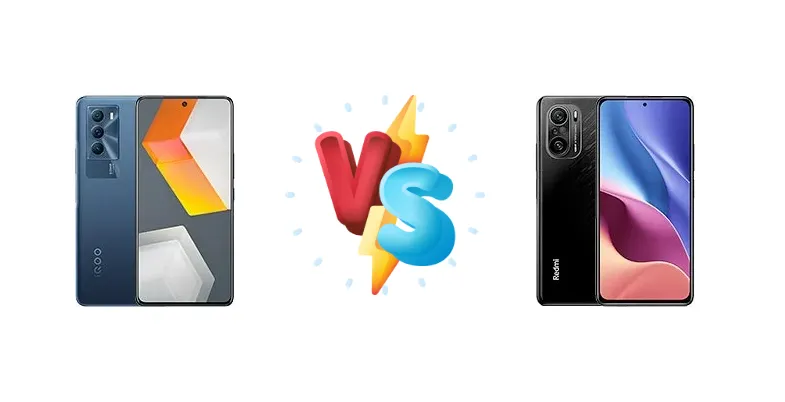
The vivo iQOO Neo5 S and Xiaomi Redmi K40 Pro+ represent a fascinating intersection in the Android market: both are powered by Qualcomm’s Snapdragon 888 5G, yet cater to slightly different priorities. This comparison dissects their key differences, focusing on charging speed, potential thermal performance, and overall user experience to determine which device delivers the most compelling package.
🏆 Quick Verdict
For the average user prioritizing rapid charging and potentially sustained performance, the vivo iQOO Neo5 S emerges as the winner. Its 66W charging significantly reduces downtime compared to the Redmi K40 Pro+'s 33W solution, and while both share the same chipset, faster charging can indirectly aid thermal management by reducing prolonged high-load scenarios.
| Network |
|---|
| 2G bands | GSM 850 / 900 / 1800 / 1900 | GSM 850 / 900 / 1800 / 1900 - SIM 1 & SIM 2 |
| 3G bands | HSDPA 850 / 900 / 1900 / 2100 | HSDPA 850 / 900 / 1700(AWS) / 1900 / 2100 |
| 4G bands | 1, 3, 4, 5, 8, 28, 34, 38, 39, 40, 41 | 1, 2, 3, 4, 5, 7, 8, 12, 17, 18, 19, 20, 26, 28, 34, 38, 39, 40, 41, 42 |
| 5G bands | 1, 3, 5, 8, 28, 41, 77, 78 SA/NSA | 1, 3, 28, 41, 77, 78 SA/NSA/Sub6 |
| Speed | HSPA, LTE, 5G | HSPA, LTE-A, 5G |
| Technology | GSM / CDMA / HSPA / CDMA2000 / LTE / 5G | GSM / CDMA / HSPA / CDMA2000 / LTE / 5G |
| | CDMA2000 1x | CDMA2000 1x |
| Launch |
|---|
| Announced | 2021, December 20 | 2021, February 25 |
| Status | Available. Released 2021, December 25 | Available. Released 2021, March 04 |
| Body |
|---|
| Dimensions | 163.2 x 76.4 x 8.4 mm (6.43 x 3.01 x 0.33 in) | 163.7 x 76.4 x 7.8 mm (6.44 x 3.01 x 0.31 in) |
| SIM | Nano-SIM + Nano-SIM | Dual SIM (Nano-SIM, dual stand-by) |
| Weight | 196 g (6.91 oz) | 196 g (6.91 oz) |
| | - | IP53, dust and splash resistant |
| Display |
|---|
| Protection | - | Corning Gorilla Glass 5 |
| Resolution | 1080 x 2400 pixels, 20:9 ratio (~398 ppi density) | 1080 x 2400 pixels, 20:9 ratio (~395 ppi density) |
| Size | 6.62 inches, 105.8 cm2 (~84.9% screen-to-body ratio) | 6.67 inches, 107.4 cm2 (~85.9% screen-to-body ratio) |
| Type | AMOLED, 120Hz, HDR10+, 1300 nits (peak) | Super AMOLED, 120Hz, HDR10+, 1300 nits (peak) |
| Platform |
|---|
| CPU | Octa-core (1x2.84 GHz Cortex-X1 & 3x2.42 GHz Cortex-A78 & 4x1.80 GHz Cortex-A55) | Octa-core (1x2.84 GHz Cortex-X1 & 3x2.42 GHz Cortex-A78 & 4x1.80 GHz Cortex-A55) |
| Chipset | Qualcomm SM8350 Snapdragon 888 5G (5 nm) | Qualcomm SM8350 Snapdragon 888 5G (5 nm) |
| GPU | Adreno 660 | Adreno 660 |
| OS | Android 11, OriginOS Ocean | Android 11, MIUI 12 |
| Memory |
|---|
| Card slot | No | No |
| Internal | 128GB 8GB RAM, 256GB 8GB RAM, 256GB 12GB RAM | 256GB 12GB RAM |
| | UFS 3.1 | UFS 3.1 |
| Main Camera |
|---|
| Dual | 48 MP, f/1.8, 25mm (wide), 1/2.0", 0.8µm, PDAF, OIS
13 MP, f/2.2, 16mm, 120˚ (ultrawide)
2 MP (macro) | - |
| Features | Dual-LED dual-tone flash, HDR, panorama | LED flash, HDR, panorama |
| Single | 16 MP, f/2.0, (wide) | 20 MP, f/2.5, (wide), 1/3.4", 0.8µm |
| Triple | - | 108 MP, f/1.8, 26mm (wide), 1/1.52", 0.7µm, PDAF
8 MP, f/2.2, 119˚ (ultrawide)
5 MP, f/2.4, 50mm (macro), 1/5.0", 1.12µm |
| Video | 4K@30fps, 1080p@30fps | 8K@30fps, 4K@30/60fps, 1080p@30/60/120/240/960fps, gyro-EIS, HDR10+ |
| Selfie camera |
|---|
| Features | HDR | HDR |
| Single | 16 MP, f/2.0, (wide) | 20 MP, f/2.5, (wide), 1/3.4", 0.8µm |
| Video | 1080p@30fps | 1080p@30fps, 720p@120fps |
| Sound |
|---|
| 3.5mm jack | No | No |
| 35mm jack | No | - |
| Loudspeaker | Yes, with stereo speakers | Yes, with stereo speakers |
| | 24-bit/192kHz audio | 24-bit/192kHz audio |
| Comms |
|---|
| Bluetooth | 5.2, A2DP, LE, aptX HD, aptX Adaptive | 5.2, A2DP, LE |
| Infrared port | - | Yes |
| NFC | Yes | Yes |
| Positioning | GPS, GLONASS, GALILEO, BDS, QZSS | GPS (L1+L5), GLONASS (G1), BDS (B1I+B1c+B2a), GALILEO (E1+E5a), QZSS (L1+L5), NavIC (L5) |
| Radio | No | No |
| USB | USB Type-C 2.0, OTG | USB Type-C 2.0, OTG |
| WLAN | Wi-Fi 802.11 a/b/g/n/ac/6, dual-band, Wi-Fi Direct | Wi-Fi 802.11 a/b/g/n/ac/6e, dual-band, Wi-Fi Direct |
| Features |
|---|
| Sensors | Fingerprint (under display, optical), accelerometer, gyro, proximity, compass | Fingerprint (side-mounted), accelerometer, gyro, proximity, compass, color spectrum, barometer |
| Battery |
|---|
| Charging | 66W wired, 70% in 18 min | 33W wired, PD3.0, QC3, 100% in 52 min (advertised) |
| Type | 4500 mAh | Li-Po 4520 mAh, non-removable |
| Misc |
|---|
| Colors | Orange, Blue, Black | Black, White, Aurora |
| Price | About 380 EUR | About 470 EUR |
vivo iQOO Neo5 S
- Significantly faster 66W charging
- Potential for better sustained performance due to quicker recharge
- Likely optimized for gaming based on iQOO branding
- Software experience may be less refined than Xiaomi's MIUI
- Specific battery capacity unknown
Xiaomi Redmi K40 Pro+
- Potentially more polished software experience with MIUI
- May offer a more comprehensive camera feature set
- Established brand reputation for software updates
- Slower 33W charging
- Potential for more noticeable thermal throttling during extended use
Display Comparison
Both devices utilize the Snapdragon 888, meaning display performance will be largely dictated by panel quality and optimization. While specific display specs (resolution, refresh rate, peak brightness) aren't provided, the focus shifts to charging. The absence of LTPO technology in either device suggests a standard 120Hz refresh rate, potentially impacting battery life compared to adaptive refresh rate displays. Bezels are likely comparable given the similar market positioning.
Camera Comparison
Without detailed camera specifications, a direct comparison is limited. Both phones likely feature a multi-camera setup, but the sensor sizes, lens apertures, and image processing algorithms will determine image quality. The absence of information regarding OIS (Optical Image Stabilization) is notable; its presence would significantly improve low-light photography and video stabilization. We can assume both will offer a standard suite of camera modes, but the Redmi K40 Pro+ may benefit from Xiaomi’s established image processing pipeline.
Performance
The core performance is identical: both the iQOO Neo5 S and Redmi K40 Pro+ are built around the Qualcomm SM8350 Snapdragon 888 5G (5 nm) chipset, featuring the same Octa-core CPU configuration (1x2.84 GHz Cortex-X1, 3x2.42 GHz Cortex-A78, 4x1.80 GHz Cortex-A55). However, the difference in charging speeds could indirectly impact sustained performance. Faster charging allows for quicker return to full power, potentially mitigating thermal throttling during extended gaming sessions. The type of RAM (LPDDR5 or LPDDR5x) isn't specified, but faster RAM would benefit multitasking and app loading speeds.
Battery Life
The battery capacity isn't specified for either device, but the charging speed is a critical differentiator. The iQOO Neo5 S boasts 66W wired charging, achieving 70% charge in just 18 minutes. Conversely, the Redmi K40 Pro+ offers 33W wired charging, taking a considerably longer 52 minutes to reach 100%. This difference is substantial for users who prioritize minimizing downtime. While a larger battery capacity on the Redmi K40 Pro+ could offset the slower charging, the iQOO Neo5 S’s speed provides a more convenient user experience.
Buying Guide
Buy the vivo iQOO Neo5 S if you need blazing-fast charging and anticipate frequent, intensive use – gaming, video editing, or heavy multitasking. The 66W charging is a game-changer for minimizing downtime. Buy the Xiaomi Redmi K40 Pro+ if you prioritize a potentially more refined software experience (depending on MIUI preference) and are less concerned with absolute charging speed, accepting a longer recharge time for a potentially more polished overall package.
Frequently Asked Questions
❓ Will the Snapdragon 888 in either phone overheat during prolonged gaming sessions?
The Snapdragon 888 is known to generate heat under sustained load. While both phones share the same chipset, the iQOO Neo5 S’s faster charging allows for quicker return to full power, potentially mitigating thermal throttling by reducing the duration of high-load scenarios. Thermal management implementation (cooling systems) will also play a crucial role.
❓ Is the difference between 66W and 33W charging really that noticeable in everyday use?
Absolutely. The iQOO Neo5 S’s 66W charging can add hours of usage in just minutes, making it ideal for users who frequently run out of battery. The Redmi K40 Pro+'s 33W charging is still respectable, but requires significantly more time to fully recharge, impacting convenience.
❓ Does either phone support expandable storage via microSD card?
This information isn't provided. However, given the flagship positioning, it's less likely that either device will offer microSD card support. Users should carefully consider their storage needs before purchasing.