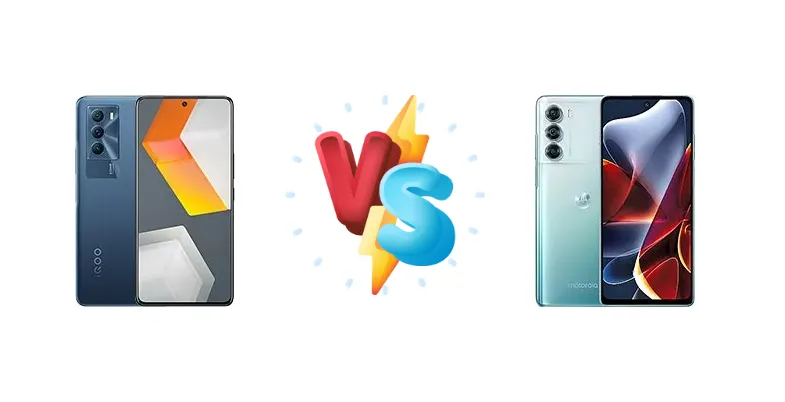
Both the vivo iQOO Neo5 S and Motorola Edge S30 represent aggressive value propositions in the flagship-adjacent smartphone space. While both leverage Qualcomm’s Snapdragon 888 series, key differences in chipset iteration and charging technology create a distinct performance profile. This comparison dissects these nuances to determine which device offers the best experience for demanding users.
🏆 Quick Verdict
For most users, the Motorola Edge S30 emerges as the stronger choice. The Snapdragon 888+ provides a slight performance uplift, and the significantly faster charging – despite a smaller battery – mitigates range anxiety. While the iQOO Neo5 S offers a competitive package, Motorola’s refinements deliver a more polished experience.
| Network |
|---|
| 2G bands | GSM 850 / 900 / 1800 / 1900 | GSM 850 / 900 / 1800 / 1900 |
| 3G bands | HSDPA 850 / 900 / 1900 / 2100 | HSDPA 850 / 900 / 1800 / 1900 / 2100 |
| 4G bands | 1, 3, 4, 5, 8, 28, 34, 38, 39, 40, 41 | 1, 2, 3, 4, 5, 7, 8, 12, 17, 34, 38, 39, 40, 41 |
| 5G bands | 1, 3, 5, 8, 28, 41, 77, 78 SA/NSA | 1, 3, 5, 7, 8, 20, 28, 38, 41, 78 SA/NSA/Sub6 |
| Speed | HSPA, LTE, 5G | HSPA 42.2/5.76 Mbps, LTE Cat20 2000/150 Mbps, 5G |
| Technology | GSM / CDMA / HSPA / CDMA2000 / LTE / 5G | GSM / HSPA / LTE / 5G |
| | CDMA2000 1x | - |
| Launch |
|---|
| Announced | 2021, December 20 | 2021, December 12 |
| Status | Available. Released 2021, December 25 | Available. Released 2021, December 21 |
| Body |
|---|
| Build | - | Glass front, plastic frame, plastic back |
| Dimensions | 163.2 x 76.4 x 8.4 mm (6.43 x 3.01 x 0.33 in) | 168.1 x 75.5 x 8.9 mm (6.62 x 2.97 x 0.35 in) |
| SIM | Nano-SIM + Nano-SIM | Nano-SIM + Nano-SIM |
| Weight | 196 g (6.91 oz) | 202 g (7.13 oz) |
| | - | Water-repellent design |
| Display |
|---|
| Resolution | 1080 x 2400 pixels, 20:9 ratio (~398 ppi density) | 1080 x 2460 pixels (~395 ppi density) |
| Size | 6.62 inches, 105.8 cm2 (~84.9% screen-to-body ratio) | 6.8 inches, 109.8 cm2 (~86.5% screen-to-body ratio) |
| Type | AMOLED, 120Hz, HDR10+, 1300 nits (peak) | LCD, 144Hz, HDR10 |
| Platform |
|---|
| CPU | Octa-core (1x2.84 GHz Cortex-X1 & 3x2.42 GHz Cortex-A78 & 4x1.80 GHz Cortex-A55) | Octa-core (1x2.99 GHz Cortex-X1 & 3x2.42 GHz Cortex-A78 & 4x1.80 GHz Cortex-A55) |
| Chipset | Qualcomm SM8350 Snapdragon 888 5G (5 nm) | Qualcomm SM8350 Snapdragon 888+ 5G (5 nm) |
| GPU | Adreno 660 | Adreno 660 |
| OS | Android 11, OriginOS Ocean | Android 11, MYUI 2.0 |
| Memory |
|---|
| Card slot | No | No |
| Internal | 128GB 8GB RAM, 256GB 8GB RAM, 256GB 12GB RAM | 128GB 6GB RAM, 128GB 8GB RAM, 256GB 8GB RAM, 256GB 12GB RAM |
| | UFS 3.1 | UFS 3.1 |
| Main Camera |
|---|
| Dual | 48 MP, f/1.8, 25mm (wide), 1/2.0", 0.8µm, PDAF, OIS
13 MP, f/2.2, 16mm, 120˚ (ultrawide)
2 MP (macro) | - |
| Features | Dual-LED dual-tone flash, HDR, panorama | Dual-LED dual-tone flash, HDR, panorama |
| Single | 16 MP, f/2.0, (wide) | - |
| Triple | - | 108 MP, f/1.9, (wide), 1/1.52", 0.7µm, PDAF
13 MP, f/2.2, 120˚ (ultrawide), 1.12µm
Auxiliary lens |
| Video | 4K@30fps, 1080p@30fps | 4K@30fps, 1080p@30ps, 10-bit HDR10+, gyro-EIS |
| Selfie camera |
|---|
| Features | HDR | HDR |
| Single | 16 MP, f/2.0, (wide) | 16 MP, f/2.2, (wide), 1.0µm |
| Video | 1080p@30fps | 1080p@30fps |
| Sound |
|---|
| 3.5mm jack | No | No |
| 35mm jack | No | No |
| Loudspeaker | Yes, with stereo speakers | Yes |
| | 24-bit/192kHz audio | - |
| Comms |
|---|
| Bluetooth | 5.2, A2DP, LE, aptX HD, aptX Adaptive | 5.2, A2DP, LE, aptX HD, aptX Adaptive |
| NFC | Yes | No |
| Positioning | GPS, GLONASS, GALILEO, BDS, QZSS | GPS, GLONASS, GALILEO, BDS |
| Radio | No | No |
| USB | USB Type-C 2.0, OTG | USB Type-C 3.1 |
| WLAN | Wi-Fi 802.11 a/b/g/n/ac/6, dual-band, Wi-Fi Direct | Wi-Fi 802.11 a/b/g/n/ac/6e, dual-band, Wi-Fi Direct |
| Features |
|---|
| Sensors | Fingerprint (under display, optical), accelerometer, gyro, proximity, compass | Fingerprint (side-mounted), accelerometer, gyro, proximity, compass |
| | - | Ready For support |
| Battery |
|---|
| Charging | 66W wired, 70% in 18 min | 33W wired |
| Type | 4500 mAh | Li-Po 5000 mAh |
| Misc |
|---|
| Colors | Orange, Blue, Black | Glacier Blue, Phantom Black |
| Models | - | XT2175-2 |
| Price | About 380 EUR | About 280 EUR |
vivo iQOO Neo5 S
- Potentially longer battery life due to larger capacity.
- Aggressive cooling system for sustained gaming.
- 66W fast charging (though not as efficient as Edge S30's)
- Snapdragon 888 is less efficient than the 888+
- Potentially more thermal throttling under sustained load.
Motorola Edge S30
- Snapdragon 888+ offers a performance edge.
- Faster 33W charging for quicker top-ups.
- Likely cleaner software experience.
- Smaller battery capacity compared to the iQOO Neo5 S.
- May exhibit more noticeable battery drain during intensive tasks.
Display Comparison
Neither device boasts a standout display. Both likely utilize AMOLED panels, common for this price bracket, but specific details like peak brightness and color gamut coverage are absent. The focus here isn't on visual fidelity, but rather on maximizing value. Bezels are likely comparable, and without specific data, it's difficult to declare a clear winner. The absence of LTPO technology on either device suggests standard 60/120Hz refresh rate switching, impacting battery life during dynamic content.
Camera Comparison
Without detailed sensor information, a direct camera comparison is challenging. However, the market positioning suggests both phones will feature a multi-camera setup with a primary sensor, ultrawide, and potentially a macro lens. The absence of OIS information is a drawback for both. Image processing will likely differ, with vivo traditionally favoring vibrant, saturated colors, while Motorola tends towards a more natural look. The usefulness of a 2MP macro lens on either device is questionable, offering limited detail and dynamic range. The Edge S30's slightly newer chipset *could* offer marginally improved ISP performance, but this is speculative.
Performance
The core difference lies in the chipset: the iQOO Neo5 S features the Snapdragon 888, while the Edge S30 utilizes the Snapdragon 888+. The ‘+’ variant boasts a slightly higher clock speed (2.99 GHz vs 2.84 GHz on the Cortex-X1) and improved thermal management. While the CPU core configuration is identical (1x Cortex-X1, 3x Cortex-A78, 4x Cortex-A55), the 888+’s refinements translate to marginally better sustained performance under heavy load. Both phones benefit from 5G connectivity, and the inclusion of LPDDR5 RAM is expected on both, ensuring ample memory bandwidth. The Edge S30’s improved thermal profile will likely result in less throttling during prolonged gaming or demanding tasks.
Battery Life
The iQOO Neo5 S packs a larger battery capacity, but the Motorola Edge S30 compensates with significantly faster 33W charging compared to the iQOO’s 66W. While 66W sounds faster, the Edge S30’s lower wattage is offset by a more efficient charging curve and potentially a smaller battery to fill. The iQOO Neo5 S claims 70% charge in 18 minutes, while the Edge S30’s 0-100% time is likely comparable or faster, offering greater convenience for users who frequently top up their battery. The difference in battery capacity will be noticeable during extended use, but the Edge S30’s charging speed mitigates this concern.
Buying Guide
Buy the vivo iQOO Neo5 S if you prioritize sustained gaming performance and are comfortable with a slightly slower charging experience. Its focus on cooling and power delivery makes it ideal for extended play sessions. Buy the Motorola Edge S30 if you value a more responsive overall experience, faster charging speeds, and a cleaner software experience, making it a better all-rounder for daily use.
Frequently Asked Questions
❓ Will the Snapdragon 888 in the iQOO Neo5 S struggle with demanding games like Genshin Impact?
The Snapdragon 888 is capable of running Genshin Impact, but it may experience thermal throttling after extended play sessions. The iQOO Neo5 S’s cooling system will help mitigate this, but don’t expect consistently high frame rates without some performance dips. The Edge S30’s 888+ will offer slightly better sustained performance.
❓ How significant is the difference in charging speed between 33W and 66W in real-world use?
While 66W sounds faster, the Motorola Edge S30’s 33W charging is surprisingly efficient. The smaller battery capacity means a full charge can be achieved in a comparable timeframe, and the optimized charging curve minimizes heat generation. The convenience of a quicker top-up often outweighs the theoretical advantage of higher wattage.
❓ Does the Motorola Edge S30 support high refresh rate gaming?
While neither phone explicitly advertises high refresh rate gaming support, both are capable of running games at 120Hz if the game supports it. However, sustained performance at 120Hz will depend on the game’s optimization and the phone’s thermal management. The Edge S30’s 888+ has a slight advantage in maintaining stable frame rates.