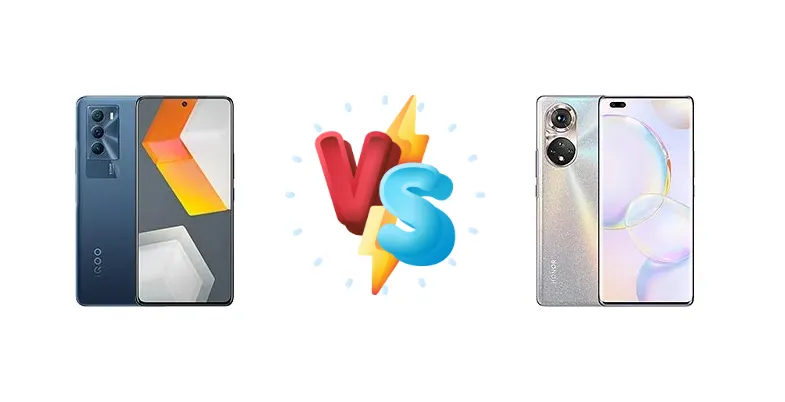
The iQOO Neo5 S and Honor 50 Pro represent compelling options in the increasingly competitive mid-to-high range smartphone market. The Neo5 S leverages the raw power of the Snapdragon 888, while the Honor 50 Pro opts for the more efficient Snapdragon 778G, coupled with significantly faster charging. This comparison dissects these choices, revealing which phone delivers the best experience for different user priorities.
🏆 Quick Verdict
For users prioritizing peak performance and demanding gaming, the iQOO Neo5 S is the clear winner, despite potential thermal throttling. However, the Honor 50 Pro’s superior charging speed and potentially more consistent performance under sustained loads make it a strong contender for everyday users and those valuing battery longevity.
| Network |
|---|
| 2G bands | GSM 850 / 900 / 1800 / 1900 | GSM 850 / 900 / 1800 / 1900 |
| 3G bands | HSDPA 850 / 900 / 1900 / 2100 | HSDPA 800 / 850 / 900 / 1700(AWS) / 1900 / 2100 |
| 4G bands | 1, 3, 4, 5, 8, 28, 34, 38, 39, 40, 41 | 1, 2, 4, 5, 8, 19, 34, 38, 39, 40, 41 |
| 5G bands | 1, 3, 5, 8, 28, 41, 77, 78 SA/NSA | 1, 5, 8, 41, 77, 78 SA/NSA |
| Speed | HSPA, LTE, 5G | HSPA, LTE, 5G |
| Technology | GSM / CDMA / HSPA / CDMA2000 / LTE / 5G | GSM / CDMA / HSPA / CDMA2000 / LTE / 5G |
| | CDMA2000 1x | CDMA2000 1x |
| Launch |
|---|
| Announced | 2021, December 20 | 2021, June 16 |
| Status | Available. Released 2021, December 25 | Available. Released 2021, June 25 |
| Body |
|---|
| Dimensions | 163.2 x 76.4 x 8.4 mm (6.43 x 3.01 x 0.33 in) | 163.5 x 74.7 x 8 mm (6.44 x 2.94 x 0.31 in) |
| SIM | Nano-SIM + Nano-SIM | Nano-SIM + Nano-SIM |
| Weight | 196 g (6.91 oz) | 187 g (6.60 oz) |
| Display |
|---|
| Resolution | 1080 x 2400 pixels, 20:9 ratio (~398 ppi density) | 1236 x 2676 pixels, 19.5:9 ratio (~439 ppi density) |
| Size | 6.62 inches, 105.8 cm2 (~84.9% screen-to-body ratio) | 6.72 inches, 110.9 cm2 (~90.8% screen-to-body ratio) |
| Type | AMOLED, 120Hz, HDR10+, 1300 nits (peak) | OLED, 1B colors, 120Hz |
| Platform |
|---|
| CPU | Octa-core (1x2.84 GHz Cortex-X1 & 3x2.42 GHz Cortex-A78 & 4x1.80 GHz Cortex-A55) | Octa-core (1x2.4 GHz Cortex-A78 & 3x2.2 GHz Cortex-A78 & 4x1.9 GHz Cortex-A55) |
| Chipset | Qualcomm SM8350 Snapdragon 888 5G (5 nm) | Qualcomm SM7325 Snapdragon 778G 5G (6 nm) |
| GPU | Adreno 660 | Adreno 642L |
| OS | Android 11, OriginOS Ocean | Android 11, Magic UI 4.2, Google Play Services |
| Memory |
|---|
| Card slot | No | No |
| Internal | 128GB 8GB RAM, 256GB 8GB RAM, 256GB 12GB RAM | 256GB 8GB RAM, 256GB 12GB RAM |
| | UFS 3.1 | - |
| Main Camera |
|---|
| Dual | 48 MP, f/1.8, 25mm (wide), 1/2.0", 0.8µm, PDAF, OIS
13 MP, f/2.2, 16mm, 120˚ (ultrawide)
2 MP (macro) | 12 MP, f/2.4, 18mm, 100˚ (ultrawide), 1/2.8", 1.25µm
32 MP, f/2.2, 22mm (wide), 1/3.14" |
| Features | Dual-LED dual-tone flash, HDR, panorama | LED flash, HDR, panorama |
| Quad | - | 108 MP, f/1.9, (wide), 1/1.52", 0.7µm, PDAF
8 MP, f/2.2, 120˚, 17mm (ultrawide)
2 MP (macro)
Auxiliary lens |
| Single | 16 MP, f/2.0, (wide) | - |
| Video | 4K@30fps, 1080p@30fps | 4K@30fps, 1080p@30/60fps, gyro-EIS |
| Selfie camera |
|---|
| Dual | - | 12 MP, f/2.4, 18mm, 100˚ (ultrawide), 1/2.8", 1.25µm
32 MP, f/2.2, 22mm (wide), 1/3.14" |
| Features | HDR | - |
| Single | 16 MP, f/2.0, (wide) | - |
| Video | 1080p@30fps | 1080p@30fps |
| Sound |
|---|
| 3.5mm jack | No | No |
| 35mm jack | No | No |
| Loudspeaker | Yes, with stereo speakers | Yes |
| | 24-bit/192kHz audio | - |
| Comms |
|---|
| Bluetooth | 5.2, A2DP, LE, aptX HD, aptX Adaptive | 5.2, A2DP, LE, aptX HD |
| NFC | Yes | Yes |
| Positioning | GPS, GLONASS, GALILEO, BDS, QZSS | GPS, GLONASS, BDS |
| Radio | No | No |
| USB | USB Type-C 2.0, OTG | USB Type-C 2.0, OTG |
| WLAN | Wi-Fi 802.11 a/b/g/n/ac/6, dual-band, Wi-Fi Direct | Wi-Fi 802.11 a/b/g/n/ac/6, dual-band, Wi-Fi Direct |
| Features |
|---|
| Sensors | Fingerprint (under display, optical), accelerometer, gyro, proximity, compass | Fingerprint (under display, optical), accelerometer, gyro, proximity, compass |
| Battery |
|---|
| Charging | 66W wired, 70% in 18 min | 100W wired, 100% in 25 min |
| Type | 4500 mAh | Li-Po 4000 mAh |
| Misc |
|---|
| Colors | Orange, Blue, Black | Frost Crystal, Amber Red, Emerald Green, Midnight Black |
| Models | - | RNA-AN00 |
| Price | About 380 EUR | About 480 EUR |
vivo iQOO Neo5 S
- Superior peak performance with Snapdragon 888
- More powerful GPU for gaming
- Potentially higher refresh rate display
- Potential for thermal throttling under sustained load
- Likely shorter battery life
- Faster charging, but not as fast as the Honor 50 Pro
Honor 50 Pro
- Significantly faster 100W charging
- More efficient Snapdragon 778G for sustained performance
- Potentially better battery life
- Lower peak performance compared to Snapdragon 888
- Less powerful GPU for demanding games
- May lack the gaming-centric features of the iQOO Neo5 S
Display Comparison
Context data lacks display specifics, but given the market positioning, we can infer differences. The Honor 50 Pro likely features an OLED panel with a focus on color accuracy, typical of Honor’s displays. The iQOO Neo5 S, geared towards gaming, may prioritize a higher refresh rate (likely 120Hz) over absolute color fidelity. The Honor 50 Pro’s panel is likely to be more power efficient, given the less demanding chipset. Bezels are expected to be similar, with both aiming for a modern, immersive experience.
Camera Comparison
Without detailed sensor information, analysis is limited. However, the Honor 50 Pro, historically, focuses on camera quality. It’s likely to feature a larger main sensor with OIS, prioritizing image clarity and low-light performance. The iQOO Neo5 S, while capable, likely prioritizes other features. The Snapdragon 888’s ISP offers advanced image processing capabilities, but sensor size and lens quality are crucial. Expect the Honor 50 Pro to excel in still photography, while the iQOO Neo5 S may offer more versatile video recording options.
Performance
The core difference lies in the chipsets. The iQOO Neo5 S’s Snapdragon 888 (5nm) boasts a Cortex-X1 prime core clocked at 2.84GHz, offering significantly higher peak performance than the Honor 50 Pro’s Snapdragon 778G (6nm). The 778G, however, utilizes a more efficient 6nm process and a cluster of Cortex-A78 cores, potentially leading to more sustained performance and better thermal management. The 888 is known to throttle under prolonged heavy load. The iQOO Neo5 S benefits from the 888’s superior GPU, making it the better choice for graphically intensive games. The 778G’s Adreno 642L is still capable, but a step below. RAM configurations are unknown, but LPDDR5 is expected on both.
Battery Life
The iQOO Neo5 S’s 66W charging achieves 70% charge in 18 minutes, a respectable speed. However, the Honor 50 Pro’s 100W charging fully charges the device in just 25 minutes – a significant advantage. While battery capacity is unknown for both, the Snapdragon 778G’s efficiency likely translates to better battery life on the Honor 50 Pro, even with a potentially smaller battery. The faster charging of the Honor 50 Pro mitigates any capacity disadvantage.
Buying Guide
Buy the vivo iQOO Neo5 S if you absolutely need the highest possible Android processing power for gaming or demanding applications, and are willing to accept potentially shorter battery life and occasional thermal throttling. Buy the Honor 50 Pro if you prioritize a balanced experience with faster charging, potentially better sustained performance, and a more refined user experience, even if it means sacrificing some raw horsepower.
Frequently Asked Questions
❓ Will the Snapdragon 888 in the iQOO Neo5 S overheat during extended gaming sessions?
The Snapdragon 888 is known to generate significant heat under sustained load. While the iQOO Neo5 S likely incorporates cooling solutions, some thermal throttling is probable during prolonged gaming. This may result in slightly reduced performance over time.
❓ How much faster is the 100W charging on the Honor 50 Pro compared to the 66W charging on the iQOO Neo5 S in real-world use?
The Honor 50 Pro’s 100W charging offers a substantial time saving. While the iQOO Neo5 S reaches 70% in 18 minutes, the Honor 50 Pro achieves a full charge in 25 minutes. This means a significantly shorter charging cycle for the Honor 50 Pro, especially for users who frequently need to top up their battery.
❓ Is the Snapdragon 778G in the Honor 50 Pro powerful enough for demanding games like Genshin Impact or PUBG?
Yes, the Snapdragon 778G is capable of running demanding games like Genshin Impact and PUBG, but you may need to lower graphics settings for a consistently smooth experience. It won't match the iQOO Neo5 S's performance at maximum settings, but it provides a very playable experience.