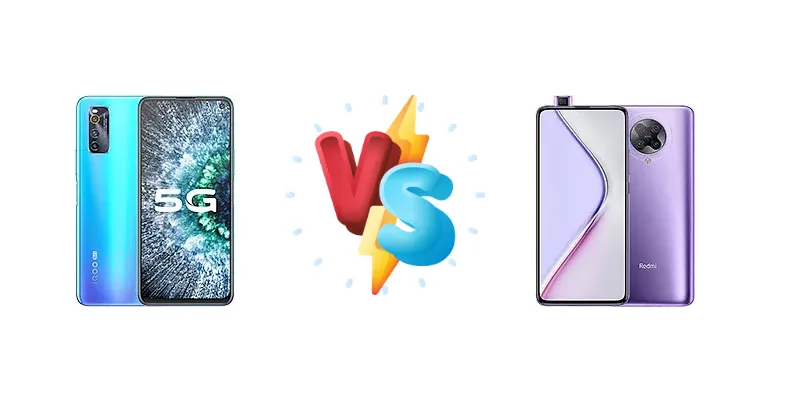
Both the vivo iQOO Neo3 5G and the Xiaomi Redmi K30 Pro Zoom represent a sweet spot in the smartphone market – flagship-level performance from the Snapdragon 865 at a more accessible price point. Released around the same time, they target power users seeking a smooth experience for gaming, multitasking, and 5G connectivity. This comparison dissects their key differences to help you choose the right device.
🏆 Quick Verdict
For the average user prioritizing rapid charging and potentially slightly better sustained performance, the vivo iQOO Neo3 5G emerges as the winner. Its 44W charging significantly reduces downtime compared to the Redmi K30 Pro Zoom’s 33W, and while both share the same chipset, the iQOO’s cooling may offer a slight edge in prolonged gaming.
| Network |
|---|
| 2G bands | GSM 850 / 900 / 1800 / 1900 | GSM 850 / 900 / 1800 / 1900 |
| 3G bands | HSDPA 850 / 900 / 1700(AWS) / 1900 / 2100 | HSDPA 850 / 900 / 1900 / 2100 |
| 4G bands | 1, 2, 3, 4, 5, 8, 18, 19, 25, 26, 34, 38, 39, 40, 41 | 1, 3, 5, 7, 8, 34, 38, 39, 40, 41 |
| 5G bands | 1, 3, 41, 77, 78 SA/NSA | 1, 3, 41, 78, 79 SA/NSA |
| Speed | HSPA, LTE, 5G (3.3 Gbps DL) | HSPA, LTE, 5G |
| Technology | GSM / CDMA / HSPA / LTE / 5G | GSM / CDMA / HSPA / EVDO / LTE / 5G |
| | CDMA 800 / 1900 & TD-SCDMA | CDMA2000 1xEV-DO |
| Launch |
|---|
| Announced | 2020, April 23. Released 2020, April 29 | 2020, March 24. Released 2020, April 04 |
| Status | Discontinued | Discontinued |
| Body |
|---|
| Build | - | Glass front (Gorilla Glass 5), glass back (Gorilla Glass 5), aluminum frame |
| Dimensions | 163.7 x 75.6 x 8.9 mm (6.44 x 2.98 x 0.35 in) | 163.3 x 75.4 x 8.9 mm (6.43 x 2.97 x 0.35 in) |
| SIM | Nano-SIM + Nano-SIM | Nano-SIM + Nano-SIM |
| Weight | 198.1 g (6.98 oz) | 218 g (7.69 oz) |
| Display |
|---|
| Protection | - | Corning Gorilla Glass 5 |
| Resolution | 1080 x 2408 pixels, 20:9 ratio (~402 ppi density) | 1080 x 2400 pixels, 20:9 ratio (~395 ppi density) |
| Size | 6.57 inches, 104.0 cm2 (~84.0% screen-to-body ratio) | 6.67 inches, 107.4 cm2 (~87.2% screen-to-body ratio) |
| Type | IPS LCD, 144Hz, HDR10 | Super AMOLED, HDR10+, 500 nits (typ) |
| Platform |
|---|
| CPU | Octa-core (1x2.84 GHz Cortex-A77 & 3x2.42 GHz Cortex-A77 & 4x1.80 GHz Cortex-A55) | Octa-core (1x2.84 GHz Cortex-A77 & 3x2.42 GHz Cortex-A77 & 4x1.80 GHz Cortex-A55) |
| Chipset | Qualcomm SM8250 Snapdragon 865 5G (7 nm+) | Qualcomm SM8250 Snapdragon 865 5G (7 nm+) |
| GPU | Adreno 650 | Adreno 650 |
| OS | Android 10, iQOO UI 1.0 | Android 10, MIUI 11 |
| Memory |
|---|
| Card slot | No | No |
| Internal | 128GB 6GB RAM, 128GB 8GB RAM, 128GB 12GB RAM, 256GB 8GB RAM | 128GB 8GB RAM, 256GB 8GB RAM, 512GB 12GB RAM |
| | UFS 3.1 | UFS 3.1 |
| Main Camera |
|---|
| Features | LED flash, HDR, panorama | Dual-LED dual-tone flash, HDR, panorama |
| Quad | - | 64 MP, 26mm (wide), 1/1.72", 0.8µm, PDAF, OIS
8 MP, (telephoto), PDAF, OIS, 3x optical zoom
13 MP, 13mm (ultrawide)
Auxiliary lens |
| Triple | 48 MP, f/1.8, 26mm (wide), 1/2.0", 0.8µm, PDAF
8 MP, f/2.2, 16mm (ultrawide), 1/4.0", 1.12µm
2 MP (macro) | - |
| Video | 4K@30fps, 1080p@30fps; gyro-EIS | 8K@24/30fps, 4K@30/60fps, 1080p@30/60/120/240fps, 1080p@960fps; gyro-EIS |
| Selfie camera |
|---|
| Features | HDR | HDR |
| Single | 16 MP, f/2.0, (wide) | Motorized pop-up 20 MP, (wide), 1/3.4", 0.8µm |
| Video | 1080p@30fps | 1080p@30fps |
| Sound |
|---|
| 3.5mm jack | Yes | Yes |
| 35mm jack | Yes | Yes |
| Loudspeaker | Yes | Yes |
| | 24-bit/192kHz audio | 24-bit/192kHz audio
|
| Comms |
|---|
| Bluetooth | 5.0, A2DP, LE, aptX HD | 5.1, A2DP, LE, aptX HD, aptX Adaptive |
| Infrared port | - | Yes |
| NFC | Yes | Yes |
| Positioning | GPS, GLONASS, BDS, GALILEO | GPS (L1+L5), GLONASS (G1), BDS (B1I+B2a), GALILEO (E1+E5a), QZSS (L1+L5) |
| Radio | No | No |
| USB | USB Type-C 2.0, OTG | USB Type-C 2.0, OTG |
| WLAN | Wi-Fi 802.11 a/b/g/n/ac/6, dual-band, Wi-Fi Direct | Wi-Fi 802.11 a/b/g/n/ac/6, dual-band, Wi-Fi Direct |
| Features |
|---|
| Sensors | Fingerprint (side-mounted), accelerometer, proximity, compass | Fingerprint (under display, optical), accelerometer, gyro, proximity, compass, barometer |
| Battery |
|---|
| Charging | 44W wired, 50% in 20 min, 100% in 58 min | 33W wired, PD, QC4, 100% in 63 min |
| Type | 4500 mAh | Li-Po 4700 mAh |
| Misc |
|---|
| Colors | Blue, Black/Dark Blue | Grey, Purple, White, Blue |
| Models | V1981A | - |
| Price | About 350 EUR | About 500 EUR |
vivo iQOO Neo3 5G
- Faster 44W charging significantly reduces downtime.
- Potentially better thermal management for sustained performance.
- iQOO’s gaming-focused brand suggests software optimizations for gamers.
- Camera system likely less versatile than the Redmi K30 Pro Zoom.
- Software experience (Funtouch OS) may not appeal to all users.
Xiaomi Redmi K30 Pro Zoom
- Potentially more versatile camera system with possible optical zoom.
- MIUI offers a wide range of customization options.
- Power Delivery (PD) support for broader charger compatibility.
- Slower 33W charging adds to downtime.
- MIUI can be resource-intensive and include bloatware.
Display Comparison
Both devices utilize the Snapdragon 865’s capabilities for smooth visuals, but detailed display specs are missing. Given the market positioning, we can infer both likely feature high refresh rate AMOLED panels. The Redmi K30 Pro Zoom’s ‘Zoom’ moniker suggests a focus on display quality, potentially with higher peak brightness or color accuracy, but this remains unconfirmed. The absence of LTPO technology in either device means refresh rate scaling won’t be as power-efficient as newer flagships.
Camera Comparison
Camera details are sparse. Without sensor size or aperture information, a direct comparison is difficult. However, the Redmi K30 Pro Zoom’s name implies a more sophisticated camera system, potentially featuring a telephoto lens for optical zoom – a feature absent from the iQOO Neo3 5G based on its naming. Image processing styles will also differ; Xiaomi’s MIUI typically favors vibrant, saturated colors, while vivo’s software often aims for a more natural look. The presence of a 2MP macro camera on either device is largely irrelevant due to its limited sensor size and image quality.
Performance
At the heart of both phones lies the Qualcomm SM8250 Snapdragon 865 5G (7 nm+). The CPU configuration is identical – an octa-core setup with 1x2.84 GHz Cortex-A77, 3x2.42 GHz Cortex-A77, and 4x1.80 GHz Cortex-A55 cores. This means raw processing power will be nearly indistinguishable. However, thermal management is crucial. While both utilize the same chipset, iQOO’s brand focus on gaming suggests a more aggressive cooling solution, potentially mitigating thermal throttling during extended, demanding tasks. RAM configurations are not specified, but both likely offer LPDDR5 options for fast memory access.
Battery Life
The iQOO Neo3 5G boasts 44W wired charging, reaching 50% in 20 minutes and 100% in 58 minutes. The Redmi K30 Pro Zoom offers 33W wired charging with PD and QC4 support, taking 63 minutes to reach a full charge. This 5-minute difference may seem small, but it adds up over time. While battery capacity isn’t specified, the faster charging of the iQOO Neo3 5G effectively mitigates any potential capacity disadvantage. The inclusion of Power Delivery (PD) on the Redmi K30 Pro Zoom offers wider charger compatibility.
Buying Guide
Buy the vivo iQOO Neo3 5G if you need the fastest possible charging speeds and value a potentially more optimized thermal solution for extended gaming sessions. Buy the Xiaomi Redmi K30 Pro Zoom if you prefer a more understated design and potentially benefit from Xiaomi’s MIUI software features, accepting a slightly slower charging experience.
Frequently Asked Questions
❓ Will the Snapdragon 865 in either phone struggle with demanding games like Genshin Impact?
The Snapdragon 865 is capable of running Genshin Impact, but sustained performance depends heavily on thermal management. While both phones share the same chipset, the iQOO Neo3 5G’s potential for better cooling could lead to less throttling during extended gaming sessions, resulting in more consistent frame rates.
❓ Does the Redmi K30 Pro Zoom’s 33W charging feel significantly slower in real-world use?
While 33W is still considered fast charging, the 44W on the iQOO Neo3 5G provides a noticeable difference. Expect roughly 10-15 minutes less charging time to reach 100% with the iQOO, which can be significant for users who frequently need to top up their battery quickly.
❓ Are there significant differences in the software experience between Funtouch OS (iQOO) and MIUI (Xiaomi)?
Yes. Funtouch OS is often described as more minimalist, while MIUI is highly customizable and feature-rich. MIUI can sometimes feel bloated with pre-installed apps, whereas Funtouch OS prioritizes a cleaner interface. User preference plays a large role here.