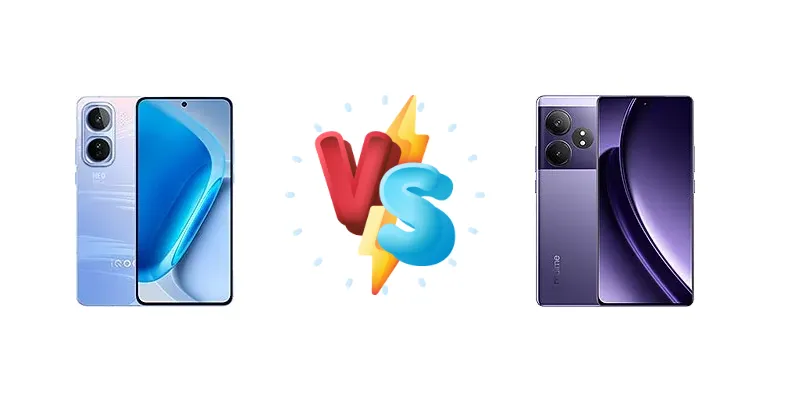
The iQOO Neo11 and Realme GT Neo6 represent a fascinating crossroads in the mid-range to upper-mid-range smartphone market. The iQOO Neo11, exclusive to China, boasts Qualcomm’s top-tier Snapdragon 8 Elite, while the globally available Realme GT Neo6 utilizes the Snapdragon 8s Gen 3. This comparison dissects which chipset delivers the best experience, alongside a detailed look at charging speeds, display quality, and overall value.
🏆 Quick Verdict
For users prioritizing raw performance and willing to navigate the China-exclusive market, the iQOO Neo11 with its Snapdragon 8 Elite is the winner. Its Oryon-based CPU offers a significant performance edge. However, the Realme GT Neo6 provides a compelling alternative with faster 120W charging and broader availability.
| Network |
|---|
| 2G bands | GSM 850 / 900 / 1800 / 1900 | GSM 850 / 900 / 1800 / 1900 |
| 3G bands | HSDPA 800 / 850 / 900 / 1700(AWS) / 1900 / 2100 | HSDPA 850 / 900 / 2100 |
| 4G bands | 1, 3, 4, 5, 7, 8, 18, 19, 26, 28, 34, 38, 39, 40, 41, 42, 43, 48, 66 | 1, 3, 5, 7, 8, 28, 34, 38, 39, 40, 41 |
| 5G bands | 1, 3, 5, 7, 8, 18, 26, 28, 38, 40, 41, 48, 66, 77, 78 SA/NSA | 1, 3, 5, 8, 28, 41, 77, 78 SA/NSA |
| Speed | HSPA, LTE, 5G | HSPA, LTE, 5G |
| Technology | GSM / HSPA / LTE / 5G | GSM / CDMA / HSPA / CDMA2000 / LTE / 5G |
| Launch |
|---|
| Announced | 2025, October 30 | 2024, May 09 |
| Status | Available. Released 2025, October 30 | Available. Released 2024, May 09 |
| Body |
|---|
| Build | Glass front, aluminum alloy frame, fiber-reinforced plastic back | - |
| Dimensions | 163.4 x 76.7 x 8.1 mm (6.43 x 3.02 x 0.32 in) | 162 x 75.1 x 8.7 mm (6.38 x 2.96 x 0.34 in) |
| SIM | Nano-SIM + Nano-SIM | Nano-SIM + Nano-SIM |
| Weight | 210 g or 216 g (7.41 oz) | 191 g (6.74 oz) |
| Display |
|---|
| Protection | Rock Glass | - |
| Resolution | 1440 x 3168 pixels (~510 ppi density) | 1264 x 2780 pixels (~450 ppi density) |
| Size | 6.82 inches, 113.0 cm2 (~90.2% screen-to-body ratio) | 6.78 inches, 111.7 cm2 (~91.8% screen-to-body ratio) |
| Type | LTPO AMOLED, 1B colors, 144Hz, 2592Hz PWM, HDR10+ | LTPO AMOLED, 1B colors, 120Hz, HDR, 1600 nits (HBM), 6000 nits (peak) |
| Platform |
|---|
| CPU | Octa-core (2x4.32 GHz Oryon V2 Phoenix L + 6x3.53 GHz Oryon V2 Phoenix M) | Octa-core (1x3.0 GHz Cortex-X4 & 4x2.8 GHz Cortex-A720 & 3x2.0 GHz Cortex-A520) |
| Chipset | Qualcomm SM8750-AC Snapdragon 8 Elite (3 nm) | Qualcomm SM8635 Snapdragon 8s Gen 3 (4 nm) |
| GPU | Adreno 830 | Adreno 735 |
| OS | Android 16, OriginOS 6 | Android 14, Realme UI 5.0 |
| Memory |
|---|
| Card slot | No | No |
| Internal | 256GB 12GB RAM, 256GB 16GB RAM, 512GB 12GB RAM, 512GB 16GB RAM, 1TB 16GB RAM | 256GB 12GB RAM, 256GB 16GB RAM, 512GB 16GB RAM, 1TB 16GB RAM |
| Main Camera |
|---|
| Dual | 50 MP, f/1.9, (wide), 1/1.56", PDAF, OIS
8 MP, f/2.2, 119˚ (ultrawide) | 50 MP, f/1.9, 26mm (wide), 1/1.95", PDAF, OIS
8 MP, f/2.2, 16mm, 112˚ (ultrawide), 1/4.0", 1.12µm |
| Features | LED flash, panorama, HDR | Color spectrum sensor, Dual-LED flash, HDR, panorama |
| Video | 8K, 4K, 1080p, gyro-EIS | 4K@30/60fps, 1080p@30/60/120fps |
| Selfie camera |
|---|
| Features | - | Panorama |
| Single | 16 MP, f/2.5, (wide) | 32 MP, f/2.5, 22mm (wide), 1/2.74" |
| Video | 1080p@30fps | 4K@30fps, 1080p@30fps |
| Sound |
|---|
| 35mm jack | No | No |
| Loudspeaker | Yes, with stereo speakers | Yes, with stereo speakers |
| Comms |
|---|
| Bluetooth | 5.4, A2DP, LE, aptX HD, aptX Adaptive, aptX Lossless, LHDC 5 | 5.4, A2DP, LE, aptX HD, LHDC |
| Infrared port | Yes | Yes |
| NFC | Yes | Yes |
| Positioning | GPS (L1+L5), GLONASS, BDS (B1I+B1c+B2a), GALILEO (E1+E5a), QZSS (L1+L5) | GPS (L1+L5), BDS (B1I+B1c+B2a), GALILEO (E1+E5a), QZSS (L1+L5), NavIC, GLONASS |
| Radio | No | No |
| USB | USB Type-C 2.0, OTG | USB Type-C 2.0 |
| WLAN | Wi-Fi 802.11 a/b/g/n/ac/6/7, dual-band | Wi-Fi 802.11 a/b/g/n/ac/6, dual-band |
| Features |
|---|
| Sensors | Fingerprint (under display, ultrasonic), accelerometer, gyro, proximity, compass | Fingerprint (under display, optical), accelerometer, gyro, proximity, compass |
| Battery |
|---|
| Charging | 100W wired, 44W UFCS, 55W PD3.0/PPS
Reverse wired | 120W wired, 50% in 10 min |
| Type | Si/C Li-Ion 7500 mAh | 5500 mAh |
| Misc |
|---|
| Colors | Black, White, Orange, Blue | Silver, Green, Purple |
| Models | V2520A | RMX3852 |
| Price | About 320 EUR | About 270 EUR |
vivo iQOO Neo11 (China)
- Superior CPU performance with Snapdragon 8 Elite
- Potentially better sustained performance due to 3nm process
- More versatile charging options (100W, UFCS, PD3.0/PPS)
- China-exclusive availability
- Potentially higher power consumption
- Software limitations due to regional restrictions
Realme GT Neo6
- Faster 120W wired charging
- Global availability
- More efficient Snapdragon 8s Gen 3
- Lower peak CPU performance compared to Snapdragon 8 Elite
- Less versatile charging options
- May throttle more under sustained load
Display Comparison
Neither device's display specifications are provided, so a direct comparison is limited. However, given the target market, both likely feature high refresh rate AMOLED panels. The Realme GT Neo6, being positioned as a more mainstream device, may prioritize color accuracy and viewing angles. The iQOO Neo11, geared towards enthusiasts, might offer a slightly higher peak brightness for HDR content. The absence of LTPO information suggests both may not have adaptive refresh rates, potentially impacting battery life during static content viewing.
Camera Comparison
Without sensor details, a definitive camera comparison is impossible. However, given the price points, both phones likely employ a primary sensor in the 50MP range. The iQOO Neo11, targeting enthusiasts, might prioritize image processing algorithms geared towards detail and dynamic range. The Realme GT Neo6 could focus on a more balanced, social media-friendly aesthetic. The presence or absence of Optical Image Stabilization (OIS) on the main sensor would be a significant differentiator, favoring the device that includes it for sharper images and smoother video. We can assume both will include ultrawide and macro lenses, but their quality is likely secondary to the main sensor.
Performance
The core difference lies in the chipsets. The iQOO Neo11’s Snapdragon 8 Elite (SM8750-AC) utilizes a 3nm process and Qualcomm’s Oryon V2 Phoenix CPU cores, clocked at up to 4.32 GHz. This architecture is designed for peak performance, potentially exceeding the Snapdragon 8s Gen 3 (SM8635) found in the Realme GT Neo6. The 8s Gen 3, built on a 4nm process, features a more conventional Cortex-X4 prime core at 3.0 GHz. While the 8s Gen 3 is efficient, the 8 Elite’s Oryon cores offer a substantial advantage in multi-threaded tasks and gaming. The iQOO Neo11 will likely exhibit superior sustained performance due to the more advanced manufacturing process and core design, though thermal management will be crucial. Both devices likely utilize LPDDR5x RAM, but the iQOO Neo11’s chipset could benefit more from faster memory bandwidth.
Battery Life
The Realme GT Neo6’s 120W wired charging is a clear advantage, promising a 50% charge in just 10 minutes. The iQOO Neo11 offers 100W wired charging, alongside 44W UFCS and 55W PD3.0/PPS, providing greater charging flexibility but slower peak speeds. While battery capacity isn’t specified, the iQOO Neo11’s more powerful chipset will likely consume more power, potentially offsetting any gains from its charging capabilities. The Realme GT Neo6’s faster charging is a significant convenience factor for users who frequently need to top up their battery quickly.
Buying Guide
Buy the vivo iQOO Neo11 (China) if you absolutely need the highest possible Android processing power for demanding games and applications, and are comfortable with importing a device and potential software limitations. Buy the Realme GT Neo6 if you prioritize fast charging, global availability, and a more balanced approach to performance and efficiency, making it ideal for everyday use and moderate gaming.
Frequently Asked Questions
❓ Will the Snapdragon 8s Gen 3 in the Realme GT Neo6 struggle with graphically intensive games like Genshin Impact?
The Snapdragon 8s Gen 3 is a capable chipset, but it won't match the iQOO Neo11's Snapdragon 8 Elite in demanding titles. Expect to play Genshin Impact at high settings, but you may need to lower graphics settings for consistently smooth frame rates, especially during prolonged gaming sessions. Thermal throttling could also become a factor.
❓ Is the iQOO Neo11's China-exclusive status a major drawback for international buyers?
Yes, it is. Importing the iQOO Neo11 involves potential import duties, warranty issues, and software limitations. The software may be entirely in Chinese, and Google Play Store support isn't guaranteed. While custom ROMs might become available, they are not officially supported and can void the warranty.
❓ How does the 44W UFCS charging on the iQOO Neo11 compare to standard PD charging?
UFCS (Universal Fast Charge Standard) is vivo's proprietary fast charging protocol. While the iQOO Neo11 also supports PD3.0/PPS, UFCS is designed to be more efficient and compatible with a wider range of chargers, including those from other brands. However, you'll achieve the fastest charging speeds with a UFCS-compatible charger.