
iQOO Neo10 Pro+ vs OnePlus 11R: A Head-to-Head Battle of Snapdragon Power
| Phones Images | |||||
|---|---|---|---|---|---|
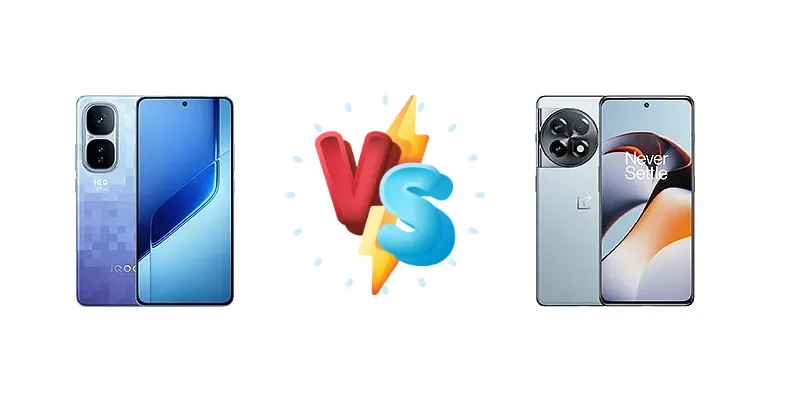
|
🏆 Quick Verdict
For users prioritizing raw processing power and the fastest charging speeds, the iQOO Neo10 Pro+ is the winner. However, the OnePlus 11R offers a more balanced package with wider availability, a proven thermal profile, and excellent value, making it the better choice for most global consumers.
| PHONES | ||
|---|---|---|
| Phone Names | vivo iQOO Neo10 Pro+ (China) | OnePlus 11R |
| Network | ||
|---|---|---|
| 2G bands | GSM 850 / 900 / 1800 / 1900 | GSM 850 / 900 / 1800 / 1900 |
| 3G bands | HSDPA 800 / 850 / 900 / 1700(AWS) / 1900 / 2100 | HSDPA 850 / 900 / 1700(AWS) / 2100 |
| 4G bands | 1, 3, 4, 5, 7, 8, 18, 19, 26, 28, 34, 38, 39, 40, 41, 42, 43, 48, 66 | 1, 3, 4, 5, 8, 28, 34, 38, 39, 40, 41 |
| 5G bands | 1, 3, 5, 7, 8, 18, 26, 28, 38, 40, 41, 48, 66, 77, 78 SA/NSA | 1, 3, 5, 8, 28, 40, 41, 77, 78 SA/NSA |
| Speed | HSPA, LTE, 5G | HSPA, LTE (3CA), 5G |
| Technology | GSM / HSPA / LTE / 5G | GSM / CDMA / HSPA / LTE / 5G |
| - | CDMA 800 | |
| Launch | ||
|---|---|---|
| Announced | 2025, May 20 | 2023, February 07 |
| Status | Available. Released 2025, May 20 | Available. Released 2023, February 21 |
| Body | ||
|---|---|---|
| Build | - | Glass front, glass back (Gorilla Glass 5), plastic frame |
| Dimensions | 163.8 x 76.6 x 8.2 mm (6.45 x 3.02 x 0.32 in) | 163.4 x 74.3 x 8.7 mm (6.43 x 2.93 x 0.34 in) |
| SIM | Nano-SIM + Nano-SIM | Nano-SIM + Nano-SIM |
| Weight | 212 g or 217 g (7.48 oz) | 204 g (7.20 oz) |
| Display | ||
|---|---|---|
| Resolution | 1440 x 3168 pixels (~510 ppi density) | 1240 x 2772 pixels, 20:9 ratio (~451 ppi density) |
| Size | 6.82 inches, 113.0 cm2 (~90.1% screen-to-body ratio) | 6.74 inches, 109.2 cm2 (~90.0% screen-to-body ratio) |
| Type | LTPO AMOLED, 1B colors, 144Hz, HDR10+, 1800 nits (HBM), 4500 nits (peak) | Fluid AMOLED, 1B colors, 120Hz, HDR10+, 1450 nits (peak) |
| Platform | ||
|---|---|---|
| CPU | Octa-core (2x4.32 GHz Oryon V2 Phoenix L + 6x3.53 GHz Oryon V2 Phoenix M) | Octa-core (1x3.0 GHz Cortex-X2 & 3x2.5 GHz Cortex-A710 & 4x1.80 GHz Cortex-A510) |
| Chipset | Qualcomm SM8750-AB Snapdragon 8 Elite (3 nm) | Qualcomm SM8475 Snapdragon 8+ Gen 1 (4 nm) |
| GPU | Adreno 830 | Adreno 730 |
| OS | Android 15, OriginOS 5 | Android 13, upgradable to Android 15, OxygenOS 15 |
| Memory | ||
|---|---|---|
| Card slot | No | No |
| Internal | 256GB 12GB RAM, 256GB 16GB RAM, 512GB 12GB RAM, 512GB 16GB RAM, 1TB 16GB RAM | 128GB 8GB RAM, 256GB 16GB RAM, 512GB 18GB RAM |
| - | UFS 3.1 | |
| Main Camera | ||
|---|---|---|
| Dual | 50 MP, f/1.9, 23mm (wide), PDAF, OIS 8 MP, f/2.2, (ultrawide), AF | - |
| Features | LED flash, panorama, HDR | Color spectrum sensor, LED flash, HDR, panorama |
| Single | - | 16 MP, f/2.4, 24mm (wide), 1/3.09", 1.0µm |
| Triple | - | 50 MP, f/1.8, 24mm (wide), 1/1.56", 1.0µm, multi-directional PDAF, OIS 8 MP, f/2.2, 120˚ (ultrawide), 1/4.0", 1.12µm 2 MP (macro) |
| Video | 8K, 4K, 1080p, gyro-EIS | 4K@30/60fps, 1080p@30/60/240fps, gyro-EIS |
| Selfie camera | ||
|---|---|---|
| Features | - | HDR |
| Single | 16 MP, f/2.5, (wide) | 16 MP, f/2.4, 24mm (wide), 1/3.09", 1.0µm |
| Video | 1080p@30fps | 1080p@30fps |
| Sound | ||
|---|---|---|
| 3.5mm jack | - | No |
| 35mm jack | No | No |
| Loudspeaker | Yes, with stereo speakers (closed type) | Yes, with stereo speakers |
| - | 24-bit/192kHz audio | |
| Comms | ||
|---|---|---|
| Bluetooth | 5.4, A2DP, LE, aptX HD, aptX Adaptive, aptX Lossless, LHDC 5 | 5.3, A2DP, LE, aptX HD |
| Infrared port | Yes | Yes |
| NFC | Yes | Yes |
| Positioning | GPS (L1+L5), GLONASS, BDS (B1I+B1c+B2a), GALILEO (E1+E5a), QZSS (L1+L5) | GPS (L1+L5), GLONASS (G1), BDS (B1I+B1c+B2a), GALILEO (E1+E5a), QZSS (L1+L5) |
| Radio | No | No |
| USB | USB Type-C 2.0, OTG | USB Type-C 2.0 |
| WLAN | Wi-Fi 802.11 a/b/g/n/ac/6/7, dual-band | Wi-Fi 802.11 a/b/g/n/ac/6, dual-band |
| Features | ||
|---|---|---|
| Sensors | Fingerprint (under display, ultrasonic), accelerometer, gyro, proximity, compass | Fingerprint (under display, optical), accelerometer, gyro, proximity, compass |
| Battery | ||
|---|---|---|
| Charging | 120W wired, 100W PPS+PD, 70% in 25 min Reverse wired | 100W wired |
| Type | Si/C Li-Ion 6800 mAh | Li-Po 5000 mAh |
| Misc | ||
|---|---|---|
| Colors | Black, White, Blue | Galactic Silver, Sonic Black, Solar Red |
| Models | - | CPH2487 |
| Price | About 350 EUR | About 600 EUR |
| SAR | - | 1.16 W/kg (head) 0.61 W/kg (body) |
vivo iQOO Neo10 Pro+ (China)
- Cutting-edge Snapdragon 8 Elite chipset
- Ultra-fast 120W wired charging
- Potential for superior gaming performance
- Supports 100W PPS+PD and reverse wired charging
- China-exclusive, limited availability
- Potential thermal throttling concerns
- Camera specs currently unknown
- Software may require navigating China-specific features
OnePlus 11R
- Proven Snapdragon 8+ Gen 1 performance
- Excellent thermal management
- Globally available with OxygenOS support
- Competitive price point
- Slightly older chipset compared to the 8 Elite
- 100W charging is slower than iQOO's 120W
- Macro camera is of limited utility
- May not match the iQOO's peak performance in demanding tasks
Display Comparison
While specific display details for the iQOO Neo10 Pro+ are missing, it's reasonable to expect a high refresh rate AMOLED panel given its positioning. The OnePlus 11R features a 6.72-inch 120Hz AMOLED display. The key differentiator lies under the hood: the iQOO’s chipset may allow for more sophisticated display processing, potentially leading to smoother animations. However, without knowing the iQOO’s peak brightness or PWM dimming rate, it’s difficult to definitively declare a winner. The OnePlus 11R’s display is known for its color accuracy and good outdoor visibility.
Camera Comparison
Details regarding the iQOO Neo10 Pro+'s camera system are currently unavailable. The OnePlus 11R features a 50MP Sony IMX890 main sensor with OIS, an 8MP ultrawide, and a 2MP macro lens. While the 2MP macro is largely inconsequential, the IMX890 delivers excellent image quality in various lighting conditions. The iQOO’s potential advantage lies in its image signal processor (ISP) integrated within the Snapdragon 8 Elite, which could offer improved noise reduction and dynamic range. However, without knowing the sensor size and lens aperture of the iQOO, it’s impossible to assess its camera capabilities accurately. The OnePlus 11R’s consistent performance and OIS give it a current edge.
Performance
The iQOO Neo10 Pro+’s Snapdragon 8 Elite, built on a 3nm process, represents a significant leap in efficiency and performance over the OnePlus 11R’s 4nm Snapdragon 8+ Gen 1. The 8 Elite’s Oryon V2 Phoenix cores (2x4.32 GHz + 6x3.53 GHz) promise substantial gains in both single-core and multi-core workloads compared to the 8+ Gen 1’s (1x3.0 GHz Cortex-X2 + 3x2.5 GHz Cortex-A710 + 4x1.80 GHz Cortex-A510). This translates to faster app loading, smoother multitasking, and higher frame rates in demanding games. However, the 8+ Gen 1 is a mature platform with excellent thermal management, while the 8 Elite’s thermal performance remains to be seen in real-world sustained loads. The iQOO’s potential for higher sustained performance is offset by the uncertainty of its cooling solution.
Battery Life
The OnePlus 11R packs a 5000mAh battery and supports 100W wired charging, achieving a full charge in approximately 25 minutes. The iQOO Neo10 Pro+ boasts an even faster 120W wired charging, claiming 70% charge in just 25 minutes, and also supports 100W PPS+PD and reverse wired charging. While the iQOO’s charging speed is undeniably faster, the OnePlus 11R’s 5000mAh battery provides ample endurance for a full day of moderate use. The Snapdragon 8 Elite’s improved efficiency *could* offset the potential battery drain from its higher performance, but real-world testing is crucial to confirm this.
Buying Guide
Buy the vivo iQOO Neo10 Pro+ (China) if you absolutely need the bleeding edge in mobile processing power, particularly if you're a demanding gamer or content creator and can navigate the China-specific software and import challenges. Buy the OnePlus 11R if you prefer a refined, globally-supported experience with excellent performance, fast charging, and a more predictable thermal profile, all at a competitive price.