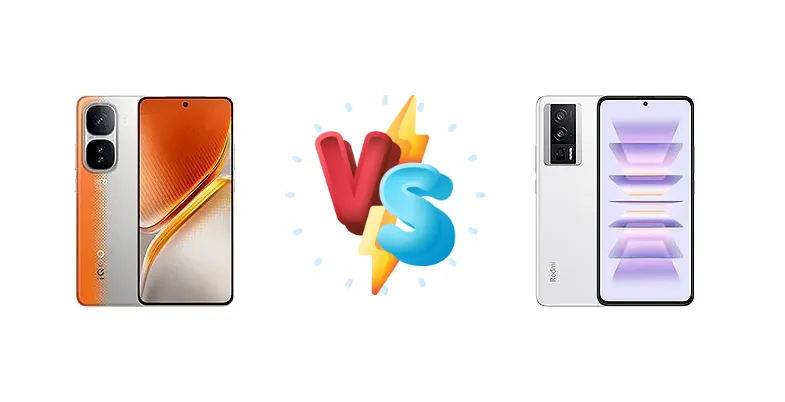
The iQOO Neo10 Pro and Xiaomi Redmi K60 Pro represent the pinnacle of value-focused flagship performance from China. Both devices aim to deliver a premium experience without the premium price tag, but they achieve this through different approaches: the iQOO leverages the cutting-edge Mediatek Dimensity 9400, while the Redmi relies on the established Qualcomm Snapdragon 8 Gen 2. This comparison dissects their strengths and weaknesses to determine which phone reigns supreme.
🏆 Quick Verdict
For the average user prioritizing sustained performance and a more refined software experience, the Xiaomi Redmi K60 Pro emerges as the winner. While the iQOO Neo10 Pro boasts the newer Dimensity 9400, the Snapdragon 8 Gen 2’s thermal efficiency and optimization provide a smoother, more consistent experience, especially during extended gaming sessions.
| Network |
|---|
| 2G bands | GSM 850 / 900 / 1800 / 1900 | GSM 850 / 900 / 1800 / 1900 |
| 3G bands | HSDPA 800 / 850 / 900 / 1700(AWS) / 1900 / 2100 | HSDPA 800 / 850 / 900 / 1700(AWS) / 2100 |
| 4G bands | 1, 3, 4, 5, 7, 8, 18, 19, 26, 28, 34, 38, 39, 40, 41 | 1, 3, 4, 5, 8, 18, 19, 26, 34, 38, 39, 40, 41, 42 |
| 5G bands | 1, 3, 5, 8, 28, 38, 40, 41, 77, 78 SA/NSA | 1, 3, 5, 8, 28, 38, 41, 77, 78 SA/NSA |
| Speed | HSPA, LTE, 5G | HSPA, LTE, 5G |
| Technology | GSM / HSPA / LTE / 5G | GSM / CDMA / HSPA / CDMA2000 / LTE / 5G |
| | - | CDMA2000 1x |
| Launch |
|---|
| Announced | 2024, November 29 | 2022, December 27 |
| Status | Available. Released 2024, November 29 | Available. Released 2023, January 01 |
| Body |
|---|
| Dimensions | 162.9 x 75.4 x 8 mm (6.41 x 2.97 x 0.31 in) | 162.8 x 75.4 x 8.6 mm or 8.9 mm |
| SIM | Nano-SIM + Nano-SIM | Nano-SIM + Nano-SIM |
| Weight | 199 g or 206 g (7.05 oz) | 201 g or 205 g (7.09 oz) |
| Display |
|---|
| Resolution | 1260 x 2800 pixels, 20:9 ratio (~453 ppi density) | 1440 x 3200 pixels, 20:9 ratio (~526 ppi density) |
| Size | 6.78 inches, 111.0 cm2 (~90.4% screen-to-body ratio) | 6.67 inches, 107.4 cm2 (~87.5% screen-to-body ratio) |
| Type | LTPO AMOLED, 1B colors, 144Hz, HDR10+, 1800 nits (HBM), 4500 nits (peak) | OLED, 68B colors, 120Hz, Dolby Vision, HDR10+, 1400 nits (peak) |
| Platform |
|---|
| CPU | Octa-core (1x3.63 GHz Cortex-X925 & 3x3.3 GHz Cortex-X4 & 4x2.4 GHz Cortex-A720) | Octa-core (1x3.2 GHz Cortex-X3 & 2x2.8 GHz Cortex-A715 & 2x2.8 GHz Cortex-A710 & 3x2.0 GHz Cortex-A510) |
| Chipset | Mediatek Dimensity 9400 (3 nm) | Qualcomm SM8550-AB Snapdragon 8 Gen 2 (4 nm) |
| GPU | Immortalis-G925 | Adreno 740 |
| OS | Android 15, OriginOS 5 | Android 13, MIUI 14 |
| Memory |
|---|
| Card slot | No | No |
| Internal | 256GB 12GB RAM, 256GB 16GB RAM, 512GB 12GB RAM, 512GB 16GB RAM, 1TB 16GB RAM | 128GB 8GB RAM, 256GB 8GB RAM, 256GB 12GB RAM, 512GB 12GB RAM, 512GB 16GB RAM |
| | - | UFS 4.0
UFS 3.1 - 128GB only |
| Main Camera |
|---|
| Dual | 50 MP, f/1.8, (wide), 1/1.56", PDAF, OIS
50 MP, f/2.0, 119˚ (ultrawide), 1/2.76", 0.64µm, AF | - |
| Features | LED flash, panorama, HDR | Color spectrum sensor, Dual-LED dual-tone flash, HDR, panorama |
| Triple | - | 54 MP, f/1.9, (wide), 1/1.49", 1.0µm, PDAF, OIS
8 MP, 118˚ (ultrawide), 1/4.0", 1.12µm
2 MP (macro) |
| Video | 8K, 4K, 1080p, gyro-EIS | 8K@24fps, 4K@30/60fps, 1080p@30/60/120/240/960fps, 720p@1920fps, gyro-EIS |
| Selfie camera |
|---|
| Features | - | HDR |
| Single | 16 MP, f/2.5, (wide) | 16 MP, (wide), 1/3.06", 1.0µm |
| Video | 1080p@30fps | 1080p@30/60/120fps |
| Sound |
|---|
| 3.5mm jack | - | No |
| 35mm jack | No | No |
| Loudspeaker | Yes, with stereo speakers (closed type) | Yes, with stereo speakers |
| | - | 24-bit/192kHz audio |
| Comms |
|---|
| Bluetooth | 5.4, A2DP, LE, aptX HD, LHDC 5 | 5.3, A2DP, LE |
| Infrared port | Yes | Yes |
| NFC | Yes | Yes |
| Positioning | GPS (L1+L5), GLONASS, BDS (B1I+B1c+B2a+B2b), GALILEO (E1+E5a+E5b), QZSS (L1+L5), NavIC (L1+L5) | GPS (L1+L5), GLONASS (G1), BDS (B1I+B2a+Bc), GALILEO (E1+E5a), QZSS (L1+L5), NavIC |
| Radio | No | Unspecified |
| USB | USB Type-C 2.0, OTG | USB Type-C 2.0, OTG |
| WLAN | Wi-Fi 802.11 a/b/g/n/ac/6/7, dual-band | Wi-Fi 802.11 a/b/g/n/ac/6e, dual-band, Wi-Fi Direct |
| Features |
|---|
| Sensors | Fingerprint (under display, ultrasonic), accelerometer, gyro, proximity, compass | Fingerprint (under display, optical), accelerometer, gyro, proximity, compass |
| Battery |
|---|
| Charging | 120W wired, 100W PPS+PD, 50% in 15 min
Reverse wired | 120W wired, PD3.0, QC3+, 100% in 19 min
30W wireless |
| Type | Si/C Li-Ion 6100 mAh | Li-Po 5000 mAh |
| Misc |
|---|
| Colors | Black, White, Orange | Black, White, Mint, Champion Black |
| Models | 2426A | 22127RK46C |
| Price | About 420 EUR | About 460 EUR |
vivo iQOO Neo10 Pro (China)
- Latest Mediatek Dimensity 9400 chipset
- Potentially higher peak CPU performance
- Fast 120W wired charging
- Potential for thermal throttling under sustained load
- Software optimization may be less mature than Xiaomi's
Xiaomi Redmi K60 Pro
- Mature Snapdragon 8 Gen 2 platform with excellent optimization
- 30W wireless charging support
- Likely better sustained performance and thermal management
- Older chipset compared to the Dimensity 9400
- May not achieve the absolute highest peak performance scores
Display Comparison
Neither device's display specifications are provided, but given their positioning, both likely feature high refresh rate AMOLED panels. The key difference will be in calibration and peak brightness. The Redmi K60 Pro, benefiting from Xiaomi’s display expertise, likely offers more accurate color reproduction. The iQOO Neo10 Pro, with its newer chipset, *could* support a higher refresh rate, but this is speculative. The absence of LTPO information suggests both may not have adaptive refresh rate technology, impacting battery life.
Camera Comparison
Without specific camera sensor details, a direct comparison is difficult. However, both phones likely feature a primary sensor exceeding 50MP. The Redmi K60 Pro, given Xiaomi’s camera tuning, likely prioritizes vibrant, social media-ready images. The iQOO Neo10 Pro may lean towards a more natural color profile. The presence of OIS (Optical Image Stabilization) on the main sensor of either device is crucial for low-light performance and video stabilization. The absence of information regarding secondary sensors suggests they are likely standard fare (ultrawide, macro) and won't be a significant differentiator.
Performance
The core battleground is the chipset. The iQOO Neo10 Pro’s Mediatek Dimensity 9400, built on a 3nm process, theoretically offers superior transistor density and power efficiency compared to the Redmi K60 Pro’s Snapdragon 8 Gen 2 (4nm). However, the Snapdragon 8 Gen 2 is a mature platform with extensive optimization. The Dimensity 9400’s CPU configuration – Cortex-X925, X4, and A720 cores – suggests a focus on peak performance, while the Snapdragon 8 Gen 2’s X3, A715, and A710 cores prioritize a balance of power and efficiency. The Redmi K60 Pro’s LPDDR5x RAM will contribute to faster data transfer speeds, complementing the Snapdragon’s capabilities. The 3nm node of the Dimensity 9400 *should* translate to better thermal management, but real-world testing will determine if it can overcome the Snapdragon 8 Gen 2’s optimization.
Battery Life
Both devices offer 120W wired charging, promising incredibly fast top-ups. The Redmi K60 Pro adds 30W wireless charging, a significant advantage for users who prefer cable-free convenience. The iQOO Neo10 Pro’s 15-minute 50% charge time is competitive, but the Redmi K60 Pro claims a full charge in 19 minutes, suggesting comparable wired charging speeds. Battery capacity is not specified, but the Snapdragon 8 Gen 2’s efficiency may allow the Redmi K60 Pro to achieve similar or better battery life despite a potentially smaller battery size.
Buying Guide
Buy the vivo iQOO Neo10 Pro (China) if you need the absolute latest processor technology and are willing to potentially manage thermal throttling for peak burst performance. Buy the Xiaomi Redmi K60 Pro if you prefer a more balanced experience with excellent sustained performance, faster wireless charging, and a proven track record of software stability.
Frequently Asked Questions
❓ Will the Dimensity 9400 in the iQOO Neo10 Pro overheat during prolonged gaming sessions?
The Dimensity 9400's 3nm process *should* improve thermal efficiency, but its focus on peak performance means it may still generate significant heat under sustained load. The iQOO Neo10 Pro may experience some throttling to manage temperatures, potentially impacting frame rates over extended gaming sessions. The Redmi K60 Pro's Snapdragon 8 Gen 2 is known for its more consistent performance due to better thermal management.
❓ Does the Redmi K60 Pro's 30W wireless charging significantly impact charging speed compared to the iQOO Neo10 Pro's 120W wired charging?
While 120W wired charging is incredibly fast, 30W wireless charging offers a convenient alternative. The Redmi K60 Pro's wireless charging won't match the speed of the iQOO Neo10 Pro's wired charging, but it provides a practical top-up option for users who don't want to deal with cables. The Redmi K60 Pro's 120W wired charging is still competitive, achieving a full charge in 19 minutes.
❓ Is the software experience on the iQOO Neo10 Pro significantly different from Xiaomi's MIUI on the Redmi K60 Pro?
Yes, the iQOO Neo10 Pro likely runs vivo's OriginOS, while the Redmi K60 Pro runs Xiaomi's MIUI. MIUI is known for its extensive customization options and feature set, but it can also be resource-intensive and include pre-installed bloatware. OriginOS aims for a cleaner, more streamlined experience, but its long-term software support and update frequency may not be as consistent as Xiaomi's.