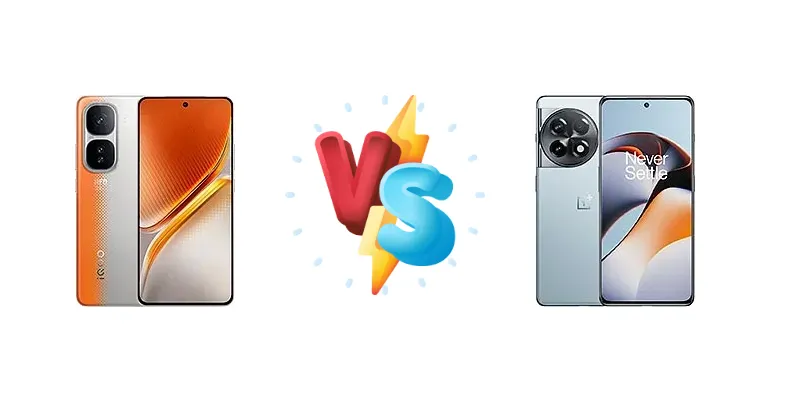
The iQOO Neo10 Pro, currently exclusive to the Chinese market, arrives with the cutting-edge Mediatek Dimensity 9400, promising a significant leap in performance. We pit it against the globally available OnePlus 11R, powered by the proven Snapdragon 8+ Gen 1, to determine which phone delivers the best experience for demanding users and gamers.
🏆 Quick Verdict
For users prioritizing raw performance and the fastest charging speeds, the iQOO Neo10 Pro is the clear winner, thanks to the Dimensity 9400 and 120W charging. However, the OnePlus 11R offers broader availability and a well-established software experience, making it a strong contender for those outside of China.
| Network |
|---|
| 2G bands | GSM 850 / 900 / 1800 / 1900 | GSM 850 / 900 / 1800 / 1900 |
| 3G bands | HSDPA 800 / 850 / 900 / 1700(AWS) / 1900 / 2100 | HSDPA 850 / 900 / 1700(AWS) / 2100 |
| 4G bands | 1, 3, 4, 5, 7, 8, 18, 19, 26, 28, 34, 38, 39, 40, 41 | 1, 3, 4, 5, 8, 28, 34, 38, 39, 40, 41 |
| 5G bands | 1, 3, 5, 8, 28, 38, 40, 41, 77, 78 SA/NSA | 1, 3, 5, 8, 28, 40, 41, 77, 78 SA/NSA |
| Speed | HSPA, LTE, 5G | HSPA, LTE (3CA), 5G |
| Technology | GSM / HSPA / LTE / 5G | GSM / CDMA / HSPA / LTE / 5G |
| | - | CDMA 800 |
| Launch |
|---|
| Announced | 2024, November 29 | 2023, February 07 |
| Status | Available. Released 2024, November 29 | Available. Released 2023, February 21 |
| Body |
|---|
| Build | - | Glass front, glass back (Gorilla Glass 5), plastic frame |
| Dimensions | 162.9 x 75.4 x 8 mm (6.41 x 2.97 x 0.31 in) | 163.4 x 74.3 x 8.7 mm (6.43 x 2.93 x 0.34 in) |
| SIM | Nano-SIM + Nano-SIM | Nano-SIM + Nano-SIM |
| Weight | 199 g or 206 g (7.05 oz) | 204 g (7.20 oz) |
| Display |
|---|
| Resolution | 1260 x 2800 pixels, 20:9 ratio (~453 ppi density) | 1240 x 2772 pixels, 20:9 ratio (~451 ppi density) |
| Size | 6.78 inches, 111.0 cm2 (~90.4% screen-to-body ratio) | 6.74 inches, 109.2 cm2 (~90.0% screen-to-body ratio) |
| Type | LTPO AMOLED, 1B colors, 144Hz, HDR10+, 1800 nits (HBM), 4500 nits (peak) | Fluid AMOLED, 1B colors, 120Hz, HDR10+, 1450 nits (peak) |
| Platform |
|---|
| CPU | Octa-core (1x3.63 GHz Cortex-X925 & 3x3.3 GHz Cortex-X4 & 4x2.4 GHz Cortex-A720) | Octa-core (1x3.0 GHz Cortex-X2 & 3x2.5 GHz Cortex-A710 & 4x1.80 GHz Cortex-A510) |
| Chipset | Mediatek Dimensity 9400 (3 nm) | Qualcomm SM8475 Snapdragon 8+ Gen 1 (4 nm) |
| GPU | Immortalis-G925 | Adreno 730 |
| OS | Android 15, OriginOS 5 | Android 13, upgradable to Android 15, OxygenOS 15 |
| Memory |
|---|
| Card slot | No | No |
| Internal | 256GB 12GB RAM, 256GB 16GB RAM, 512GB 12GB RAM, 512GB 16GB RAM, 1TB 16GB RAM | 128GB 8GB RAM, 256GB 16GB RAM, 512GB 18GB RAM |
| | - | UFS 3.1 |
| Main Camera |
|---|
| Dual | 50 MP, f/1.8, (wide), 1/1.56", PDAF, OIS
50 MP, f/2.0, 119˚ (ultrawide), 1/2.76", 0.64µm, AF | - |
| Features | LED flash, panorama, HDR | Color spectrum sensor, LED flash, HDR, panorama |
| Single | - | 16 MP, f/2.4, 24mm (wide), 1/3.09", 1.0µm |
| Triple | - | 50 MP, f/1.8, 24mm (wide), 1/1.56", 1.0µm, multi-directional PDAF, OIS
8 MP, f/2.2, 120˚ (ultrawide), 1/4.0", 1.12µm
2 MP (macro) |
| Video | 8K, 4K, 1080p, gyro-EIS | 4K@30/60fps, 1080p@30/60/240fps, gyro-EIS |
| Selfie camera |
|---|
| Features | - | HDR |
| Single | 16 MP, f/2.5, (wide) | 16 MP, f/2.4, 24mm (wide), 1/3.09", 1.0µm |
| Video | 1080p@30fps | 1080p@30fps |
| Sound |
|---|
| 3.5mm jack | - | No |
| 35mm jack | No | No |
| Loudspeaker | Yes, with stereo speakers (closed type) | Yes, with stereo speakers |
| | - | 24-bit/192kHz audio |
| Comms |
|---|
| Bluetooth | 5.4, A2DP, LE, aptX HD, LHDC 5 | 5.3, A2DP, LE, aptX HD |
| Infrared port | Yes | Yes |
| NFC | Yes | Yes |
| Positioning | GPS (L1+L5), GLONASS, BDS (B1I+B1c+B2a+B2b), GALILEO (E1+E5a+E5b), QZSS (L1+L5), NavIC (L1+L5) | GPS (L1+L5), GLONASS (G1), BDS (B1I+B1c+B2a), GALILEO (E1+E5a), QZSS (L1+L5) |
| Radio | No | No |
| USB | USB Type-C 2.0, OTG | USB Type-C 2.0 |
| WLAN | Wi-Fi 802.11 a/b/g/n/ac/6/7, dual-band | Wi-Fi 802.11 a/b/g/n/ac/6, dual-band |
| Features |
|---|
| Sensors | Fingerprint (under display, ultrasonic), accelerometer, gyro, proximity, compass | Fingerprint (under display, optical), accelerometer, gyro, proximity, compass |
| Battery |
|---|
| Charging | 120W wired, 100W PPS+PD, 50% in 15 min
Reverse wired | 100W wired |
| Type | Si/C Li-Ion 6100 mAh | Li-Po 5000 mAh |
| Misc |
|---|
| Colors | Black, White, Orange | Galactic Silver, Sonic Black, Solar Red |
| Models | 2426A | CPH2487 |
| Price | About 420 EUR | About 600 EUR |
| SAR | - | 1.16 W/kg (head) 0.61 W/kg (body) |
vivo iQOO Neo10 Pro (China)
- Superior processing power with Dimensity 9400
- Ultra-fast 120W charging
- More efficient 3nm fabrication process
- China-exclusive availability
- Potential software localization challenges
OnePlus 11R
- Global availability and support
- Refined OxygenOS software experience
- Proven Snapdragon 8+ Gen 1 performance
- Less powerful processor compared to Dimensity 9400
- Slower 100W charging
Display Comparison
While both phones likely feature high refresh rate AMOLED displays (specs not provided), the core battle lies in the processing power. The iQOO Neo10 Pro’s Dimensity 9400, built on a 3nm process, should offer superior efficiency compared to the OnePlus 11R’s 4nm Snapdragon 8+ Gen 1. This efficiency translates to potentially lower heat generation during sustained use, impacting display brightness stability. Without specific display specs, it's difficult to assess color accuracy or peak brightness, but the chipset advantage suggests the iQOO Neo10 Pro could maintain higher brightness levels for longer.
Camera Comparison
Without detailed camera specifications, a direct comparison is limited. However, the iQOO Neo10 Pro’s chipset likely includes a more advanced ISP (Image Signal Processor) capable of faster image processing and improved noise reduction. The Snapdragon 8+ Gen 1 in the OnePlus 11R is known for its excellent image processing, but the newer Dimensity 9400 should offer incremental improvements. We anticipate both phones will deliver competitive image quality, but the iQOO Neo10 Pro may have an edge in low-light performance and video recording capabilities due to its more modern ISP.
Performance
The Mediatek Dimensity 9400 in the iQOO Neo10 Pro represents a significant architectural upgrade. Its Cortex-X925 prime core, clocked at 3.63 GHz, is expected to outperform the Snapdragon 8+ Gen 1’s Cortex-X2 (3.0 GHz). The Dimensity 9400 also incorporates newer Cortex-X4 and A720 cores, further widening the performance gap. The 3nm fabrication process is crucial; it allows for higher transistor density and improved power efficiency, potentially mitigating throttling during extended gaming sessions. The OnePlus 11R’s Snapdragon 8+ Gen 1 remains a capable performer, but the iQOO Neo10 Pro is poised to deliver a noticeably smoother and faster experience, especially in demanding applications.
Battery Life
The OnePlus 11R features 100W wired charging, a respectable speed. However, the iQOO Neo10 Pro’s 120W charging is significantly faster, promising a 50% charge in just 15 minutes. While battery capacity isn’t specified, the Dimensity 9400’s improved efficiency could offset a potentially smaller battery size in the iQOO Neo10 Pro, resulting in comparable real-world battery life. The faster charging speed is a major advantage for users who prioritize minimizing downtime.
Buying Guide
Buy the vivo iQOO Neo10 Pro (China) if you absolutely need the latest processor technology for peak gaming performance and are comfortable with importing a device and potential software limitations. Buy the OnePlus 11R if you prioritize global availability, a refined OxygenOS experience, and a proven track record of reliable performance without the import hassle.
Frequently Asked Questions
❓ Is the iQOO Neo10 Pro's Dimensity 9400 likely to overheat during prolonged gaming sessions?
The Dimensity 9400's 3nm process and improved efficiency are designed to mitigate thermal throttling. While sustained high loads will generate heat, it's expected to perform better than the Snapdragon 8+ Gen 1 in this regard, potentially allowing for longer gaming sessions at peak performance.
❓ What are the potential drawbacks of purchasing the iQOO Neo10 Pro outside of China?
The iQOO Neo10 Pro is currently a China-exclusive device. Importing it may result in software localization issues (language, missing apps), warranty complications, and potential compatibility problems with local network bands. You may also need to use a third-party ROM.
❓ Does the OnePlus 11R support high frame rate gaming (90fps or 120fps) in popular titles like PUBG Mobile?
The Snapdragon 8+ Gen 1 in the OnePlus 11R is capable of running PUBG Mobile at high frame rates. However, achieving 90fps or 120fps will depend on the game settings and the phone's thermal management. Expect to make some compromises on graphics quality to maintain consistently high frame rates.
❓ How does the 100W charging on the OnePlus 11R compare to other phones with similar charging speeds?
The OnePlus 11R's 100W charging is relatively standard for flagship-level phones. It typically takes around 25-30 minutes to fully charge the device from 0% to 100%. While not the fastest available, it's still significantly quicker than traditional charging methods.