
iQOO Neo10 Pro vs Huawei P60 Pro: A Deep Dive into Performance, Camera, and Battery Life
| Phones Images | |||||
|---|---|---|---|---|---|
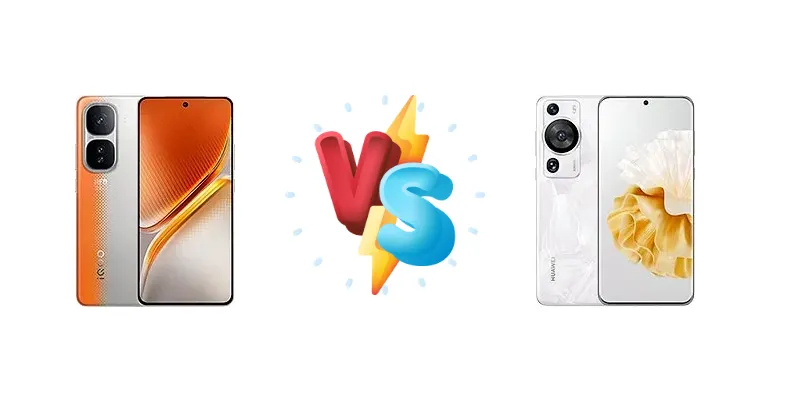
|
🏆 Quick Verdict
For the average user prioritizing raw performance and future-proofing, the iQOO Neo10 Pro is the clear winner thanks to the Dimensity 9400. However, the Huawei P60 Pro remains a compelling choice for those valuing camera consistency and a proven track record of battery optimization, despite its older chipset.
| PHONES | ||
|---|---|---|
| Phone Names | vivo iQOO Neo10 Pro (China) | Huawei P60 Pro |
| Network | ||
|---|---|---|
| 2G bands | GSM 850 / 900 / 1800 / 1900 | GSM 850 / 900 / 1800 / 1900 |
| 3G bands | HSDPA 800 / 850 / 900 / 1700(AWS) / 1900 / 2100 | HSDPA 800 / 850 / 900 / 1700(AWS) / 1900 / 2100 |
| 4G bands | 1, 3, 4, 5, 7, 8, 18, 19, 26, 28, 34, 38, 39, 40, 41 | 1, 2, 3, 4, 5, 7, 8, 12, 13, 17, 18, 19, 20, 26, 28, 32, 34, 38, 39, 40, 41, 66 - International |
| 5G bands | 1, 3, 5, 8, 28, 38, 40, 41, 77, 78 SA/NSA | - |
| Speed | HSPA, LTE, 5G | HSPA, LTE |
| Technology | GSM / HSPA / LTE / 5G | GSM / CDMA / HSPA / CDMA2000 / LTE |
| - | 1, 2, 3, 4, 5, 7, 8, 12, 17, 18, 19, 20, 26, 28, 34, 38, 39, 40, 41 - China | |
| Launch | ||
|---|---|---|
| Announced | 2024, November 29 | 2023, March 23 |
| Status | Available. Released 2024, November 29 | Available. Released 2023, March 31 |
| Body | ||
|---|---|---|
| Dimensions | 162.9 x 75.4 x 8 mm (6.41 x 2.97 x 0.31 in) | 161 x 74.5 x 8.3 mm (6.34 x 2.93 x 0.33 in) |
| SIM | Nano-SIM + Nano-SIM | · Nano-SIM· Nano-SIM + Nano-SIM |
| Weight | 199 g or 206 g (7.05 oz) | 200 g (7.05 oz) |
| - | IP68 dust/water resistant (up to 1.5m for 30 min) | |
| Display | ||
|---|---|---|
| Protection | - | Kunlun Glass |
| Resolution | 1260 x 2800 pixels, 20:9 ratio (~453 ppi density) | 1220 x 2700 pixels (~444 ppi density) |
| Size | 6.78 inches, 111.0 cm2 (~90.4% screen-to-body ratio) | 6.67 inches, 107.7 cm2 (~89.8% screen-to-body ratio) |
| Type | LTPO AMOLED, 1B colors, 144Hz, HDR10+, 1800 nits (HBM), 4500 nits (peak) | LTPO OLED, 1B colors, 120Hz |
| Platform | ||
|---|---|---|
| CPU | Octa-core (1x3.63 GHz Cortex-X925 & 3x3.3 GHz Cortex-X4 & 4x2.4 GHz Cortex-A720) | Octa-core (1x3.19 GHz Cortex-X2 & 3x2.75 GHz Cortex-A710 & 4x2.0 GHz Cortex-A510) |
| Chipset | Mediatek Dimensity 9400 (3 nm) | Qualcomm SM8475 Snapdragon 8+ Gen 1 4G (4 nm) |
| GPU | Immortalis-G925 | Adreno 730 |
| OS | Android 15, OriginOS 5 | HarmonyOS 3.1 (China), EMUI 13.1 (Europe), no Google Play Services |
| Memory | ||
|---|---|---|
| Card slot | No | Nano Memory (uses shared SIM slot) |
| Internal | 256GB 12GB RAM, 256GB 16GB RAM, 512GB 12GB RAM, 512GB 16GB RAM, 1TB 16GB RAM | 256GB 8GB RAM, 256GB 12GB RAM, 512GB 12GB RAM |
| - | UFS | |
| Main Camera | ||
|---|---|---|
| Dual | 50 MP, f/1.8, (wide), 1/1.56", PDAF, OIS 50 MP, f/2.0, 119˚ (ultrawide), 1/2.76", 0.64µm, AF | - |
| Features | LED flash, panorama, HDR | Laser AF, color spectrum sensor, LED flash, HDR, panorama |
| Triple | - | 48 MP, f/1.4-f/4.0, 25mm (wide), PDAF, OIS 48 MP, f/2.1, 90mm (telephoto), PDAF, sensor-shift OIS, 3.5x optical zoom 13 MP, f/2.2, 13mm (ultrawide), AF |
| Video | 8K, 4K, 1080p, gyro-EIS | 4K@30/60fps, 1080p@30/60fps, 1080p@960fps; gyro-EIS, HDR Vivid |
| Selfie camera | ||
|---|---|---|
| Features | - | Panorama, HDR |
| Single | 16 MP, f/2.5, (wide) | 13 MP, f/2.4, (ultrawide) |
| Video | 1080p@30fps | 4K@30/60fps, 1080p@30fps, HDR Vivid |
| Sound | ||
|---|---|---|
| 3.5mm jack | - | No |
| 35mm jack | No | No |
| Loudspeaker | Yes, with stereo speakers (closed type) | Yes, with stereo speakers |
| Comms | ||
|---|---|---|
| Bluetooth | 5.4, A2DP, LE, aptX HD, LHDC 5 | 5.2, A2DP, LE |
| Infrared port | Yes | Yes |
| NFC | Yes | Yes |
| Positioning | GPS (L1+L5), GLONASS, BDS (B1I+B1c+B2a+B2b), GALILEO (E1+E5a+E5b), QZSS (L1+L5), NavIC (L1+L5) | GPS (L1+L5), GLONASS (B1I+B1c+B2a), BDS (B1I+B1c+B2a), GALILEO (E1+E5a), QZSS (L1+L5), NavIC |
| Radio | No | No |
| USB | USB Type-C 2.0, OTG | USB Type-C 3.1, OTG |
| WLAN | Wi-Fi 802.11 a/b/g/n/ac/6/7, dual-band | Wi-Fi 802.11 a/b/g/n/ac/6, dual-band, Wi-Fi Direct |
| Features | ||
|---|---|---|
| Sensors | Fingerprint (under display, ultrasonic), accelerometer, gyro, proximity, compass | Fingerprint (under display, optical), accelerometer, gyro, proximity, compass |
| - | BDS Satellite Message | |
| Battery | ||
|---|---|---|
| Charging | 120W wired, 100W PPS+PD, 50% in 15 min Reverse wired | 88W wired 50W wireless Reverse wireless |
| Type | Si/C Li-Ion 6100 mAh | Li-Po 4815 mAh |
| Misc | ||
|---|---|---|
| Colors | Black, White, Orange | Black, Green, Violet, Rococo Pearl |
| Models | 2426A | MNA-AL00, MNA-LX9 |
| Price | About 420 EUR | € 738.50 |
| Tests | ||
|---|---|---|
| Battery life | - | Endurance rating 96h |
| Camera | - | Photo / Video |
| Display | - | Contrast ratio: Infinite (nominal) |
| Loudspeaker | - | -27.3 LUFS (Good) |
| Performance | - | AnTuTu: 1030473 (v9) GeekBench: 4422 (v6) GFXBench: 65fps (ES 3.1 onscreen) |
vivo iQOO Neo10 Pro (China)
- Significantly faster charging (120W)
- More powerful processor (Dimensity 9400)
- Potentially better thermal management due to 3nm process
- China-exclusive model (importing required)
- Battery capacity and display specs currently unknown
Huawei P60 Pro
- Excellent camera reputation and image processing
- Wireless and reverse wireless charging
- Globally available and supported
- Older chipset (Snapdragon 8+ Gen 1)
- Slower wired charging (88W)
Display Comparison
The Huawei P60 Pro boasts a display capable of reaching 1135 nits of peak brightness, ensuring excellent visibility even in direct sunlight. While the iQOO Neo10 Pro’s display specs are currently unavailable, iQOO typically prioritizes high refresh rates. The P60 Pro’s ‘Infinite’ contrast ratio suggests a high-quality OLED panel, but without detailed color accuracy data for the iQOO, it’s difficult to definitively declare a winner. The P60 Pro’s brightness advantage is a tangible benefit for outdoor use.
Camera Comparison
Both devices are marketed as having strong photo and video capabilities, but specifics are limited. The Huawei P60 Pro has a history of excellent image processing and consistent camera performance, likely leveraging advanced computational photography techniques. Without sensor size or aperture details for the iQOO Neo10 Pro, it’s difficult to assess its low-light performance. The P60 Pro’s established reputation and likely superior image stabilization (OIS) give it an edge, assuming similar sensor sizes. We'd need to see sample images to make a definitive judgement.
Performance
The iQOO Neo10 Pro’s Mediatek Dimensity 9400, built on a 3nm process, represents a significant leap over the Huawei P60 Pro’s 4nm Snapdragon 8+ Gen 1. The Dimensity 9400’s Cortex-X925 core, clocked at 3.63 GHz, promises substantially higher single-core performance than the P60 Pro’s 3.19 GHz Cortex-X2. The architectural improvements in the Cortex-X4 and A720 cores further extend the iQOO’s multi-core advantage. While the Snapdragon 8+ Gen 1 remains a capable performer, the 3nm node of the Dimensity 9400 translates to improved thermal efficiency, potentially reducing throttling during sustained workloads. The iQOO Neo10 Pro is geared towards users who demand the absolute best in mobile processing.
Battery Life
Both phones achieve an impressive endurance rating of 96 hours, suggesting similar real-world battery life despite differing battery capacities (unspecified for the iQOO). However, the charging speeds are drastically different. The iQOO Neo10 Pro’s 120W wired charging can replenish 50% of the battery in just 15 minutes, significantly faster than the Huawei P60 Pro’s 88W wired charging. The iQOO also supports 100W PPS+PD, offering wider compatibility. The P60 Pro compensates with 50W wireless charging and reverse wireless charging, features absent on the iQOO. The iQOO’s charging speed is a major convenience factor for users who frequently need to top up their battery quickly.
Buying Guide
Buy the vivo iQOO Neo10 Pro (China) if you need uncompromising processing power for demanding games and applications, and are comfortable with importing a China-exclusive device. Buy the Huawei P60 Pro if you prioritize a consistently excellent camera experience, long-term software support (within the Huawei ecosystem), and a more readily available global model.