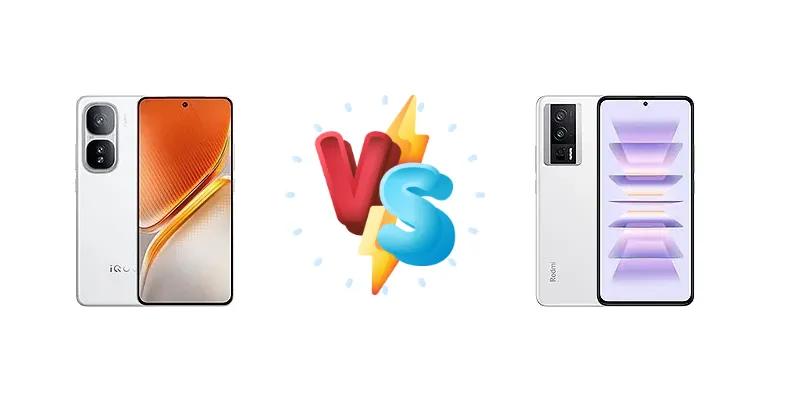
The iQOO Neo10 and Xiaomi Redmi K60 Pro represent compelling options in the competitive Chinese smartphone market. Both leverage Qualcomm’s flagship Snapdragon platforms, but a generation gap and differing feature sets create a clear distinction. This comparison dissects the iQOO Neo10’s newer Snapdragon 8 Gen 3 against the Redmi K60 Pro’s Snapdragon 8 Gen 2, focusing on real-world performance implications and user benefits.
🏆 Quick Verdict
For users prioritizing raw performance and future-proofing, the iQOO Neo10 emerges as the winner. Its Snapdragon 8 Gen 3 chipset delivers a noticeable performance uplift, particularly in demanding tasks. However, the Redmi K60 Pro remains a strong contender, offering excellent value and the convenience of wireless charging.
| Network |
|---|
| 2G bands | GSM 850 / 900 / 1800 / 1900 | GSM 850 / 900 / 1800 / 1900 |
| 3G bands | HSDPA 800 / 850 / 900 / 1700(AWS) / 1900 / 2100 | HSDPA 800 / 850 / 900 / 1700(AWS) / 2100 |
| 4G bands | 1, 3, 4, 5, 7, 8, 18, 19, 26, 28, 34, 38, 39, 40, 41 | 1, 3, 4, 5, 8, 18, 19, 26, 34, 38, 39, 40, 41, 42 |
| 5G bands | 1, 3, 5, 8, 28, 38, 40, 41, 77, 78 SA/NSA | 1, 3, 5, 8, 28, 38, 41, 77, 78 SA/NSA |
| Speed | HSPA, LTE, 5G | HSPA, LTE, 5G |
| Technology | GSM / HSPA / LTE / 5G | GSM / CDMA / HSPA / CDMA2000 / LTE / 5G |
| | - | CDMA2000 1x |
| Launch |
|---|
| Announced | 2024, November 29 | 2022, December 27 |
| Status | Available. Released 2024, November 29 | Available. Released 2023, January 01 |
| Body |
|---|
| Dimensions | 162.9 x 75.4 x 8 mm (6.41 x 2.97 x 0.31 in) | 162.8 x 75.4 x 8.6 mm or 8.9 mm |
| SIM | Nano-SIM + Nano-SIM | Nano-SIM + Nano-SIM |
| Weight | 199 g or 206 g (7.05 oz) | 201 g or 205 g (7.09 oz) |
| Display |
|---|
| Resolution | 1260 x 2800 pixels, 20:9 ratio (~453 ppi density) | 1440 x 3200 pixels, 20:9 ratio (~526 ppi density) |
| Size | 6.78 inches, 111.0 cm2 (~90.4% screen-to-body ratio) | 6.67 inches, 107.4 cm2 (~87.5% screen-to-body ratio) |
| Type | LTPO AMOLED, 1B colors, 144Hz, HDR10+, 1800 nits (HBM), 4500 nits (peak) | OLED, 68B colors, 120Hz, Dolby Vision, HDR10+, 1400 nits (peak) |
| Platform |
|---|
| CPU | Octa-core (1x3.3 GHz Cortex-X4 & 3x3.2 GHz Cortex-A720 & 2x3.0 GHz Cortex-A720 & 2x2.3 GHz Cortex-A520) | Octa-core (1x3.2 GHz Cortex-X3 & 2x2.8 GHz Cortex-A715 & 2x2.8 GHz Cortex-A710 & 3x2.0 GHz Cortex-A510) |
| Chipset | Qualcomm SM8650-AB Snapdragon 8 Gen 3 (4 nm) | Qualcomm SM8550-AB Snapdragon 8 Gen 2 (4 nm) |
| GPU | Adreno 750 | Adreno 740 |
| OS | Android 15, OriginOS 5 | Android 13, MIUI 14 |
| Memory |
|---|
| Card slot | No | No |
| Internal | 256GB 12GB RAM, 256GB 16GB RAM, 512GB 12GB RAM, 512GB 16GB RAM, 1TB 16GB RAM | 128GB 8GB RAM, 256GB 8GB RAM, 256GB 12GB RAM, 512GB 12GB RAM, 512GB 16GB RAM |
| | - | UFS 4.0
UFS 3.1 - 128GB only |
| Main Camera |
|---|
| Dual | 50 MP, f/1.8, (wide), 1/1.56", PDAF, OIS
8 MP, f/2.2, 119˚ (ultrawide) | - |
| Features | LED flash, panorama, HDR | Color spectrum sensor, Dual-LED dual-tone flash, HDR, panorama |
| Triple | - | 54 MP, f/1.9, (wide), 1/1.49", 1.0µm, PDAF, OIS
8 MP, 118˚ (ultrawide), 1/4.0", 1.12µm
2 MP (macro) |
| Video | 8K, 4K, 1080p, gyro-EIS | 8K@24fps, 4K@30/60fps, 1080p@30/60/120/240/960fps, 720p@1920fps, gyro-EIS |
| Selfie camera |
|---|
| Features | - | HDR |
| Single | 16 MP, f/2.5, (wide) | 16 MP, (wide), 1/3.06", 1.0µm |
| Video | 1080p@30fps | 1080p@30/60/120fps |
| Sound |
|---|
| 3.5mm jack | - | No |
| 35mm jack | No | No |
| Loudspeaker | Yes, with stereo speakers (closed type) | Yes, with stereo speakers |
| | - | 24-bit/192kHz audio |
| Comms |
|---|
| Bluetooth | 5.4, A2DP, LE, aptX HD, aptX Adaptive, aptX Lossless, LHDC 5 | 5.3, A2DP, LE |
| Infrared port | Yes | Yes |
| NFC | Yes | Yes |
| Positioning | GPS (L1+L5), GLONASS, BDS (B1I+B1c+B2a), GALILEO (E1+E5a), QZSS (L1+L5) | GPS (L1+L5), GLONASS (G1), BDS (B1I+B2a+Bc), GALILEO (E1+E5a), QZSS (L1+L5), NavIC |
| Radio | No | Unspecified |
| USB | USB Type-C 2.0, OTG | USB Type-C 2.0, OTG |
| WLAN | Wi-Fi 802.11 a/b/g/n/ac/6/7, dual-band | Wi-Fi 802.11 a/b/g/n/ac/6e, dual-band, Wi-Fi Direct |
| Features |
|---|
| Sensors | Fingerprint (under display, ultrasonic), accelerometer, gyro, proximity, compass | Fingerprint (under display, optical), accelerometer, gyro, proximity, compass |
| Battery |
|---|
| Charging | 120W wired, 100W PPS+PD, 50% in 15 min
Reverse wired | 120W wired, PD3.0, QC3+, 100% in 19 min
30W wireless |
| Type | Si/C Li-Ion 6100 mAh | Li-Po 5000 mAh |
| Misc |
|---|
| Colors | Black, White, Orange | Black, White, Mint, Champion Black |
| Models | 2425A, V2425A | 22127RK46C |
| Price | About 300 EUR | About 460 EUR |
vivo iQOO Neo10 (China)
- Latest Snapdragon 8 Gen 3 chipset for superior performance
- Faster charging speed (50% in 15 minutes)
- Potentially better thermal management due to newer architecture
- Lacks wireless charging
- May be more expensive than the Redmi K60 Pro
Xiaomi Redmi K60 Pro
- 30W wireless charging support
- Excellent value for flagship performance
- PD3.0/QC3+ charging compatibility
- Older Snapdragon 8 Gen 2 chipset
- Slightly slower wired charging (100% in 19 minutes)
Display Comparison
While both devices are expected to feature high-refresh-rate AMOLED displays, specific details like peak brightness and panel technology (LTPO) are missing. However, given the Redmi K60 Pro’s positioning, it likely boasts a higher peak brightness and potentially LTPO technology for adaptive refresh rates, improving battery efficiency. The iQOO Neo10, focusing on performance, may prioritize raw refresh rate over advanced panel features. Bezels are expected to be minimal on both, but the Redmi K60 Pro’s history suggests a focus on maximizing screen-to-body ratio.
Camera Comparison
Without specific camera sensor details, a direct comparison is difficult. However, both phones are expected to feature capable camera systems. The Redmi K60 Pro, given Xiaomi’s camera focus, may prioritize image processing algorithms and software features. The iQOO Neo10, while capable, is likely to focus more on overall system performance, potentially resulting in slightly less refined image processing. The absence of information on OIS and lens apertures makes a definitive judgment impossible, but a larger main sensor on either device would be a significant advantage.
Performance
The iQOO Neo10’s Snapdragon 8 Gen 3 (4nm) represents a significant leap over the Redmi K60 Pro’s Snapdragon 8 Gen 2 (4nm). The 8 Gen 3’s CPU configuration – 1x3.3 GHz Cortex-X4, 3x3.2 GHz Cortex-A720, 2x3.0 GHz Cortex-A720, and 2x2.3 GHz Cortex-A520 – offers improved single-core and multi-core performance compared to the 8 Gen 2’s 1x3.2 GHz Cortex-X3, 2x2.8 GHz Cortex-A715, 2x2.8 GHz Cortex-A710, and 3x2.0 GHz Cortex-A510. This translates to faster app loading, smoother multitasking, and higher frame rates in games. The newer architecture also provides better thermal efficiency, potentially reducing throttling during sustained workloads. Both devices likely utilize LPDDR5x RAM, but the iQOO Neo10’s chipset will benefit more from the faster memory bandwidth.
Battery Life
Both devices feature 120W wired charging, promising incredibly fast top-ups. The iQOO Neo10 claims 50% charge in 15 minutes, while the Redmi K60 Pro reaches 100% in 19 minutes. This difference, while noticeable, is unlikely to be a major deciding factor for most users. The Redmi K60 Pro adds 30W wireless charging and support for PD3.0/QC3+, offering greater charging flexibility. While battery capacity is unknown, the Redmi K60 Pro’s wireless charging capability provides a convenience factor the iQOO Neo10 lacks.
Buying Guide
Buy the vivo iQOO Neo10 (China) if you need the absolute fastest processing power for gaming and demanding applications, and are willing to forgo wireless charging. Buy the Xiaomi Redmi K60 Pro if you prefer a more balanced package with the added convenience of 30W wireless charging, and still require flagship-level performance at a potentially lower price point.
Frequently Asked Questions
❓ Will the Snapdragon 8 Gen 3 in the iQOO Neo10 handle demanding games like Genshin Impact at maximum settings?
Yes, the Snapdragon 8 Gen 3 is designed to excel in demanding gaming scenarios. Its improved CPU and GPU architecture, coupled with efficient thermal management, should allow for sustained high frame rates at maximum settings in Genshin Impact and other graphically intensive titles.
❓ Does the Redmi K60 Pro's wireless charging significantly impact its long-term battery health?
While all batteries degrade over time, the Redmi K60 Pro's 30W wireless charging is implemented with safety features to minimize heat generation and prevent overcharging. However, frequent use of wireless charging *can* contribute to slightly faster battery degradation compared to solely using wired charging. Utilizing optimized charging settings within the phone's software can help mitigate this.
❓ Is the difference in charging speed between the iQOO Neo10 and Redmi K60 Pro noticeable in everyday use?
The 4-minute difference in reaching 100% charge is unlikely to be a major concern for most users. Both phones offer incredibly fast charging, providing a significant top-up in just a few minutes. The convenience of wireless charging on the Redmi K60 Pro may be more impactful than the slight difference in wired charging speed.