
vivo iQOO Neo10 vs Xiaomi 13T Pro: A Head-to-Head Performance and Value Showdown
| Phones Images | |||||
|---|---|---|---|---|---|
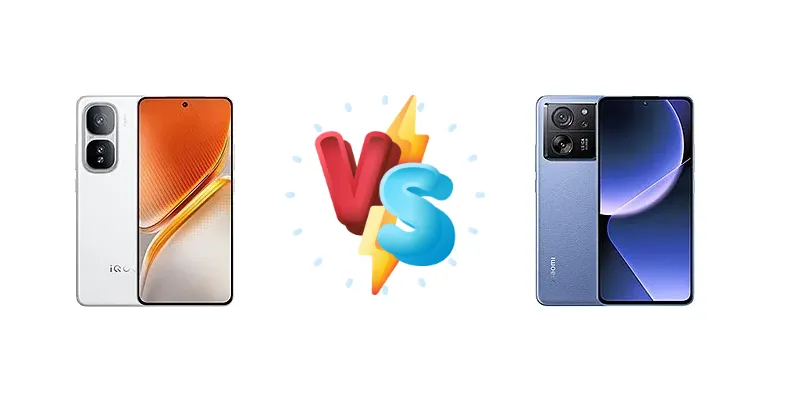
|
🏆 Quick Verdict
For users prioritizing raw processing power and future-proofing, the vivo iQOO Neo10 with its Snapdragon 8 Gen 3 is the clear winner. However, the Xiaomi 13T Pro delivers excellent battery life and a well-rounded experience, making it a strong contender for those valuing longevity and a balanced feature set.
| PHONES | ||
|---|---|---|
| Phone Names | vivo iQOO Neo10 (China) | Xiaomi 13T Pro |
| Network | ||
|---|---|---|
| 2G bands | GSM 850 / 900 / 1800 / 1900 | GSM 850 / 900 / 1800 / 1900 |
| 3G bands | HSDPA 800 / 850 / 900 / 1700(AWS) / 1900 / 2100 | HSDPA 800 / 850 / 900 / 1700(AWS) / 1900 / 2100 |
| 4G bands | 1, 3, 4, 5, 7, 8, 18, 19, 26, 28, 34, 38, 39, 40, 41 | 1, 2, 3, 4, 5, 7, 8, 12, 13, 17, 18, 19, 20, 25, 26, 28, 32, 38, 39, 40, 41, 42, 48, 66 |
| 5G bands | 1, 3, 5, 8, 28, 38, 40, 41, 77, 78 SA/NSA | 1, 3, 5, 7, 8, 20, 28, 38, 40, 41, 66, 75, 77, 78 SA/NSA |
| Speed | HSPA, LTE, 5G | HSPA, LTE, 5G |
| Technology | GSM / HSPA / LTE / 5G | GSM / HSPA / LTE / 5G |
| Launch | ||
|---|---|---|
| Announced | 2024, November 29 | 2023, September 26 |
| Status | Available. Released 2024, November 29 | Available. Released 2023, September 26 |
| Body | ||
|---|---|---|
| Build | - | Glass front (Gorilla Glass 5), glass back or silicone polymer back, plastic frame |
| Dimensions | 162.9 x 75.4 x 8 mm (6.41 x 2.97 x 0.31 in) | 162.2 x 75.7 x 8.5 mm (6.39 x 2.98 x 0.33 in) |
| SIM | Nano-SIM + Nano-SIM | · Nano-SIM + eSIM· Nano-SIM + Nano-SIM |
| Weight | 199 g or 206 g (7.05 oz) | 200 g or 206 g (7.05 oz) |
| Display | ||
|---|---|---|
| Protection | - | Corning Gorilla Glass 5 |
| Resolution | 1260 x 2800 pixels, 20:9 ratio (~453 ppi density) | 1220 x 2712 pixels, 20:9 ratio (~446 ppi density) |
| Size | 6.78 inches, 111.0 cm2 (~90.4% screen-to-body ratio) | 6.67 inches, 107.4 cm2 (~87.5% screen-to-body ratio) |
| Type | LTPO AMOLED, 1B colors, 144Hz, HDR10+, 1800 nits (HBM), 4500 nits (peak) | AMOLED, 68B colors, 144Hz, Dolby Vision, HDR10+, 1200 nits (HBM), 2600 nits (peak) |
| Platform | ||
|---|---|---|
| CPU | Octa-core (1x3.3 GHz Cortex-X4 & 3x3.2 GHz Cortex-A720 & 2x3.0 GHz Cortex-A720 & 2x2.3 GHz Cortex-A520) | Octa-core (1x3.35 GHz Cortex-X3 & 3x3.0 GHz Cortex-A715 & 4x2.0 GHz Cortex-A510) |
| Chipset | Qualcomm SM8650-AB Snapdragon 8 Gen 3 (4 nm) | Mediatek Dimensity 9200+ (4 nm) |
| GPU | Adreno 750 | Immortalis-G715 MC11 |
| OS | Android 15, OriginOS 5 | Android 13, up to 4 major Android upgrades, HyperOS |
| Memory | ||
|---|---|---|
| Card slot | No | No |
| Internal | 256GB 12GB RAM, 256GB 16GB RAM, 512GB 12GB RAM, 512GB 16GB RAM, 1TB 16GB RAM | 256GB 12GB RAM, 512GB 12GB RAM, 1TB 16GB RAM |
| Main Camera | ||
|---|---|---|
| Dual | 50 MP, f/1.8, (wide), 1/1.56", PDAF, OIS 8 MP, f/2.2, 119˚ (ultrawide) | - |
| Features | LED flash, panorama, HDR | Leica lens, color spectrum sensor, LED flash, HDR, panorama |
| Triple | - | 50 MP, f/1.9, 24mm (wide), 1/1.28", 1.22µm, PDAF, OIS 50 MP, f/1.9, 50mm (telephoto), 1/2.88", 0.61µm, PDAF, 2x optical zoom 12 MP, f/2.2, 15mm (ultrawide), 1/3.06", 1.12µm |
| Video | 8K, 4K, 1080p, gyro-EIS | 8K@24fps, 4K@24/30/60fps, 4K/1080p@30fps HDR10+, 1080p@30/60/120/240fps; 10-bit LOG, gyro-EIS |
| Selfie camera | ||
|---|---|---|
| Features | - | HDR |
| Single | 16 MP, f/2.5, (wide) | 20 MP, f/2.2, (wide), 0.8µm |
| Video | 1080p@30fps | 1080p@30fps, HDR10+ |
| Sound | ||
|---|---|---|
| 35mm jack | No | No |
| Loudspeaker | Yes, with stereo speakers (closed type) | Yes, with stereo speakers |
| Comms | ||
|---|---|---|
| Bluetooth | 5.4, A2DP, LE, aptX HD, aptX Adaptive, aptX Lossless, LHDC 5 | 5.4, A2DP, LE |
| Infrared port | Yes | Yes |
| NFC | Yes | Yes |
| Positioning | GPS (L1+L5), GLONASS, BDS (B1I+B1c+B2a), GALILEO (E1+E5a), QZSS (L1+L5) | GPS (L1+L5), GLONASS (G1), GALILEO (E1+E5a), NavIC (L5), BDS |
| Radio | No | No |
| USB | USB Type-C 2.0, OTG | USB Type-C 2.0, OTG |
| WLAN | Wi-Fi 802.11 a/b/g/n/ac/6/7, dual-band | Wi-Fi 802.11 a/b/g/n/ac/6e/7, dual/tri-band (market/region dependent), Wi-Fi Direct |
| Features | ||
|---|---|---|
| Sensors | Fingerprint (under display, ultrasonic), accelerometer, gyro, proximity, compass | Fingerprint (under display, optical), accelerometer, gyro, proximity, compass |
| Battery | ||
|---|---|---|
| Charging | 120W wired, 100W PPS+PD, 50% in 15 min Reverse wired | 120W wired, PD3.0, QC4, 100% in 19 min |
| Type | Si/C Li-Ion 6100 mAh | Li-Po 5000 mAh |
| Misc | ||
|---|---|---|
| Colors | Black, White, Orange | Alpine Blue, Meadow Green, Black |
| Models | 2425A, V2425A | 23078PND5G |
| Price | About 300 EUR | $ 370.00 / £ 482.55 / € 301.99 |
| SAR EU | - | 1.00 W/kg (head) 0.99 W/kg (body) |
vivo iQOO Neo10 (China)
- Latest Snapdragon 8 Gen 3 chipset for top-tier performance
- Potentially superior thermal management due to newer architecture
- Faster initial charging speed (50% in 15 minutes)
- Battery life may be shorter than the Xiaomi 13T Pro
- Display brightness likely lower than Xiaomi 13T Pro
Xiaomi 13T Pro
- Excellent battery life (11:50h active use)
- Fast 120W charging with a full charge in 19 minutes
- High peak display brightness (1094 nits)
- Older Dimensity 9200+ chipset compared to Snapdragon 8 Gen 3
- May exhibit more throttling under sustained heavy load
Display Comparison
The Xiaomi 13T Pro edges out the iQOO Neo10 in display specifications with a measured peak brightness of 1094 nits, suggesting superior outdoor visibility. While the iQOO Neo10’s display specs are not provided, Xiaomi’s high peak brightness is a significant advantage. Both devices likely utilize AMOLED panels, common in this price bracket, but the 13T Pro’s brightness is a quantifiable advantage. We expect both to offer vibrant colors and deep blacks, but the Xiaomi’s panel is demonstrably brighter.
Camera Comparison
Detailed camera specifications are lacking for both devices. However, given the market positioning, we can infer that both will feature multi-camera systems. The Xiaomi 13T Pro is likely to emphasize its camera capabilities in marketing materials, potentially featuring a larger main sensor or more advanced image processing algorithms. Without specific sensor size or aperture data, it’s difficult to definitively declare a winner. The presence of a 2MP macro camera on either device is unlikely to significantly impact image quality, serving primarily as a marketing feature.
Performance
The core difference lies in the chipsets. The iQOO Neo10’s Snapdragon 8 Gen 3 (4nm) utilizes a new CPU architecture – Cortex-X4 – promising a significant performance uplift over the Xiaomi 13T Pro’s Dimensity 9200+ (4nm). The Snapdragon’s CPU configuration (1x3.3 GHz X4, 3x3.2 GHz A720, 2x3.0 GHz A720, 2x2.3 GHz A520) is optimized for both peak performance and efficiency. The Dimensity 9200+ (1x3.35 GHz X3, 3x3.0 GHz A715, 4x2.0 GHz A510) is still a very capable chip, but the newer Cortex-X4 core in the Snapdragon 8 Gen 3 provides a noticeable advantage in CPU-intensive tasks. The iQOO Neo10 is likely to excel in gaming and demanding applications, while the 13T Pro will offer a smooth experience for everyday use.
Battery Life
The Xiaomi 13T Pro boasts an impressive active use battery score of 11:50h and an endurance rating of 102h, indicating excellent battery life. Both phones support 120W wired charging, but the Xiaomi 13T Pro achieves a full charge in 19 minutes, while the iQOO Neo10 reaches 50% in 15 minutes. While the iQOO Neo10’s initial charging speed is faster, the Xiaomi 13T Pro’s complete charge time is quicker. The Xiaomi’s superior endurance rating suggests a larger battery capacity or more efficient power management, making it the better choice for users who prioritize all-day battery life.
Buying Guide
Buy the vivo iQOO Neo10 (China) if you demand the absolute best performance for demanding tasks like gaming and video editing, and are willing to potentially trade off some battery endurance. Buy the Xiaomi 13T Pro if you prioritize all-day battery life, fast charging, and a consistently smooth experience without necessarily needing the bleeding edge in processing power.