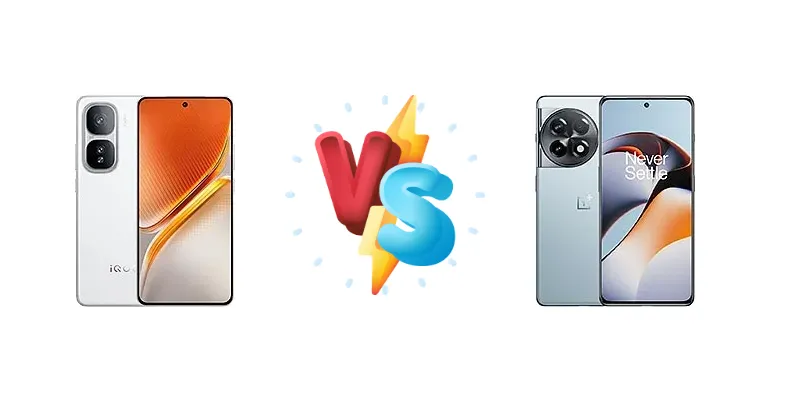
The iQOO Neo10, exclusive to the Chinese market, arrives wielding Qualcomm’s newest Snapdragon 8 Gen 3, promising a leap in performance. However, the OnePlus 11R, with its Snapdragon 8+ Gen 1, remains a compelling option, particularly for those seeking a balance of power and price. This comparison dissects these two devices to determine which offers the best experience for your needs.
🏆 Quick Verdict
For users prioritizing raw processing power and future-proofing, the iQOO Neo10 is the clear winner thanks to the Snapdragon 8 Gen 3. However, the OnePlus 11R delivers excellent performance at a potentially lower price point, making it a strong contender for budget-conscious gamers and power users.
| Network |
|---|
| 2G bands | GSM 850 / 900 / 1800 / 1900 | GSM 850 / 900 / 1800 / 1900 |
| 3G bands | HSDPA 800 / 850 / 900 / 1700(AWS) / 1900 / 2100 | HSDPA 850 / 900 / 1700(AWS) / 2100 |
| 4G bands | 1, 3, 4, 5, 7, 8, 18, 19, 26, 28, 34, 38, 39, 40, 41 | 1, 3, 4, 5, 8, 28, 34, 38, 39, 40, 41 |
| 5G bands | 1, 3, 5, 8, 28, 38, 40, 41, 77, 78 SA/NSA | 1, 3, 5, 8, 28, 40, 41, 77, 78 SA/NSA |
| Speed | HSPA, LTE, 5G | HSPA, LTE (3CA), 5G |
| Technology | GSM / HSPA / LTE / 5G | GSM / CDMA / HSPA / LTE / 5G |
| | - | CDMA 800 |
| Launch |
|---|
| Announced | 2024, November 29 | 2023, February 07 |
| Status | Available. Released 2024, November 29 | Available. Released 2023, February 21 |
| Body |
|---|
| Build | - | Glass front, glass back (Gorilla Glass 5), plastic frame |
| Dimensions | 162.9 x 75.4 x 8 mm (6.41 x 2.97 x 0.31 in) | 163.4 x 74.3 x 8.7 mm (6.43 x 2.93 x 0.34 in) |
| SIM | Nano-SIM + Nano-SIM | Nano-SIM + Nano-SIM |
| Weight | 199 g or 206 g (7.05 oz) | 204 g (7.20 oz) |
| Display |
|---|
| Resolution | 1260 x 2800 pixels, 20:9 ratio (~453 ppi density) | 1240 x 2772 pixels, 20:9 ratio (~451 ppi density) |
| Size | 6.78 inches, 111.0 cm2 (~90.4% screen-to-body ratio) | 6.74 inches, 109.2 cm2 (~90.0% screen-to-body ratio) |
| Type | LTPO AMOLED, 1B colors, 144Hz, HDR10+, 1800 nits (HBM), 4500 nits (peak) | Fluid AMOLED, 1B colors, 120Hz, HDR10+, 1450 nits (peak) |
| Platform |
|---|
| CPU | Octa-core (1x3.3 GHz Cortex-X4 & 3x3.2 GHz Cortex-A720 & 2x3.0 GHz Cortex-A720 & 2x2.3 GHz Cortex-A520) | Octa-core (1x3.0 GHz Cortex-X2 & 3x2.5 GHz Cortex-A710 & 4x1.80 GHz Cortex-A510) |
| Chipset | Qualcomm SM8650-AB Snapdragon 8 Gen 3 (4 nm) | Qualcomm SM8475 Snapdragon 8+ Gen 1 (4 nm) |
| GPU | Adreno 750 | Adreno 730 |
| OS | Android 15, OriginOS 5 | Android 13, upgradable to Android 15, OxygenOS 15 |
| Memory |
|---|
| Card slot | No | No |
| Internal | 256GB 12GB RAM, 256GB 16GB RAM, 512GB 12GB RAM, 512GB 16GB RAM, 1TB 16GB RAM | 128GB 8GB RAM, 256GB 16GB RAM, 512GB 18GB RAM |
| | - | UFS 3.1 |
| Main Camera |
|---|
| Dual | 50 MP, f/1.8, (wide), 1/1.56", PDAF, OIS
8 MP, f/2.2, 119˚ (ultrawide) | - |
| Features | LED flash, panorama, HDR | Color spectrum sensor, LED flash, HDR, panorama |
| Single | - | 16 MP, f/2.4, 24mm (wide), 1/3.09", 1.0µm |
| Triple | - | 50 MP, f/1.8, 24mm (wide), 1/1.56", 1.0µm, multi-directional PDAF, OIS
8 MP, f/2.2, 120˚ (ultrawide), 1/4.0", 1.12µm
2 MP (macro) |
| Video | 8K, 4K, 1080p, gyro-EIS | 4K@30/60fps, 1080p@30/60/240fps, gyro-EIS |
| Selfie camera |
|---|
| Features | - | HDR |
| Single | 16 MP, f/2.5, (wide) | 16 MP, f/2.4, 24mm (wide), 1/3.09", 1.0µm |
| Video | 1080p@30fps | 1080p@30fps |
| Sound |
|---|
| 3.5mm jack | - | No |
| 35mm jack | No | No |
| Loudspeaker | Yes, with stereo speakers (closed type) | Yes, with stereo speakers |
| | - | 24-bit/192kHz audio |
| Comms |
|---|
| Bluetooth | 5.4, A2DP, LE, aptX HD, aptX Adaptive, aptX Lossless, LHDC 5 | 5.3, A2DP, LE, aptX HD |
| Infrared port | Yes | Yes |
| NFC | Yes | Yes |
| Positioning | GPS (L1+L5), GLONASS, BDS (B1I+B1c+B2a), GALILEO (E1+E5a), QZSS (L1+L5) | GPS (L1+L5), GLONASS (G1), BDS (B1I+B1c+B2a), GALILEO (E1+E5a), QZSS (L1+L5) |
| Radio | No | No |
| USB | USB Type-C 2.0, OTG | USB Type-C 2.0 |
| WLAN | Wi-Fi 802.11 a/b/g/n/ac/6/7, dual-band | Wi-Fi 802.11 a/b/g/n/ac/6, dual-band |
| Features |
|---|
| Sensors | Fingerprint (under display, ultrasonic), accelerometer, gyro, proximity, compass | Fingerprint (under display, optical), accelerometer, gyro, proximity, compass |
| Battery |
|---|
| Charging | 120W wired, 100W PPS+PD, 50% in 15 min
Reverse wired | 100W wired |
| Type | Si/C Li-Ion 6100 mAh | Li-Po 5000 mAh |
| Misc |
|---|
| Colors | Black, White, Orange | Galactic Silver, Sonic Black, Solar Red |
| Models | 2425A, V2425A | CPH2487 |
| Price | About 300 EUR | About 600 EUR |
| SAR | - | 1.16 W/kg (head) 0.61 W/kg (body) |
vivo iQOO Neo10 (China)
- Latest Snapdragon 8 Gen 3 chipset for unparalleled performance.
- Ultra-fast 120W wired charging with 100W PPS+PD.
- Reverse wired charging capability for added convenience.
- Limited availability (China only).
- Potential premium price tag.
OnePlus 11R
- Excellent performance with the Snapdragon 8+ Gen 1.
- Fast 100W wired charging.
- More widely available and potentially more affordable.
- Older chipset compared to the Snapdragon 8 Gen 3.
- Lacks reverse wireless charging.
Display Comparison
While both devices likely feature high refresh rate AMOLED panels (based on brand trends), specific details like peak brightness and resolution are missing. However, the iQOO Neo10’s potential for a newer panel technology could offer advantages in color accuracy and viewing angles. The OnePlus 11R, benefiting from a mature display supply chain, likely delivers a well-calibrated and vibrant visual experience. The absence of LTPO information prevents a definitive statement on adaptive refresh rate efficiency.
Camera Comparison
Without specific camera sensor details, a direct comparison is difficult. However, given iQOO’s focus on gaming, the camera system is likely optimized for speed and social media sharing. The OnePlus 11R, historically, has offered a more balanced camera experience. The Snapdragon 8 Gen 3’s improved ISP (Image Signal Processor) in the iQOO Neo10 should provide better image processing capabilities, potentially leading to superior low-light performance and dynamic range. The absence of OIS information for both devices makes it hard to assess video stabilization capabilities.
Performance
The core difference lies in the chipsets. The iQOO Neo10’s Snapdragon 8 Gen 3 (4nm) represents a significant architectural upgrade over the OnePlus 11R’s Snapdragon 8+ Gen 1 (4nm). The Gen 3 features a new CPU configuration – 1x3.3 GHz Cortex-X4, 3x3.2 GHz Cortex-A720, 2x3.0 GHz Cortex-A720, and 2x2.3 GHz Cortex-A520 – compared to the 1x3.0 GHz Cortex-X2, 3x2.5 GHz Cortex-A710, and 4x1.80 GHz Cortex-A510 in the 11R. This translates to faster single-core and multi-core performance, particularly in CPU-intensive tasks. The newer Adreno GPU in the Gen 3 also provides a substantial graphics boost. While the 8+ Gen 1 is no slouch, the Gen 3’s efficiency gains on the 4nm node should also result in better thermal management during sustained workloads.
Battery Life
The OnePlus 11R’s 100W wired charging is impressive, but the iQOO Neo10 steps it up with 120W wired charging, plus 100W PPS+PD. This means the iQOO Neo10 can likely charge from 0-50% in just 15 minutes, significantly faster than the 11R. While battery capacity isn’t specified, the iQOO Neo10’s more efficient chipset could offset a potentially smaller battery size, resulting in comparable real-world battery life. The addition of reverse wired charging on the iQOO Neo10 adds a convenient feature for topping up accessories.
Buying Guide
Buy the vivo iQOO Neo10 (China) if you absolutely need the latest and greatest in mobile processing power, and are willing to pay a premium for it. This phone is ideal for demanding gamers, content creators, and those who want a device that will remain fast for years to come. Buy the OnePlus 11R if you prioritize value and a well-rounded experience. It offers flagship-level performance at a more accessible price, making it perfect for everyday use, gaming, and photography without breaking the bank.
Frequently Asked Questions
❓ Does the Snapdragon 8 Gen 3 in the iQOO Neo10 get significantly hotter than the Snapdragon 8+ Gen 1 in the OnePlus 11R during prolonged gaming sessions?
While the Snapdragon 8 Gen 3 is more powerful, its 4nm process and architectural improvements are designed to improve thermal efficiency. However, the increased performance also generates more heat. The iQOO Neo10 will likely require a more robust cooling system to prevent throttling during extended gaming, but should still outperform the 11R overall.
❓ Is the iQOO Neo10’s 120W charging compatible with all USB-PD chargers, or does it require a specific iQOO charger for optimal speed?
The iQOO Neo10 supports 100W PPS+PD, meaning it *should* work with many USB-PD chargers, but achieving the full 120W speed will likely require the included iQOO charger or a compatible charger specifically rated for that wattage and protocol. Using a lower-wattage charger will still charge the phone, but at a slower rate.
❓ Given the iQOO Neo10 is only available in China, what are the import risks and potential costs associated with purchasing one?
Importing the iQOO Neo10 carries risks including potential customs fees, taxes, and warranty limitations. Software compatibility (language and regional restrictions) can also be an issue. The total cost, including shipping and import duties, could significantly increase the price compared to locally available alternatives.