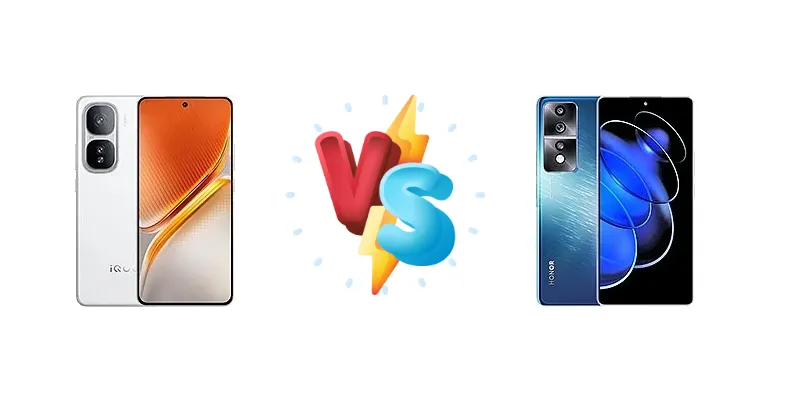
The iQOO Neo10 and Honor 80 GT represent compelling options in the competitive mid-to-high range smartphone market, particularly within China. The iQOO Neo10 boasts the latest Snapdragon 8 Gen 3, while the Honor 80 GT leverages the still-potent Snapdragon 8+ Gen 1. This comparison dissects the key differences to determine which device delivers the best experience for your needs.
🏆 Quick Verdict
For users prioritizing raw performance and future-proofing, the iQOO Neo10 is the clear winner. Its Snapdragon 8 Gen 3 offers a significant leap in CPU and GPU capabilities. However, the Honor 80 GT provides excellent value, delivering flagship-level performance at a potentially lower price point, making it a strong contender for budget-conscious gamers.
| Network |
|---|
| 2G bands | GSM 850 / 900 / 1800 / 1900 | GSM 850 / 900 / 1800 / 1900 |
| 3G bands | HSDPA 800 / 850 / 900 / 1700(AWS) / 1900 / 2100 | HSDPA 800 / 850 / 900 / 1700(AWS) / 2100 |
| 4G bands | 1, 3, 4, 5, 7, 8, 18, 19, 26, 28, 34, 38, 39, 40, 41 | 1, 3, 4, 5, 8, 19, 28, 34, 38, 39, 40, 41 |
| 5G bands | 1, 3, 5, 8, 28, 38, 40, 41, 77, 78 SA/NSA | 1, 5, 8, 28, 41, 77, 78 SA/NSA |
| Speed | HSPA, LTE, 5G | HSPA, LTE, 5G |
| Technology | GSM / HSPA / LTE / 5G | GSM / CDMA / HSPA / CDMA2000 / LTE / 5G |
| | - | CDMA2000 1x |
| Launch |
|---|
| Announced | 2024, November 29 | 2022, December 26 |
| Status | Available. Released 2024, November 29 | Available. Released 2022, December 26 |
| Body |
|---|
| Dimensions | 162.9 x 75.4 x 8 mm (6.41 x 2.97 x 0.31 in) | 162.5 x 75.3 x 7.9 mm (6.40 x 2.96 x 0.31 in) |
| SIM | Nano-SIM + Nano-SIM | Nano-SIM + Nano-SIM |
| Weight | 199 g or 206 g (7.05 oz) | 187 g or 195 g (6.60 oz) |
| Display |
|---|
| Resolution | 1260 x 2800 pixels, 20:9 ratio (~453 ppi density) | 1080 x 2400 pixels, 20:9 ratio (~395 ppi density) |
| Size | 6.78 inches, 111.0 cm2 (~90.4% screen-to-body ratio) | 6.67 inches, 107.4 cm2 (~87.8% screen-to-body ratio) |
| Type | LTPO AMOLED, 1B colors, 144Hz, HDR10+, 1800 nits (HBM), 4500 nits (peak) | AMOLED, 1B colors, 120Hz, HDR10, 1400 nits (peak) |
| Platform |
|---|
| CPU | Octa-core (1x3.3 GHz Cortex-X4 & 3x3.2 GHz Cortex-A720 & 2x3.0 GHz Cortex-A720 & 2x2.3 GHz Cortex-A520) | Octa-core (1x3.0 GHz Cortex-X2 & 3x2.5 GHz Cortex-A710 & 4x1.80 GHz Cortex-A510) |
| Chipset | Qualcomm SM8650-AB Snapdragon 8 Gen 3 (4 nm) | Qualcomm SM8475 Snapdragon 8+ Gen 1 (4 nm) |
| GPU | Adreno 750 | Adreno 730 |
| OS | Android 15, OriginOS 5 | Android 12, MagicOS 7 |
| Memory |
|---|
| Card slot | No | No |
| Internal | 256GB 12GB RAM, 256GB 16GB RAM, 512GB 12GB RAM, 512GB 16GB RAM, 1TB 16GB RAM | 256GB 12GB RAM, 256GB 16GB RAM, 512GB 12GB RAM |
| Main Camera |
|---|
| Dual | 50 MP, f/1.8, (wide), 1/1.56", PDAF, OIS
8 MP, f/2.2, 119˚ (ultrawide) | - |
| Features | LED flash, panorama, HDR | LED flash, HDR, panorama |
| Single | - | 16 MP, f/2.4, (wide) |
| Triple | - | 54 MP, f/1.9, (wide), 1/1.49", PDAF
8 MP, f/2.2, (ultrawide)
2 MP (macro) |
| Video | 8K, 4K, 1080p, gyro-EIS | 4K@30fps, 1080p@30/60fps, gyro-EIS |
| Selfie camera |
|---|
| Single | 16 MP, f/2.5, (wide) | 16 MP, f/2.4, (wide) |
| Video | 1080p@30fps | 1080p@30fps, gyro-EIS |
| Sound |
|---|
| 3.5mm jack | - | No |
| 35mm jack | No | No |
| Loudspeaker | Yes, with stereo speakers (closed type) | Yes |
| Comms |
|---|
| Bluetooth | 5.4, A2DP, LE, aptX HD, aptX Adaptive, aptX Lossless, LHDC 5 | 5.2, A2DP, LE, aptX HD |
| Infrared port | Yes | Yes |
| NFC | Yes | Yes |
| Positioning | GPS (L1+L5), GLONASS, BDS (B1I+B1c+B2a), GALILEO (E1+E5a), QZSS (L1+L5) | GPS, GALILEO, GLONASS, BDS, QZSS |
| Radio | No | No |
| USB | USB Type-C 2.0, OTG | USB Type-C 2.0, OTG |
| WLAN | Wi-Fi 802.11 a/b/g/n/ac/6/7, dual-band | Wi-Fi 802.11 a/b/g/n/ac/6, dual-band, Wi-Fi Direct |
| Features |
|---|
| Sensors | Fingerprint (under display, ultrasonic), accelerometer, gyro, proximity, compass | Fingerprint (under display, optical), accelerometer, gyro, compass |
| | - | Virtual proximity sensing |
| Battery |
|---|
| Charging | 120W wired, 100W PPS+PD, 50% in 15 min
Reverse wired | 66W wired, 3-50% in 15 min
5W reverse wired |
| Type | Si/C Li-Ion 6100 mAh | Li-Po 4800 mAh |
| Misc |
|---|
| Colors | Black, White, Orange | Black, Blue, White |
| Models | 2425A, V2425A | AGT-AN00 |
| Price | About 300 EUR | About 450 EUR |
vivo iQOO Neo10 (China)
- Significantly faster charging (120W)
- Latest Snapdragon 8 Gen 3 processor
- Potentially superior camera system
- May be more expensive
- Availability limited to China
Honor 80 GT
- Excellent value for the performance
- Still a very capable Snapdragon 8+ Gen 1
- Potentially wider availability
- Slower charging (66W)
- Older processor architecture
Display Comparison
Context data lacks display specifics. However, given the market positioning, both devices likely feature high refresh rate AMOLED panels. The iQOO Neo10, being newer, may benefit from a slightly brighter panel and potentially LTPO technology for adaptive refresh rates, improving power efficiency. Honor typically focuses on color accuracy, so expect a well-calibrated display on the 80 GT. Bezels are likely comparable, with both aiming for an immersive viewing experience.
Camera Comparison
Without specific camera sensor details, it’s difficult to make a definitive judgment. However, given the iQOO Neo10’s newer status, it’s reasonable to expect a more advanced camera system, potentially with a larger main sensor and improved image processing algorithms. The Honor 80 GT likely relies on a well-tuned camera system optimized for its target market, but may lack the latest advancements in computational photography found in the iQOO Neo10. We can assume both phones will offer capable cameras for everyday use, but the iQOO Neo10 likely has an edge in low-light performance and dynamic range.
Performance
The iQOO Neo10’s Snapdragon 8 Gen 3 (4nm) represents a substantial upgrade over the Honor 80 GT’s Snapdragon 8+ Gen 1 (4nm). The 8 Gen 3’s Cortex-X4 prime core, clocked at 3.3 GHz, offers significantly improved single-core performance compared to the 8+ Gen 1’s Cortex-X2 at 3.0 GHz. The newer architecture also translates to a more efficient GPU, resulting in higher frame rates and sustained performance during extended gaming sessions. While both chips are built on a 4nm process, the architectural improvements in the 8 Gen 3 minimize thermal throttling. The iQOO Neo10’s CPU configuration (1+3+2+2) also suggests a more balanced approach to power and efficiency compared to the 80 GT’s (1+3+4).
Battery Life
The iQOO Neo10’s 120W wired charging is a significant advantage, capable of charging 50% in just 15 minutes. The Honor 80 GT’s 66W charging, while still fast, is considerably slower. The iQOO Neo10 also supports 100W PPS+PD, offering wider compatibility with chargers. While battery capacity isn’t specified, the faster charging of the iQOO Neo10 mitigates the impact of a potentially smaller battery, allowing for quicker top-ups throughout the day. The iQOO Neo10 also offers reverse wired charging, a feature absent or limited on the Honor 80 GT.
Buying Guide
Buy the vivo iQOO Neo10 (China) if you demand the absolute best performance for demanding tasks like gaming and video editing, and value the fastest charging speeds available. Buy the Honor 80 GT if you prioritize a balanced experience with excellent performance for the price, and are comfortable with slightly slower charging and a less cutting-edge processor.
Frequently Asked Questions
❓ Does the Snapdragon 8+ Gen 1 in the Honor 80 GT suffer from significant thermal throttling during prolonged gaming sessions?
While the Snapdragon 8+ Gen 1 is a capable chip, it is known to generate more heat than newer processors. The Honor 80 GT likely incorporates thermal management solutions to mitigate throttling, but users may experience some performance degradation during extended, graphically intensive gaming sessions. The iQOO Neo10's Snapdragon 8 Gen 3, with its improved efficiency, is less prone to throttling.
❓ How does the 120W charging on the iQOO Neo10 compare to the 66W charging on the Honor 80 GT in real-world usage?
The iQOO Neo10's 120W charging is substantially faster. While Honor claims 3-50% in 15 minutes, the iQOO Neo10 achieves 50% in the same timeframe. This translates to significantly less downtime plugged into the wall, making the iQOO Neo10 ideal for users who need to quickly top up their battery.
❓ Is the iQOO Neo10 officially available outside of China, and what are the implications for warranty and software updates?
Currently, the iQOO Neo10 is primarily a China-focused device. Official global availability is limited. Purchasing through import channels may void the warranty and complicate software updates, as the firmware may not be optimized for international networks or languages.