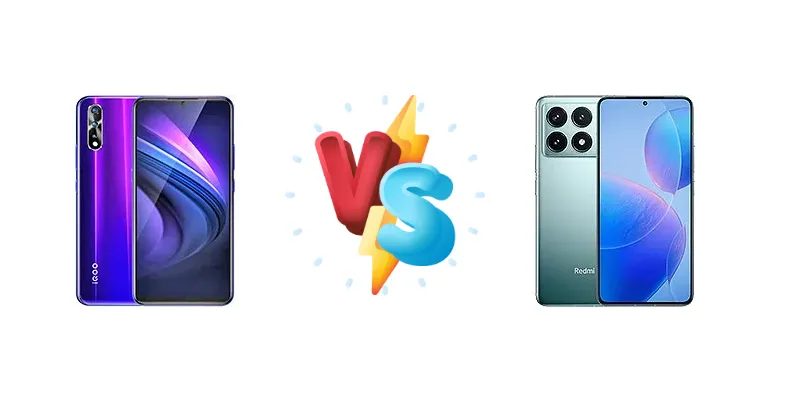
The vivo iQOO Neo represents a previous generation of performance-focused smartphones, while the Xiaomi Redmi K70 Pro arrives with cutting-edge silicon. This comparison isn't about two equally matched contenders; it's about understanding the dramatic advancements made in mobile processing and charging technology over the past few years, and whether the K70 Pro's premium features justify its likely higher price point.
🏆 Quick Verdict
For the vast majority of users, the Xiaomi Redmi K70 Pro is the clear winner. Its Snapdragon 8 Gen 3 chipset offers significantly faster performance and improved efficiency, coupled with blazing-fast 120W charging. The iQOO Neo remains a viable option for budget-conscious users prioritizing basic functionality, but it's a step behind in almost every key metric.
| Network |
|---|
| 2G bands | GSM 850 / 900 / 1800 / 1900 | GSM 850 / 900 / 1800 / 1900 |
| 3G bands | HSDPA 850 / 900 / 1700(AWS) / 2100 | HSDPA 800 / 850 / 900 / 1700(AWS) / 2100 |
| 4G bands | 1, 3, 4, 5, 8, 34, 38, 39, 40, 41 | 1, 3, 4, 5, 8, 18, 19, 26, 28, 34, 38, 39, 40, 41, 42, 48, 66 |
| 5G bands | - | 1, 3, 5, 8, 28, 38, 41, 48, 66, 77, 78 SA/NSA |
| Speed | HSPA, LTE | HSPA, LTE, 5G |
| Technology | GSM / CDMA / HSPA / LTE | GSM / CDMA / HSPA / CDMA2000 / LTE / 5G |
| | CDMA 800 & TD-SCDMA | - |
| Launch |
|---|
| Announced | 2019, July. Released 2019, July | 2023, November 29 |
| Status | Discontinued | Available. Released 2023, November 29 |
| Body |
|---|
| Build | Glass front, glass back, aluminum frame | - |
| Dimensions | 159.5 x 75.2 x 8.1 mm (6.28 x 2.96 x 0.32 in) | 160.9 x 75 x 8.2 mm (6.33 x 2.95 x 0.32 in) |
| SIM | Nano-SIM + Nano-SIM | Nano-SIM + Nano-SIM |
| Weight | 198.5 g (7.02 oz) | 209 g (7.37 oz) |
| Display |
|---|
| Resolution | 1080 x 2340 pixels, 19.5:9 ratio (~404 ppi density) | 1440 x 3200 pixels, 20:9 ratio (~526 ppi density) |
| Size | 6.38 inches, 99.9 cm2 (~83.3% screen-to-body ratio) | 6.67 inches, 107.4 cm2 (~89.0% screen-to-body ratio) |
| Type | Super AMOLED | OLED, 68B colors, 120Hz, Dolby Vision, HDR10+, 4000 nits (peak) |
| Platform |
|---|
| CPU | Octa-core (4x2.8 GHz Kryo 385 Gold & 4x1.7 GHz Kryo 385 Silver) | Octa-core (1x3.3 GHz Cortex-X4 & 3x3.2 GHz Cortex-A720 & 2x3.0 GHz Cortex-A720 & 2x2.3 GHz Cortex-A520) |
| Chipset | Qualcomm SDM845 Snapdragon 845 (10 nm) | Qualcomm SM8650-AB Snapdragon 8 Gen 3 (4 nm) |
| GPU | Adreno 630 | Adreno 750 |
| OS | Android 9.0 (Pie), Funtouch 9 | Android 14, HyperOS |
| Memory |
|---|
| Card slot | No | No |
| Internal | 64GB 6GB RAM, 64GB 8GB RAM, 128GB 6GB RAM, 128GB 8GB RAM | 256GB 12GB RAM, 256GB 16GB RAM, 512GB 12GB RAM, 512GB 16GB RAM, 1TB 24GB RAM |
| Main Camera |
|---|
| Features | LED flash, HDR, panorama | Color spectrum sensor, LED flash, HDR, panorama |
| Triple | 12 MP, f/1.8, 1/2.55", 1.4µm, dual pixel PDAF
8 MP, f/2.2, (wide)
Auxiliary lens | 50 MP, f/1.6, (wide), 1/1.55", 1.0µm, PDAF, OIS
50 MP, (telephoto), PDAF, 2x optical zoom
12 MP, (ultrawide) |
| Video | 4K@30fps, 1080p@30fps | 8K@24fps, 4K@24/30/60fps, 1080p@30/60/120/240/960fps, 720p@1920fps, gyro-EIS |
| Selfie camera |
|---|
| Features | HDR | HDR |
| Single | 12 MP, f/2.0, (wide), 1/2.8", 1.28µm | 16 MP, (wide) |
| Video | 1080p@30fps | 1080p@30/60fps, gyro-EIS |
| Sound |
|---|
| 3.5mm jack | Yes | - |
| 35mm jack | Yes | No |
| Loudspeaker | Yes | Yes, with stereo speakers |
| | 32-bit/192kHz audio
| - |
| Comms |
|---|
| Bluetooth | 5.0, A2DP, LE, aptX | 5.4, A2DP, LE, aptX HD, aptX Adaptive, aptX Lossless |
| Infrared port | - | Yes |
| NFC | No | Yes |
| Positioning | GPS, GLONASS, BDS, GALILEO | GPS (L1+L5), GLONASS (G1), BDS (B1I+B1c+B2a), GALILEO (E1+E5a), QZSS (L1+L5), NavIC (L5) |
| Radio | No | No |
| USB | USB Type-C, OTG | USB Type-C, OTG |
| WLAN | Wi-Fi 802.11 a/b/g/n/ac, dual-band, Wi-Fi Direct | Wi-Fi 802.11 a/b/g/n/ac/6e/7, dual-band, Wi-Fi Direct |
| Features |
|---|
| Sensors | Fingerprint (under display, optical), accelerometer, gyro, proximity, compass | Fingerprint (under display, optical), accelerometer, proximity, gyro, compass |
| Battery |
|---|
| Charging | 22.5W wired | 120W wired, PD3.0, QC3+, 100% in 18 min |
| Type | 4500 mAh, non-removable | Li-Po 5000 mAh |
| Misc |
|---|
| Colors | Black, Purple | Black, Silver, Blue/Green, Lamborgini Green, Lamborgini Yellow |
| Models | V1914A | 23117RK66C |
| Price | About 250 EUR | About 430 EUR |
vivo iQOO Neo
- Significantly lower price point
- Potentially larger battery capacity (speculation)
- Familiar Android experience
- Outdated chipset and slow performance
- Slow 22.5W charging
- Inferior camera system
Xiaomi Redmi K70 Pro
- Blazing-fast Snapdragon 8 Gen 3 performance
- Ultra-fast 120W charging
- Superior display quality (likely)
- Advanced camera system (likely)
- Higher price tag
- Potential for more aggressive thermal throttling under sustained load (though the 4nm process helps)
Display Comparison
Context data lacks display specifics for both devices. However, given the iQOO Neo's age, it likely features an LCD panel with a standard 60Hz refresh rate. The Redmi K70 Pro, being a more recent flagship, almost certainly boasts a high-resolution AMOLED display with at least a 120Hz refresh rate, and potentially LTPO technology for variable refresh rate and improved power efficiency. Expect significantly better color accuracy, contrast, and viewing angles on the K70 Pro. Bezels are also likely to be slimmer on the newer device.
Camera Comparison
Without specific camera specs, we can infer differences based on the devices' positioning. The iQOO Neo likely features a competent but mid-range camera system. The Redmi K70 Pro, as a flagship, is expected to have a more advanced camera setup, potentially including a larger main sensor with optical image stabilization (OIS) and improved image processing algorithms. The K70 Pro's image processing will likely prioritize dynamic range and detail, while the iQOO Neo may lean towards more saturated colors. The aperture of the main lens on the K70 Pro will likely be wider, improving low-light performance.
Performance
The core difference lies in the chipsets. The iQOO Neo's Snapdragon 845 (10nm) was a flagship in its time, featuring an octa-core CPU with peak speeds of 2.8GHz. However, the Redmi K70 Pro's Snapdragon 8 Gen 3 (4nm) is in a different league. The 4nm process node provides superior power efficiency, allowing for sustained performance without significant throttling. The CPU architecture is also vastly improved, with the K70 Pro utilizing a Cortex-X4 prime core clocked at 3.3GHz, alongside newer Cortex-A720 performance cores. This translates to a substantial increase in both single-core and multi-core performance, benefiting everything from app launch speeds to demanding games. The K70 Pro will also benefit from faster LPDDR5x RAM, further enhancing responsiveness.
Battery Life
The iQOO Neo's 22.5W wired charging is slow by today's standards, requiring over an hour to fully charge. The Redmi K70 Pro's 120W wired charging is a game-changer, capable of charging the battery from 0 to 100% in approximately 18 minutes. While the iQOO Neo might have a slightly larger battery capacity, the K70 Pro's faster charging and more efficient chipset will likely result in comparable, if not better, real-world battery life. The K70 Pro also supports PD3.0 and QC3+ standards, offering wider compatibility with chargers.
Buying Guide
Buy the vivo iQOO Neo if you need a functional smartphone for everyday tasks and light gaming, and your budget is extremely limited. It's a good choice for those upgrading from very old devices. Buy the Xiaomi Redmi K70 Pro if you prioritize performance for demanding games, content creation, or simply want a future-proofed device with incredibly fast charging and a more refined user experience. It's ideal for power users and mobile gamers.
Frequently Asked Questions
❓ Will the Redmi K70 Pro get noticeably hot during extended gaming sessions?
While the Snapdragon 8 Gen 3 is more efficient than the 845, it's still a powerful chip. Expect some heat during prolonged gaming, but the K70 Pro likely incorporates advanced cooling solutions to mitigate throttling and maintain stable performance. The 4nm process also contributes to better thermal management compared to the iQOO Neo's 10nm chip.
❓ Is the performance difference between the Snapdragon 845 and 8 Gen 3 noticeable in everyday tasks?
Absolutely. While both phones can handle basic tasks like browsing and social media, the Snapdragon 8 Gen 3 offers a much smoother and more responsive experience. App launch times will be significantly faster, and multitasking will be more fluid. The difference is most apparent in demanding applications and games.
❓ Does the Redmi K70 Pro support wireless charging?
Context data does not specify wireless charging support. However, many flagship Xiaomi devices include wireless charging, so it's a likely feature of the K70 Pro. The iQOO Neo does not support wireless charging.