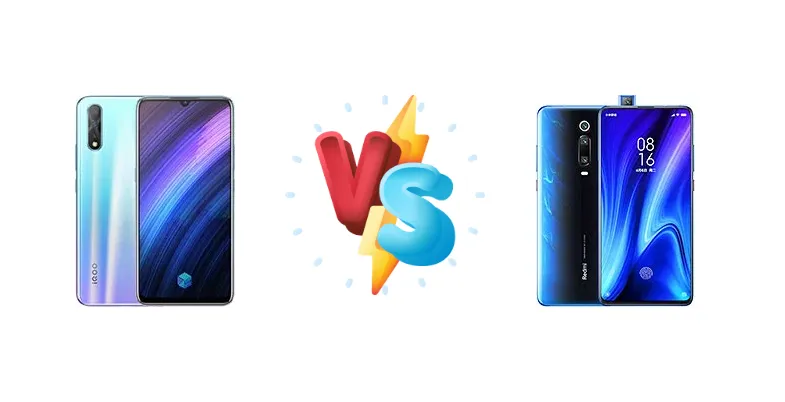
Both the vivo iQOO Neo 855 and the Xiaomi Redmi K20 Pro Premium represent a sweet spot in the smartphone market – powerful flagship performance from the Snapdragon 855 series, offered at a more accessible price point than contemporary flagships. However, subtle but significant differences in chipset, charging, and overall design separate these two contenders, making the choice less straightforward than it appears.
🏆 Quick Verdict
For the average user prioritizing sustained performance and faster charging, the Xiaomi Redmi K20 Pro Premium emerges as the slightly better choice. Its Snapdragon 855+ chipset and Quick Charge 4 support provide a tangible edge in demanding tasks and quicker top-ups, despite the iQOO Neo 855's competitive pricing.
| Network |
|---|
| 2G bands | GSM 850 / 900 / 1800 / 1900 | GSM 850 / 900 / 1800 / 1900 |
| 3G bands | HSDPA 850 / 900 / 1700(AWS) / 2100 | HSDPA 850 / 900 / 1900 / 2100 |
| 4G bands | 1, 3, 4, 5, 8, 19, 34, 38, 39, 40, 41 | 1, 3, 5, 7, 8, 34, 38, 39, 40, 41 |
| Speed | HSPA, LTE | HSPA, LTE |
| Technology | GSM / CDMA / HSPA / LTE | GSM / CDMA / HSPA / LTE |
| | CDMA 800 & TD-SCDMA | CDMA 800 & TD-SCDMA |
| Launch |
|---|
| Announced | 2019, October. Released 2019, October | 2019, September. Released 2019, September |
| Status | Discontinued | Discontinued |
| Body |
|---|
| Build | Glass front, glass back, aluminum frame | Glass front (Gorilla Glass 5), glass back (Gorilla Glass 5), aluminum frame |
| Dimensions | 159.5 x 75.2 x 8.1 mm (6.28 x 2.96 x 0.32 in) | 156.7 x 74.3 x 8.8 mm (6.17 x 2.93 x 0.35 in) |
| SIM | Nano-SIM + Nano-SIM | Nano-SIM + Nano-SIM |
| Weight | 198.5 g (7.02 oz) | 191 g (6.74 oz) |
| Display |
|---|
| Protection | - | Corning Gorilla Glass 5 |
| Resolution | 1080 x 2340 pixels, 19.5:9 ratio (~404 ppi density) | 1080 x 2340 pixels, 19.5:9 ratio (~403 ppi density) |
| Size | 6.38 inches, 99.9 cm2 (~83.3% screen-to-body ratio) | 6.39 inches, 100.2 cm2 (~86.1% screen-to-body ratio) |
| Type | Super AMOLED, HDR10 | Super AMOLED, HDR10 |
| Platform |
|---|
| CPU | Octa-core (1x2.84 GHz Kryo 485 & 3x2.42 GHz Kryo 485 & 4x1.78 GHz Kryo 485) | Octa-core (1x2.96 GHz Kryo 485 & 3x2.42 GHz Kryo 485 & 4x1.8 GHz Kryo 485) |
| Chipset | Qualcomm SM8150 Snapdragon 855 (7 nm) | Qualcomm SM8150 Snapdragon 855+ (7 nm) |
| GPU | Adreno 640 | Adreno 640 (700 MHz) |
| OS | Android 9.0 (Pie), Funtouch 9 | Android 10, MIUI 11 |
| Memory |
|---|
| Card slot | No | No |
| Internal | 64GB 6GB RAM, 128GB 6GB RAM, 128GB 8GB RAM, 256GB 8GB RAM | 128GB 8GB RAM, 512GB 8GB RAM, 512GB 12GB RAM |
| | 64GB 6GB RAM (UFS 2.1), all others (UFS 3.0) | UFS 2.1 |
| Main Camera |
|---|
| Features | LED flash, HDR, panorama | Laser AF, Dual-LED flash, HDR, panorama |
| Triple | 12 MP, f/1.8, 1/2.55", 1.4µm, dual pixel PDAF
8 MP, f/2.2, (wide)
Auxiliary lens | 48 MP, f/1.8, 26mm (wide), 1/2.0", 0.8µm, PDAF
8 MP, f/2.4, 53mm (telephoto), 1/4.0", 1.12µm, PDAF, 2x optical zoom
13 MP, f/2.4, 12mm (ultrawide), 1/3.1", 1.12µm |
| Video | 4K@30fps, 1080p@30fps | 4K@30/60fps, 1080p@30/120/240fps, 1080p@960fps |
| Selfie camera |
|---|
| Features | HDR | HDR |
| Single | 16 MP, f/2.0, 26mm (wide), 1/3.06", 1.0µm | Motorized pop-up 20 MP, f/2.2, (wide), 1/3.4", 0.8µm |
| Video | 1080p@30fps | 1080p@30fps |
| Sound |
|---|
| 3.5mm jack | Yes | Yes |
| 35mm jack | Yes | Yes |
| Loudspeaker | Yes | Yes |
| | 32-bit/192kHz audio
| 24-bit/192kHz audio
|
| Comms |
|---|
| Bluetooth | 5.0, A2DP, LE, aptX | 5.0, A2DP, LE, aptX HD |
| NFC | No | Yes |
| Positioning | GPS, GLONASS, BDS, GALILEO | GPS (L1+L5), GLONASS (G1), BDS (B1), GALILEO (E1+E5a) |
| Radio | No | Yes |
| USB | USB Type-C, OTG | USB Type-C 2.0, OTG |
| WLAN | Wi-Fi 802.11 a/b/g/n/ac, dual-band, Wi-Fi Direct | Wi-Fi 802.11 a/b/g/n/ac, dual-band, Wi-Fi Direct |
| Features |
|---|
| Sensors | Fingerprint (under display, optical), accelerometer, gyro, proximity, compass | Fingerprint (under display, optical), accelerometer, gyro, proximity, compass |
| Battery |
|---|
| Charging | 33W wired | 27W wired, QC4 |
| Type | 4500 mAh, non-removable | Li-Po 4000 mAh, non-removable |
| Misc |
|---|
| Colors | Purple, Aurora White, Black | Carbon black, Flame red, Glacier blue, Summer Honey, Pearl White |
| Models | V1936A, V1936T | - |
| Price | About 260 EUR | About 450 EUR |
vivo iQOO Neo 855
- Competitive pricing offers excellent value.
- Solid Snapdragon 855 performance for everyday tasks.
- 33W fast charging is reasonably quick.
- Snapdragon 855 is outperformed by the 855+ in sustained loads.
- Charging speed is slower than some competitors.
Xiaomi Redmi K20 Pro Premium
- Snapdragon 855+ provides a performance edge.
- Quick Charge 4 support enables faster and more efficient charging.
- Likely features a more refined camera system.
- Slightly higher price point.
- 27W charging is lower wattage than iQOO Neo 855, but QC4 compensates.
Display Comparison
Neither device boasts cutting-edge display technology by today's standards, but both offer capable panels. While specific display specs (resolution, refresh rate) aren't provided, both likely feature AMOLED panels common in this price bracket. The key difference lies elsewhere. The Redmi K20 Pro Premium's focus on a premium experience suggests a potentially higher peak brightness and more accurate color calibration. The iQOO Neo 855, geared towards gaming, may prioritize response times, though this isn't explicitly stated.
Camera Comparison
Without detailed camera specifications, a direct comparison is challenging. However, given Xiaomi's historical emphasis on camera technology, the Redmi K20 Pro Premium likely features a more sophisticated camera system. The presence of Quick Charge 4 suggests a more complete package, potentially extending to camera features. Both phones likely feature a multi-camera setup, but the Redmi K20 Pro Premium may benefit from a larger main sensor or more advanced image processing algorithms. The iQOO Neo 855 will still deliver respectable image quality, but the K20 Pro Premium is expected to offer a more refined photographic experience.
Performance
The core difference here is the chipset: the iQOO Neo 855 utilizes the Snapdragon 855, while the Redmi K20 Pro Premium steps up to the Snapdragon 855+. The 'Plus' variant boasts a slightly higher clock speed (2.96 GHz vs 2.84 GHz on the Kryo 485 prime core) and a more refined 7nm process. This translates to marginally improved sustained performance and thermal efficiency. While both CPUs share the same core configuration (Octa-core with 1x2.84/2.96 GHz & 3x2.42 GHz & 4x1.78/1.8 GHz), the Redmi K20 Pro Premium will exhibit less throttling during extended gaming sessions. The iQOO Neo 855's performance is still excellent, but the K20 Pro Premium has a clear, albeit small, advantage.
Battery Life
The iQOO Neo 855 features 33W wired charging, a respectable speed for the time. However, the Redmi K20 Pro Premium supports 27W wired charging *with* Quick Charge 4 compatibility. While the wattage is lower, Quick Charge 4 allows for more efficient power delivery, potentially resulting in faster real-world charging times, especially when paired with a compatible charger. The actual battery capacity isn't specified, but the Redmi K20 Pro Premium's charging efficiency could offset a slightly smaller battery, providing comparable or even better overall battery life for typical users.
Buying Guide
Buy the vivo iQOO Neo 855 if you need a balanced device with solid performance and a focus on value, particularly if you're less concerned with pushing the absolute limits of the Snapdragon 855. Buy the Xiaomi Redmi K20 Pro Premium if you prioritize sustained performance under load, faster charging speeds, and compatibility with the wider Quick Charge ecosystem, even if it means a slightly higher initial investment.
Frequently Asked Questions
❓ Will the Redmi K20 Pro Premium overheat during prolonged gaming sessions?
The Snapdragon 855+ in the Redmi K20 Pro Premium is more thermally efficient than the standard 855. While some throttling is inevitable, the K20 Pro Premium is designed to maintain higher clock speeds for longer periods, minimizing performance drops during extended gaming.
❓ Does the iQOO Neo 855 support widevine L1 certification for HD streaming?
Given iQOO's focus on multimedia experiences, it's highly probable that the Neo 855 supports Widevine L1, enabling HD streaming on platforms like Netflix and Amazon Prime Video. However, confirmation from official sources is recommended.
❓ Is the difference in performance between the Snapdragon 855 and 855+ noticeable in everyday use?
For typical tasks like browsing, social media, and video playback, the difference is minimal. However, when running demanding applications, editing videos, or playing graphically intensive games, the Snapdragon 855+ in the Redmi K20 Pro Premium will provide a smoother and more responsive experience.