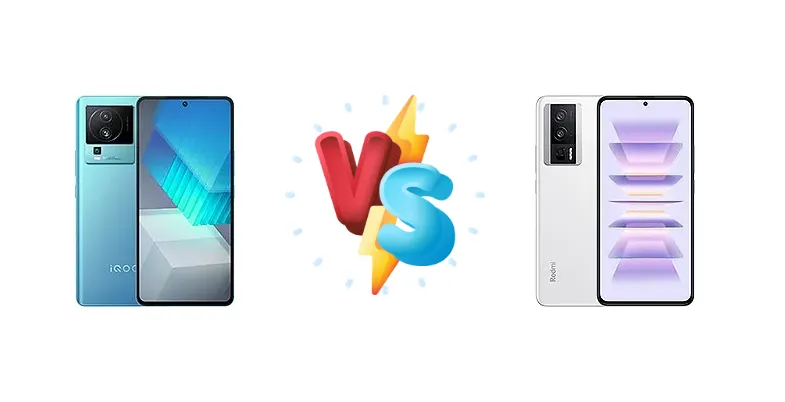
Both the Xiaomi Redmi K60 Pro and the vivo iQOO Neo 7 represent compelling value in the mid-to-high range smartphone market. The K60 Pro aims for near-flagship performance with Qualcomm’s Snapdragon 8 Gen 2, while the iQOO Neo 7 prioritizes rapid charging and a balanced experience with the MediaTek Dimensity 8200. This comparison dissects their key differences to determine which device best suits your needs.
🏆 Quick Verdict
For most users, the Xiaomi Redmi K60 Pro emerges as the stronger choice. The Snapdragon 8 Gen 2 provides a noticeable performance uplift, particularly in demanding tasks and gaming, and the addition of 30W wireless charging adds convenience. However, the iQOO Neo 7’s incredibly fast 120W wired charging remains a significant advantage for those prioritizing speed.
| Network |
|---|
| 2G bands | GSM 850 / 900 / 1800 / 1900 | GSM 850 / 900 / 1800 / 1900 |
| 3G bands | HSDPA 850 / 900 / 2100 - India | HSDPA 800 / 850 / 900 / 1700(AWS) / 2100 |
| 4G bands | 1, 3, 5, 8, 28, 38, 40, 41 - India | 1, 3, 4, 5, 8, 18, 19, 26, 34, 38, 39, 40, 41, 42 |
| 5G bands | 1, 3, 5, 8, 28, 41, 77, 78 SA/NSA - India | 1, 3, 5, 8, 28, 38, 41, 77, 78 SA/NSA |
| Speed | HSPA, LTE, 5G | HSPA, LTE, 5G |
| Technology | GSM / HSPA / LTE / 5G | GSM / CDMA / HSPA / CDMA2000 / LTE / 5G |
| | - | CDMA2000 1x |
| Launch |
|---|
| Announced | 2023, February 16 | 2022, December 27 |
| Status | Available. Released 2023, February 16 | Available. Released 2023, January 01 |
| Body |
|---|
| Build | Glass front, plastic frame, plastic back | - |
| Dimensions | 164.8 x 76.9 x 8.6 mm (6.49 x 3.03 x 0.34 in) | 162.8 x 75.4 x 8.6 mm or 8.9 mm |
| SIM | Nano-SIM + Nano-SIM | Nano-SIM + Nano-SIM |
| Weight | 193 g (6.81 oz) | 201 g or 205 g (7.09 oz) |
| Display |
|---|
| Resolution | 1080 x 2400 pixels, 20:9 ratio (~388 ppi density) | 1440 x 3200 pixels, 20:9 ratio (~526 ppi density) |
| Size | 6.78 inches, 111.0 cm2 (~87.6% screen-to-body ratio) | 6.67 inches, 107.4 cm2 (~87.5% screen-to-body ratio) |
| Type | AMOLED, 120Hz, HDR10+, 500 nits (typ), 1000 nits (HBM), 1300 nits (peak) | OLED, 68B colors, 120Hz, Dolby Vision, HDR10+, 1400 nits (peak) |
| | Always-on display | - |
| Platform |
|---|
| CPU | Octa-core (1x3.1 GHz Cortex-A78 & 3x3.0 GHz Cortex-A78 & 4x2.0 GHz Cortex-A55) | Octa-core (1x3.2 GHz Cortex-X3 & 2x2.8 GHz Cortex-A715 & 2x2.8 GHz Cortex-A710 & 3x2.0 GHz Cortex-A510) |
| Chipset | Mediatek Dimensity 8200 (4 nm) | Qualcomm SM8550-AB Snapdragon 8 Gen 2 (4 nm) |
| GPU | Mali-G610 MC6 | Adreno 740 |
| OS | Android 13, Funtouch 13 | Android 13, MIUI 14 |
| Memory |
|---|
| Card slot | No | No |
| Internal | 128GB 8GB RAM, 256GB 12GB RAM | 128GB 8GB RAM, 256GB 8GB RAM, 256GB 12GB RAM, 512GB 12GB RAM, 512GB 16GB RAM |
| | UFS 3.1 | UFS 4.0
UFS 3.1 - 128GB only |
| Main Camera |
|---|
| Features | LED flash, HDR, panorama | Color spectrum sensor, Dual-LED dual-tone flash, HDR, panorama |
| Single | 16 MP, f/2.5, (wide) | - |
| Triple | 64 MP, f/1.8, 24mm (wide), 1/1.97", 0.7µm, PDAF, OIS
2 MP (macro)
Auxiliary lens | 54 MP, f/1.9, (wide), 1/1.49", 1.0µm, PDAF, OIS
8 MP, 118˚ (ultrawide), 1/4.0", 1.12µm
2 MP (macro) |
| Video | 4K@30fps, 1080p@30fps | 8K@24fps, 4K@30/60fps, 1080p@30/60/120/240/960fps, 720p@1920fps, gyro-EIS |
| Selfie camera |
|---|
| Features | HDR | HDR |
| Single | 16 MP, f/2.5, (wide) | 16 MP, (wide), 1/3.06", 1.0µm |
| Video | 1080p@30fps | 1080p@30/60/120fps |
| Sound |
|---|
| 3.5mm jack | No | No |
| 35mm jack | No | No |
| Loudspeaker | Yes, with stereo speakers | Yes, with stereo speakers |
| | 24-bit/192kHz audio | 24-bit/192kHz audio |
| Comms |
|---|
| Bluetooth | 5.3, A2DP, LE | 5.3, A2DP, LE |
| Infrared port | Yes | Yes |
| NFC | Yes (market/region dependent) | Yes |
| Positioning | GPS, GLONASS, GALILEO, BDS, QZSS, NavIC | GPS (L1+L5), GLONASS (G1), BDS (B1I+B2a+Bc), GALILEO (E1+E5a), QZSS (L1+L5), NavIC |
| Radio | No | Unspecified |
| USB | USB Type-C 2.0, OTG | USB Type-C 2.0, OTG |
| WLAN | Wi-Fi 802.11 a/b/g/n/ac, dual-band | Wi-Fi 802.11 a/b/g/n/ac/6e, dual-band, Wi-Fi Direct |
| Features |
|---|
| Sensors | Fingerprint (under display, optical), accelerometer, gyro, proximity, compass | Fingerprint (under display, optical), accelerometer, gyro, proximity, compass |
| Battery |
|---|
| Charging | 120W wired, 50% in 10 min, 100% in 25 min | 120W wired, PD3.0, QC3+, 100% in 19 min
30W wireless |
| Type | 5000 mAh | Li-Po 5000 mAh |
| Misc |
|---|
| Colors | Interstellar Black, Frost Blue | Black, White, Mint, Champion Black |
| Models | I2214 | 22127RK46C |
| Price | About 440 EUR | About 460 EUR |
vivo iQOO Neo 7
- Incredibly fast 120W wired charging
- Balanced performance for everyday tasks
- Potentially more affordable price point
- Dimensity 8200 is outperformed by Snapdragon 8 Gen 2
- Lacks wireless charging
Xiaomi Redmi K60 Pro
- Superior performance with Snapdragon 8 Gen 2
- 30W wireless charging support
- Faster 120W wired charging (19 mins vs 25 mins)
- Likely a higher price tag
- May run slightly warmer under sustained load
Display Comparison
While both devices likely feature high-refresh-rate AMOLED displays (data not provided), the core difference lies in the processing power driving them. The Redmi K60 Pro’s Snapdragon 8 Gen 2 benefits from Qualcomm’s advanced display engine, potentially offering more efficient rendering and smoother animations. The iQOO Neo 7’s Dimensity 8200, while capable, may exhibit slightly lower graphical fidelity in demanding games. Without specific display specs like peak brightness or color gamut coverage, it’s difficult to definitively declare a winner, but the chipset advantage leans towards the K60 Pro.
Camera Comparison
Without detailed camera specifications, a direct comparison is challenging. However, the Redmi K60 Pro, positioned as a more premium device, likely incorporates a more sophisticated camera system. The Snapdragon 8 Gen 2’s ISP (Image Signal Processor) offers advanced features like improved noise reduction and dynamic range. While the iQOO Neo 7’s camera will be competent, the K60 Pro’s processing capabilities and potentially larger sensor size (assumed based on market positioning) should result in superior image quality, particularly in low-light conditions. We can assume both phones will have a main camera, ultrawide, and potentially a macro lens, but the K60 Pro is expected to have better overall image processing.
Performance
The Snapdragon 8 Gen 2 in the Redmi K60 Pro is the clear performance leader. Its octa-core configuration, featuring the Cortex-X3 prime core clocked at 3.2 GHz, delivers superior single-core and multi-core performance compared to the iQOO Neo 7’s Dimensity 8200. The Dimensity 8200, with its Cortex-A78 cores, is still a very capable chip, but the Snapdragon 8 Gen 2’s newer architecture and higher clock speeds translate to faster app loading, smoother multitasking, and higher frame rates in graphically intensive games. The 4nm fabrication process used by both chips contributes to improved thermal efficiency, but the Snapdragon 8 Gen 2 generally manages heat more effectively, reducing the likelihood of throttling during prolonged gaming sessions.
Battery Life
Both phones feature 120W wired charging, but the Redmi K60 Pro claims a full charge in 19 minutes, while the iQOO Neo 7 takes 25 minutes. This 6-minute difference, while seemingly small, represents a significant advantage for the K60 Pro. Furthermore, the K60 Pro adds 30W wireless charging, a feature absent on the iQOO Neo 7. While battery capacity isn’t specified, the K60 Pro’s more efficient chipset and charging options provide a more versatile and convenient charging experience.
Buying Guide
Buy the vivo iQOO Neo 7 if you absolutely need the fastest possible wired charging and prioritize a consistently smooth experience over raw peak performance. Buy the Xiaomi Redmi K60 Pro if you demand the highest possible Android performance for gaming, multitasking, and future-proofing, and appreciate the added convenience of wireless charging.
Frequently Asked Questions
❓ Will the Redmi K60 Pro’s Snapdragon 8 Gen 2 overheat during extended gaming sessions?
While the Snapdragon 8 Gen 2 is a powerful chip, Xiaomi has implemented advanced thermal management solutions in the K60 Pro. While some heat is inevitable during prolonged gaming, the K60 Pro is designed to mitigate throttling and maintain stable performance for longer periods compared to older Snapdragon generations.
❓ How much faster is the 120W charging on the iQOO Neo 7 compared to standard fast charging?
The iQOO Neo 7’s 120W charging is significantly faster than typical 25W or 45W fast charging. It can charge a phone from 0% to 100% in approximately 25 minutes, whereas standard fast charging can take over an hour. This speed is particularly beneficial for users who frequently need to quickly top up their battery.
❓ Does the Redmi K60 Pro support high refresh rate gaming?
Yes, the Snapdragon 8 Gen 2 in the Redmi K60 Pro is capable of driving high refresh rate gaming (90Hz, 120Hz, or even higher, depending on the game and display settings). The Adreno GPU provides the necessary graphical horsepower for smooth and responsive gameplay.
❓ Is the difference in performance between the Dimensity 8200 and Snapdragon 8 Gen 2 noticeable in everyday use?
For basic tasks like browsing, social media, and video streaming, the difference is minimal. However, when launching demanding apps, editing videos, or playing graphically intensive games, the Snapdragon 8 Gen 2’s superior processing power becomes readily apparent.