
iQOO Neo 7 vs Motorola Edge 30 Pro: A Deep Dive into Mid-Range Powerhouses
| Phones Images | |||||
|---|---|---|---|---|---|
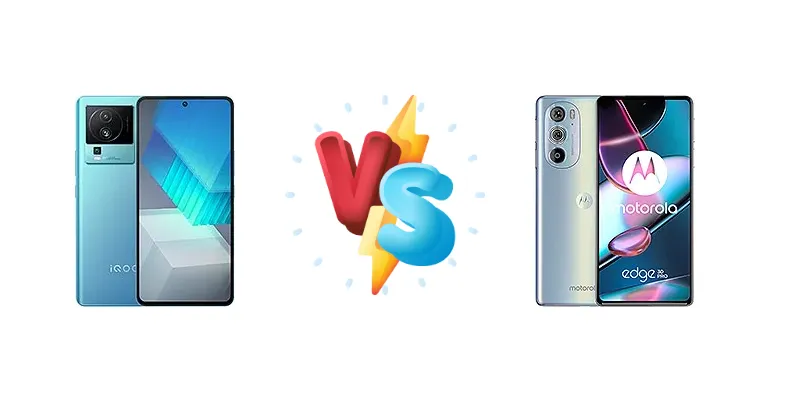
|
🏆 Quick Verdict
For the average user prioritizing raw speed and incredibly fast charging, the iQOO Neo 7 emerges as the winner. Its Dimensity 8200 offers excellent performance, and the 120W charging is a game-changer. However, the Motorola Edge 30 Pro remains a strong contender for those valuing wireless charging and a potentially more refined software experience.
| PHONES | ||
|---|---|---|
| Phone Names | vivo iQOO Neo 7 | Motorola Edge 30 Pro |
| Network | ||
|---|---|---|
| 2G bands | GSM 850 / 900 / 1800 / 1900 | GSM 850 / 900 / 1800 / 1900 |
| 3G bands | HSDPA 850 / 900 / 2100 - India | HSDPA 850 / 900 / 1700(AWS) / 1900 / 2100 |
| 4G bands | 1, 3, 5, 8, 28, 38, 40, 41 - India | 1, 2, 3, 4, 5, 7, 8, 12, 13, 17, 18, 19, 20, 25, 26, 28, 32, 38, 39, 40, 41, 42, 43, 48, 66 - International |
| 5G bands | 1, 3, 5, 8, 28, 41, 77, 78 SA/NSA - India | 1, 3, 5, 7, 8, 20, 28, 38, 40, 41, 66, 77, 78 SA/NSA/Sub6 - International |
| Speed | HSPA, LTE, 5G | HSPA 42.2/5.76 Mbps, LTE Cat20 2000/150 Mbps, 5G |
| Technology | GSM / HSPA / LTE / 5G | GSM / HSPA / LTE / 5G |
| - | 2, 5, 7, 12, 25, 26, 29, 30, 41, 48, 66, 71, 77, 78, 260, 261 SA/NSA/Sub6/mmWave - USA | |
| Launch | ||
|---|---|---|
| Announced | 2023, February 16 | 2022, January 24 |
| Status | Available. Released 2023, February 16 | Available. Released 2022, March 04 |
| Body | ||
|---|---|---|
| Build | Glass front, plastic frame, plastic back | Glass front (Gorilla Glass 3), glass back (Gorilla Glass 5), plastic frame |
| Dimensions | 164.8 x 76.9 x 8.6 mm (6.49 x 3.03 x 0.34 in) | 163.1 x 76 x 8.8 mm (6.42 x 2.99 x 0.35 in) |
| SIM | Nano-SIM + Nano-SIM | · Nano-SIM· Nano-SIM + Nano-SIM |
| Weight | 193 g (6.81 oz) | 196 g (6.91 oz) |
| - | Water-repellent design | |
| Display | ||
|---|---|---|
| Protection | - | Corning Gorilla Glass 3 |
| Resolution | 1080 x 2400 pixels, 20:9 ratio (~388 ppi density) | 1080 x 2400 pixels, 20:9 ratio (~393 ppi density) |
| Size | 6.78 inches, 111.0 cm2 (~87.6% screen-to-body ratio) | 6.7 inches, 108.4 cm2 (~87.4% screen-to-body ratio) |
| Type | AMOLED, 120Hz, HDR10+, 500 nits (typ), 1000 nits (HBM), 1300 nits (peak) | OLED, 1B colors, 144Hz, HDR10+ |
| Always-on display | Always-on display | |
| Platform | ||
|---|---|---|
| CPU | Octa-core (1x3.1 GHz Cortex-A78 & 3x3.0 GHz Cortex-A78 & 4x2.0 GHz Cortex-A55) | Octa-core (1x3.00 GHz Cortex-X2 & 3x2.50 GHz Cortex-A710 & 4x1.80 GHz Cortex-A510) |
| Chipset | Mediatek Dimensity 8200 (4 nm) | Qualcomm SM8450 Snapdragon 8 Gen 1 (4 nm) |
| GPU | Mali-G610 MC6 | Adreno 730 |
| OS | Android 13, Funtouch 13 | Android 12, upgradable to Android 14 |
| Memory | ||
|---|---|---|
| Card slot | No | No |
| Internal | 128GB 8GB RAM, 256GB 12GB RAM | 128GB 8GB RAM, 256GB 8GB RAM, 256GB 12GB RAM, 512GB 8GB RAM, 512GB 12GB RAM |
| UFS 3.1 | UFS 3.1 | |
| Main Camera | ||
|---|---|---|
| Features | LED flash, HDR, panorama | Dual-LED dual-tone flash, HDR, panorama |
| Single | 16 MP, f/2.5, (wide) | - |
| Triple | 64 MP, f/1.8, 24mm (wide), 1/1.97", 0.7µm, PDAF, OIS 2 MP (macro) Auxiliary lens | 50 MP, f/1.8, (wide), 1/1.55", 1.0µm, multi-directional PDAF, OIS 50 MP, f/2.2, 114˚ (ultrawide), 1/2.76", 0.64µm, AF Auxiliary lens |
| Video | 4K@30fps, 1080p@30fps | 8K@24/30fps, 4K@30/60fps, 1080p@30/60/120/240/960fps, 10-bit HDR10+, gyro-EIS |
| Selfie camera | ||
|---|---|---|
| Features | HDR | HDR |
| Single | 16 MP, f/2.5, (wide) | 60 MP, f/2.2, (wide), 1/2.8", 0.61µm |
| Video | 1080p@30fps | 4K@30fps, 1080p@30/120fps |
| Sound | ||
|---|---|---|
| 3.5mm jack | No | No |
| 35mm jack | No | No |
| Loudspeaker | Yes, with stereo speakers | Yes, with stereo speakers |
| 24-bit/192kHz audio | 24-bit/192kHz audio | |
| Comms | ||
|---|---|---|
| Bluetooth | 5.3, A2DP, LE | 5.2, A2DP, LE, aptX HD, aptX Adaptive |
| Infrared port | Yes | - |
| NFC | Yes (market/region dependent) | Yes |
| Positioning | GPS, GLONASS, GALILEO, BDS, QZSS, NavIC | GPS (L1+L5), GLONASS, BDS, GALILEO |
| Radio | No | No |
| USB | USB Type-C 2.0, OTG | USB Type-C 3.1, DisplayPort 1.4 |
| WLAN | Wi-Fi 802.11 a/b/g/n/ac, dual-band | Wi-Fi 802.11 a/b/g/n/ac/6e, dual-band, Wi-Fi Direct |
| Features | ||
|---|---|---|
| Sensors | Fingerprint (under display, optical), accelerometer, gyro, proximity, compass | Fingerprint (side-mounted), accelerometer, gyro, proximity, compass, barometer |
| - | Ready For support | |
| Battery | ||
|---|---|---|
| Charging | 120W wired, 50% in 10 min, 100% in 25 min | 68W wired, 50% in 15 min, 100% in 35 min 15W wireless 5W reverse wireless |
| Type | 5000 mAh | Li-Po 4800 mAh |
| Misc | ||
|---|---|---|
| Colors | Interstellar Black, Frost Blue | Cosmos Blue, Stardust White |
| Models | I2214 | XT2201-1 |
| Price | About 440 EUR | € 475.45 |
| Tests | ||
|---|---|---|
| Battery life | - | Endurance rating 80h |
| Camera | - | Photo / Video |
| Display | - | Contrast ratio: Infinite (nominal) |
| Loudspeaker | - | -24.2 LUFS (Very good) |
| Performance | - | AnTuTu: 941895 (v9) GeekBench: 3658 (v5.1) GFXBench: 78fps (ES 3.1 onscreen) |
vivo iQOO Neo 7
- Incredibly fast 120W charging
- Potentially superior sustained performance with Dimensity 8200
- Likely optimized for gaming
- No wireless charging
- Battery capacity unknown
- Camera specs currently unavailable
Motorola Edge 30 Pro
- Wireless and reverse wireless charging
- Proven Snapdragon 8 Gen 1 performance
- 80-hour endurance rating
- Slower charging speeds (68W)
- Snapdragon 8 Gen 1 prone to throttling
- May not offer the same level of gaming optimization
Display Comparison
The Motorola Edge 30 Pro boasts a measured peak brightness of 685 nits, a respectable figure, but the iQOO Neo 7’s display specifications are currently unavailable for direct comparison. However, given iQOO’s focus on gaming, it’s likely to prioritize a high refresh rate and color accuracy. The Edge 30 Pro’s ‘Infinite’ contrast ratio is a marketing term, typical of OLED panels, and doesn’t provide a quantifiable advantage. Without knowing the iQOO Neo 7’s panel technology (LTPO or not), it’s difficult to assess potential power savings or variable refresh rate capabilities.
Camera Comparison
Both devices are listed as having Photo/Video capabilities, but specific details are lacking. Without sensor size, aperture, or OIS information, a meaningful comparison is impossible. The Motorola Edge 30 Pro likely benefits from Qualcomm’s image signal processor (ISP), known for its strong image processing. However, iQOO has been steadily improving its camera performance, and the Neo 7 could offer competitive results. We can safely assume both phones will offer a standard suite of camera modes, but image quality will depend heavily on the hardware not specified in the provided data.
Performance
The core of the difference lies in the chipsets. The Motorola Edge 30 Pro utilizes the Qualcomm Snapdragon 8 Gen 1 (4nm), featuring a Cortex-X2 prime core clocked at 3.00 GHz. The iQOO Neo 7, however, employs the Mediatek Dimensity 8200 (4nm) with a Cortex-A78 prime core at 3.1 GHz. While the Snapdragon 8 Gen 1 initially held a performance lead, the Dimensity 8200’s more efficient architecture and higher clock speed on its primary core often translate to comparable, and sometimes superior, real-world performance, particularly in sustained workloads. The Snapdragon 8 Gen 1 is known to throttle under prolonged stress, a potential issue for gamers, while the Dimensity 8200’s 4nm process offers better thermal efficiency. Both phones utilize octa-core CPUs, but the architectural differences in the core designs impact performance characteristics.
Battery Life
The Motorola Edge 30 Pro has an endurance rating of 80 hours, suggesting a decent battery life. However, the iQOO Neo 7’s battery capacity is unknown. The charging speeds are where the iQOO Neo 7 truly shines. Its 120W wired charging can deliver a 50% charge in just 10 minutes and a full charge in 25 minutes, significantly faster than the Motorola Edge 30 Pro’s 68W charging (50% in 15 minutes, 100% in 35 minutes). The Edge 30 Pro adds the convenience of 15W wireless charging and 5W reverse wireless charging, features absent on the iQOO Neo 7. The faster charging of the iQOO Neo 7 could offset a potentially smaller battery capacity, providing a more convenient user experience for those who frequently need to top up their phone.
Buying Guide
Buy the vivo iQOO Neo 7 if you need a phone that charges incredibly quickly, excels in gaming, and delivers flagship-level performance without breaking the bank. Buy the Motorola Edge 30 Pro if you prefer the convenience of wireless charging, a cleaner Android experience, and a phone with a proven track record of software updates, even if it means sacrificing some charging speed.