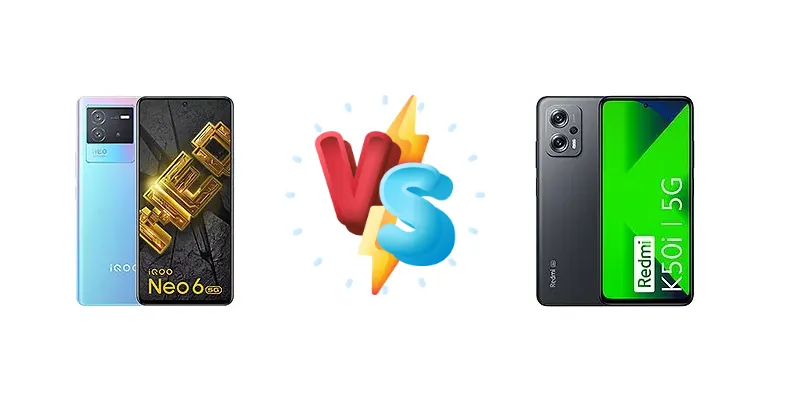
The mid-range smartphone market is fiercely competitive, and the vivo iQOO Neo 6 and Xiaomi Redmi K50i are two strong contenders. Both offer impressive specs at attractive price points, but which one truly delivers the best overall experience? Let's dive into a comprehensive comparison to help you decide.
🏆 Quick Verdict
The iQOO Neo 6 edges out the Redmi K50i thanks to its superior Snapdragon 870 chipset, faster charging, and brighter display. However, the Redmi K50i offers a compelling alternative with its Dimensity 8100 and potentially better software experience, depending on user preference.
| Network |
|---|
| 2G bands | GSM 850 / 900 / 1800 / 1900 | GSM 850 / 900 / 1800 / 1900 |
| 3G bands | HSDPA 850 / 900 / 1700(AWS) / 2100 | HSDPA 850 / 900 / 1700(AWS) / 1900 / 2100 |
| 4G bands | 1, 3, 4, 5, 8, 38, 40, 41 | 1, 2, 3, 4, 5, 7, 8, 20, 28, 38, 40, 41 |
| 5G bands | 1, 41, 77, 78 SA/NSA | 1, 3, 5, 7, 8, 20, 28, 38, 40, 41, 77, 78 SA/NSA |
| Speed | HSPA, LTE, 5G | HSPA, LTE, 5G |
| Technology | GSM / HSPA / LTE / 5G | GSM / HSPA / LTE / 5G |
| Launch |
|---|
| Announced | 2022, May 31 | 2022, July 20 |
| Status | Available. Released 2022, May 31 | Available. Released 2022, July 23 |
| Body |
|---|
| Build | Glass front, plastic frame, plastic back | - |
| Dimensions | 163 x 76.2 x 8.5 mm (6.42 x 3.00 x 0.33 in) | 163.6 x 74.3 x 8.9 mm (6.44 x 2.93 x 0.35 in) |
| SIM | Nano-SIM + Nano-SIM | Nano-SIM + Nano-SIM |
| Weight | 190 g (6.70 oz) | 200 g (7.05 oz) |
| Display |
|---|
| Protection | - | Corning Gorilla Glass 5 |
| Resolution | 1080 x 2400 pixels, 20:9 ratio (~398 ppi density) | 1080 x 2460 pixels (~407 ppi density) |
| Size | 6.62 inches, 105.8 cm2 (~85.2% screen-to-body ratio) | 6.6 inches, 103.4 cm2 (~85.1% screen-to-body ratio) |
| Type | AMOLED, 120Hz, HDR10+, 500 nits (typ), 800 nits (HBM), 1300 nits (peak) | FFS LCD, 144Hz, HDR10, Dolby Vision, 500 nits (typ), 650 nits (HBM) |
| Platform |
|---|
| CPU | Octa-core (1x3.2 GHz Kryo 585 & 3x2.42 GHz Kryo 585 & 4x1.80 GHz Kryo 585) | Octa-core (4x2.85 GHz Cortex-A78 & 4x2.0 GHz Cortex-A55) |
| Chipset | Qualcomm SM8250-AC Snapdragon 870 5G (7 nm) | Mediatek Dimensity 8100 (5 nm) |
| GPU | Adreno 650 | Mali-G610 MC6 |
| OS | Android 12, Funtouch 12 | Android 12, upgradable to Android 13, MIUI 14 |
| Memory |
|---|
| Card slot | No | No |
| Internal | 128GB 8GB RAM, 256GB 12GB RAM | 128GB 6GB RAM, 128GB 8GB RAM, 256GB 8GB RAM |
| | UFS 3.1 | - |
| Main Camera |
|---|
| Features | LED flash, HDR, panorama | Color spectrum sensor, LED flash, HDR, panorama |
| Single | 16 MP, f/2.0, (wide), 1/3.1", 1.0µm | - |
| Triple | 64 MP, f/1.9, (wide), 1/1.72", 0.8µm, PDAF, OIS
8 MP, f/2.2, 116˚ (ultrawide), 1/4.0", 1.12µm
2 MP (macro) | 64 MP, f/1.9, (wide), 1/1.72", 0.8µm, PDAF
8 MP, f/2.2, 120˚, (ultrawide)
2 MP (macro) |
| Video | 4K@30/60fps, 1080p@30/60fps | 4K@30fps, 1080p@30/60fps |
| Selfie camera |
|---|
| Features | HDR | - |
| Single | 16 MP, f/2.0, (wide), 1/3.1", 1.0µm | 16 MP, f/2.5, (wide) |
| Video | 1080p@30fps | 1080p@30fps |
| Sound |
|---|
| 3.5mm jack | No | - |
| 35mm jack | No | Yes |
| Loudspeaker | Yes, with stereo speakers | Yes, with stereo speakers |
| | 24-bit/192kHz audio | - |
| Comms |
|---|
| Bluetooth | 5.2, A2DP, LE, aptX HD, aptX Adaptive, aptX Lossless | 5.3, A2DP, LE |
| Infrared port | Yes | Yes |
| NFC | No | No |
| Positioning | GPS, GLONASS, GALILEO, BDS, QZSS | GPS (L1), GLONASS (L1), BDS (B1I+B1c), GALILEO (E1), QZSS (L1) |
| Radio | No | No |
| USB | USB Type-C 2.0, OTG | USB Type-C 2.0, OTG |
| WLAN | Wi-Fi 802.11 a/b/g/n/ac, dual-band, Wi-Fi Direct | Wi-Fi 802.11 a/b/g/n/ac/6, dual-band, Wi-Fi Direct |
| Features |
|---|
| Sensors | Fingerprint (under display, optical), accelerometer, gyro, proximity, compass | Fingerprint (side-mounted), accelerometer, proximity, gyro, compass |
| Battery |
|---|
| Charging | 80W wired, 50% in 12 min, 100% in 32 min | 67W wired, 50% in 15 min, 100% in 46 min |
| Type | 4700 mAh | Li-Po 5080 mAh |
| Misc |
|---|
| Colors | Dark Nova, Cyber Rage | Phantom Blue, Stealth Black, Quick Silver |
| Models | I2126 | 22041216I |
| Price | About 360 EUR | About 320 EUR |
| Tests |
|---|
| Battery life |
Endurance rating 97h
| - |
| Camera |
Photo / Video | - |
| Display |
Contrast ratio: Infinite (nominal) | - |
| Loudspeaker |
-25.0 LUFS (Very good)
| - |
| Performance |
AnTuTu: 627246 (v8), 730223 (v9)
GeekBench: 3076 (v5.1)
GFXBench: 50fps (ES 3.1 onscreen) | - |
vivo iQOO Neo 6
- Superior Performance (Snapdragon 870)
- Faster 80W Charging
- Brighter Display (772 nits)
- Excellent Battery Life (97h Endurance)
- Software experience can be polarizing (Funtouch OS)
- Camera quality may not be class-leading
Xiaomi Redmi K50i
- Competitive Performance (Dimensity 8100)
- Good Value for Money
- Potentially Cleaner MIUI Experience (depending on version)
- Slower 67W Charging
- Less Bright Display
- Slightly lower sustained performance compared to Snapdragon 870
Display Comparison
The iQOO Neo 6 boasts a measured peak brightness of 772 nits, significantly brighter than the Redmi K50i. While the Redmi K50i has an 'infinite' contrast ratio (likely a marketing term), the iQOO Neo 6's higher brightness will provide better visibility in outdoor conditions. Both likely feature AMOLED panels with smooth refresh rates (likely 120Hz).
Camera Comparison
Camera performance is subjective and requires more detailed testing. Both phones likely offer versatile camera setups, but the iQOO Neo 6's image processing might lean towards more vibrant colors, while the Redmi K50i could offer a more natural look. Video recording capabilities are likely comparable, both supporting 4K recording.
Performance
Here, the iQOO Neo 6 takes a clear lead. The Snapdragon 870 is generally considered more powerful and efficient than the Dimensity 8100, especially in sustained performance scenarios. While the Dimensity 8100 is no slouch, the 870's proven track record makes it the preferred choice for demanding tasks and gaming.
Battery Life
The iQOO Neo 6's endurance rating of 97h is exceptional, suggesting excellent battery life. Its 80W charging is also significantly faster than the Redmi K50i's 67W, allowing for quicker top-ups.
Buying Guide
The vivo iQOO Neo 6 is ideal for gamers and power users who prioritize performance and fast charging. The Xiaomi Redmi K50i is a great choice for those seeking a well-rounded device with a focus on value and a potentially cleaner MIUI experience (though this can vary).
Frequently Asked Questions
❓ Which phone is better for gaming?
The iQOO Neo 6 is generally better for gaming due to its more powerful Snapdragon 870 chipset and efficient thermal management.
❓ Does the Redmi K50i have a headphone jack?
Yes, the Redmi K50i retains a 3.5mm headphone jack, a feature often missing in modern smartphones.