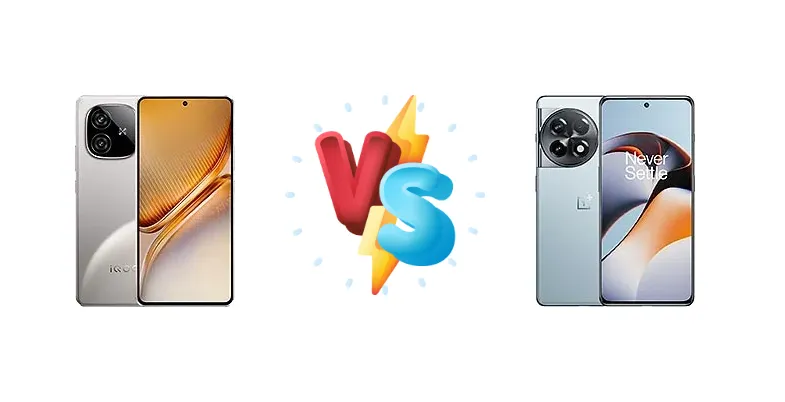
The iQOO Neo 10R and OnePlus 11R represent compelling options in the increasingly competitive mid-to-high range smartphone market. While both aim to deliver a premium experience, they take different approaches. The iQOO Neo 10R leverages the newer Snapdragon 8s Gen 3, while the OnePlus 11R relies on the proven Snapdragon 8+ Gen 1. This comparison dissects their strengths and weaknesses to determine which device offers the best overall package.
🏆 Quick Verdict
For most users, the OnePlus 11R emerges as the slightly better choice. Its Snapdragon 8+ Gen 1, while a generation older, provides consistently strong performance and benefits from a mature software optimization. The 100W charging is also a significant advantage, offsetting the iQOO's newer chipset.
| Network |
|---|
| 2G bands | GSM 850 / 900 / 1800 / 1900 | GSM 850 / 900 / 1800 / 1900 |
| 3G bands | HSDPA 850 / 900 / 2100 | HSDPA 850 / 900 / 1700(AWS) / 2100 |
| 4G bands | 1, 3, 5, 8, 28, 38, 40, 41 | 1, 3, 4, 5, 8, 28, 34, 38, 39, 40, 41 |
| 5G bands | 1, 3, 5, 8, 28, 38, 40, 41, 77, 78 SA/NSA | 1, 3, 5, 8, 28, 40, 41, 77, 78 SA/NSA |
| Speed | HSPA, LTE, 5G | HSPA, LTE (3CA), 5G |
| Technology | GSM / HSPA / LTE / 5G | GSM / CDMA / HSPA / LTE / 5G |
| | - | CDMA 800 |
| Launch |
|---|
| Announced | 2025, March 11 | 2023, February 07 |
| Status | Available. Released 2025, March 19 | Available. Released 2023, February 21 |
| Body |
|---|
| Build | Glass front (Schott Xensation Up), plastic back, plastic frame | Glass front, glass back (Gorilla Glass 5), plastic frame |
| Dimensions | 163.7 x 75.9 x 8 mm (6.44 x 2.99 x 0.31 in) | 163.4 x 74.3 x 8.7 mm (6.43 x 2.93 x 0.34 in) |
| SIM | Nano-SIM + Nano-SIM | Nano-SIM + Nano-SIM |
| Weight | 196 g (6.91 oz) | 204 g (7.20 oz) |
| Display |
|---|
| Protection | Schott Xensation Up | - |
| Resolution | 1260 x 2800 pixels, 20:9 ratio (~452 ppi density) | 1240 x 2772 pixels, 20:9 ratio (~451 ppi density) |
| Size | 6.78 inches, 111.5 cm2 (~89.7% screen-to-body ratio) | 6.74 inches, 109.2 cm2 (~90.0% screen-to-body ratio) |
| Type | AMOLED, 1B colors, 144Hz, 3840Hz PWM, HDR10+, 4500 nits (peak) | Fluid AMOLED, 1B colors, 120Hz, HDR10+, 1450 nits (peak) |
| Platform |
|---|
| CPU | Octa-core (1x3.0 GHz Cortex-X4 & 4x2.8 GHz Cortex-A720 & 3x2.0 GHz Cortex-A520) | Octa-core (1x3.0 GHz Cortex-X2 & 3x2.5 GHz Cortex-A710 & 4x1.80 GHz Cortex-A510) |
| Chipset | Qualcomm SM8635 Snapdragon 8s Gen 3 (4 nm) | Qualcomm SM8475 Snapdragon 8+ Gen 1 (4 nm) |
| GPU | Adreno 735 | Adreno 730 |
| OS | Android 15, up to 3 major Android upgrades, Funtouch 15 | Android 13, upgradable to Android 15, OxygenOS 15 |
| Memory |
|---|
| Card slot | No | No |
| Internal | 128GB 8GB RAM, 256GB 8GB RAM, 256GB 12GB RAM | 128GB 8GB RAM, 256GB 16GB RAM, 512GB 18GB RAM |
| | - | UFS 3.1 |
| Main Camera |
|---|
| Dual | 50 MP, f/1.8, (wide), 1/1.95", 0.8µm, PDAF, OIS
8 MP, f/2.2, (ultrawide), 1/4.0", 1.12µm | - |
| Features | LED flash, panorama, HDR | Color spectrum sensor, LED flash, HDR, panorama |
| Single | - | 16 MP, f/2.4, 24mm (wide), 1/3.09", 1.0µm |
| Triple | - | 50 MP, f/1.8, 24mm (wide), 1/1.56", 1.0µm, multi-directional PDAF, OIS
8 MP, f/2.2, 120˚ (ultrawide), 1/4.0", 1.12µm
2 MP (macro) |
| Video | 4K@30/60fps, 1080p, gyro-EIS, OIS | 4K@30/60fps, 1080p@30/60/240fps, gyro-EIS |
| Selfie camera |
|---|
| Features | - | HDR |
| Single | 32 MP, f/2.5, (wide), 1/3.1", 0.7µm | 16 MP, f/2.4, 24mm (wide), 1/3.09", 1.0µm |
| Video | 4K@30/60fps, 1080p, gyro-EIS | 1080p@30fps |
| Sound |
|---|
| 3.5mm jack | - | No |
| 35mm jack | No | No |
| Loudspeaker | Yes, with stereo speakers | Yes, with stereo speakers |
| | - | 24-bit/192kHz audio |
| Comms |
|---|
| Bluetooth | 5.4, A2DP, LE, aptX HD, aptX Adaptive, aptX Lossless | 5.3, A2DP, LE, aptX HD |
| Infrared port | Yes | Yes |
| NFC | No | Yes |
| Positioning | GPS, GLONASS, GALILEO, BDS, QZSS, NavIC | GPS (L1+L5), GLONASS (G1), BDS (B1I+B1c+B2a), GALILEO (E1+E5a), QZSS (L1+L5) |
| Radio | No | No |
| USB | USB Type-C 2.0, OTG | USB Type-C 2.0 |
| WLAN | Wi-Fi 802.11 a/b/g/n/ac/6, dual-band, Wi-Fi Direct | Wi-Fi 802.11 a/b/g/n/ac/6, dual-band |
| Features |
|---|
| Sensors | Fingerprint (under display, optical), accelerometer, gyro, proximity, compass | Fingerprint (under display, optical), accelerometer, gyro, proximity, compass |
| Battery |
|---|
| Charging | 80W wired, 55W PD, 50% in 26 min, 100% in 55 min
7.5W reverse wired
Bypass charging | 100W wired |
| Type | Si/C Li-Ion 6400 mAh | Li-Po 5000 mAh |
| Misc |
|---|
| Colors | Raging Blue, MoonKnight Titanium | Galactic Silver, Sonic Black, Solar Red |
| Models | I2221 | CPH2487 |
| Price | ₹ 24,998 | About 600 EUR |
| SAR | - | 1.16 W/kg (head) 0.61 W/kg (body) |
vivo iQOO Neo 10R
- Newer Snapdragon 8s Gen 3 chipset
- Bypass charging for cooler charging
- Potentially better long-term software support
- Slower 80W charging compared to OnePlus 11R
- Chipset optimization may not be as mature
OnePlus 11R
- Faster 100W charging
- Proven Snapdragon 8+ Gen 1 performance
- Mature software optimization
- Older generation chipset
- No bypass charging
Display Comparison
Neither device boasts a standout display, focusing instead on value. While specific display specs (resolution, refresh rate, peak brightness) are not provided, both likely feature 120Hz AMOLED panels common in this price bracket. The key difference lies in the underlying chipset's ability to drive the display efficiently. The iQOO Neo 10R's newer Snapdragon 8s Gen 3 *may* offer slightly better power efficiency in display-intensive tasks, but without concrete display specs, it's difficult to quantify.
Camera Comparison
Without detailed camera specifications, a direct comparison is limited. Both phones likely feature a multi-camera setup with a primary sensor, ultrawide, and potentially a macro lens. However, the quality of image processing and sensor size are crucial. Given OnePlus’s history, the 11R likely prioritizes a balanced and natural image profile, while iQOO often leans towards more vibrant, saturated colors. The absence of sensor details makes it impossible to determine which phone captures more detail or performs better in low light.
Performance
The core of this comparison rests on the chipsets. The iQOO Neo 10R’s Snapdragon 8s Gen 3 (4nm) features a 1x3.0 GHz Cortex-X4 prime core, paired with 4x2.8 GHz Cortex-A720 performance cores and 3x2.0 GHz Cortex-A520 efficiency cores. This contrasts with the OnePlus 11R’s Snapdragon 8+ Gen 1 (4nm) which utilizes a 1x3.0 GHz Cortex-X2, 3x2.5 GHz Cortex-A710, and 4x1.80 GHz Cortex-A510. While the 8s Gen 3's X4 core is newer, the 8+ Gen 1's A710 cores are clocked higher. In real-world usage, the 8+ Gen 1 benefits from extensive optimization, potentially leading to more consistent sustained performance, especially in demanding games. The iQOO's newer architecture *could* close the gap with software updates, but currently, the OnePlus 11R likely holds a slight edge.
Battery Life
The iQOO Neo 10R offers 80W wired charging, 55W PD, and 7.5W reverse wired charging, reaching 50% in 26 minutes and 100% in 55 minutes. The OnePlus 11R boasts a significantly faster 100W charging solution. This difference is substantial; the 11R will charge from 0-100% much quicker, a critical advantage for users who frequently need to top up their battery. While the iQOO Neo 10R offers bypass charging, minimizing heat during charging, the sheer speed of the OnePlus 11R’s charging is a compelling benefit.
Buying Guide
Buy the vivo iQOO Neo 10R if you prioritize the latest silicon and potentially benefit from future software optimizations tailored to the Snapdragon 8s Gen 3. It's a good choice for those who want to be on the cutting edge. Buy the OnePlus 11R if you value a proven track record of performance, exceptionally fast 100W charging, and a more refined user experience out of the box. It's ideal for gamers and power users who demand reliability.
Frequently Asked Questions
❓ Will the Snapdragon 8s Gen 3 in the iQOO Neo 10R outperform the Snapdragon 8+ Gen 1 in the OnePlus 11R in demanding games like Genshin Impact?
While the 8s Gen 3 is newer, the Snapdragon 8+ Gen 1 in the OnePlus 11R benefits from extensive software optimization and a more mature thermal profile. Expect very similar performance in most scenarios, with the OnePlus 11R potentially maintaining higher frame rates for longer periods due to better thermal management.
❓ How much faster is the 100W charging on the OnePlus 11R compared to the 80W charging on the iQOO Neo 10R in real-world use?
The 100W charging on the OnePlus 11R will likely charge the phone from 0-100% in around 25-30 minutes, while the iQOO Neo 10R takes approximately 55 minutes. This 25-minute difference is significant for users who prioritize quick top-ups.
❓ Does the iQOO Neo 10R's bypass charging feature make a noticeable difference in battery health over time?
Bypass charging reduces heat buildup during charging, which can contribute to slower battery degradation over the long term. While the impact isn't massive, it's a beneficial feature for users who want to maximize their battery's lifespan.