
iQOO Neo 10 vs Redmi K60 Pro: A Deep Dive into Mid-Range Powerhouses
| Phones Images | |||||
|---|---|---|---|---|---|
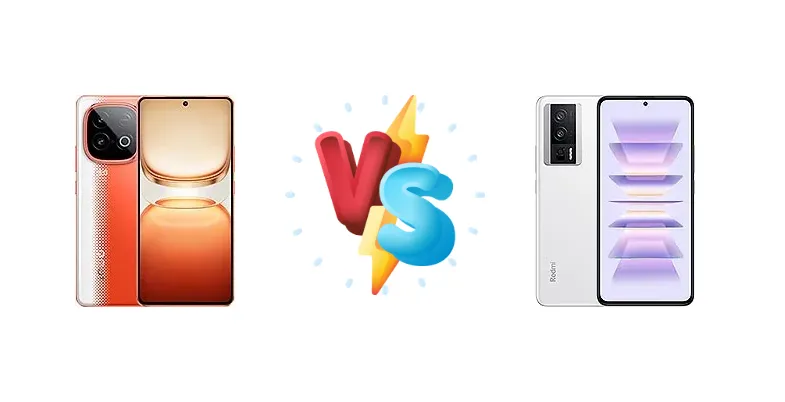
|
🏆 Quick Verdict
For most users, the Xiaomi Redmi K60 Pro emerges as the slightly stronger choice. While the iQOO Neo 10 boasts faster charging and a newer chipset, the K60 Pro’s Snapdragon 8 Gen 2 provides a more mature and consistently powerful experience, coupled with the convenience of wireless charging.
| PHONES | ||
|---|---|---|
| Phone Names | vivo iQOO Neo 10 | Xiaomi Redmi K60 Pro |
| Network | ||
|---|---|---|
| 2G bands | GSM 850 / 900 / 1800 / 1900 | GSM 850 / 900 / 1800 / 1900 |
| 3G bands | HSDPA 800 / 850 / 900 / 2100 | HSDPA 800 / 850 / 900 / 1700(AWS) / 2100 |
| 4G bands | 1, 3, 5, 7, 8, 18, 19, 20, 26, 28, 38, 40, 41, 42, 48 | 1, 3, 4, 5, 8, 18, 19, 26, 34, 38, 39, 40, 41, 42 |
| 5G bands | 1, 3, 5, 7, 8, 18, 20, 26, 28, 38, 40, 41, 48, 77, 78 SA/NSA | 1, 3, 5, 8, 28, 38, 41, 77, 78 SA/NSA |
| Speed | HSPA, LTE, 5G | HSPA, LTE, 5G |
| Technology | GSM / HSPA / LTE / 5G | GSM / CDMA / HSPA / CDMA2000 / LTE / 5G |
| - | CDMA2000 1x | |
| Launch | ||
|---|---|---|
| Announced | 2025, May 26 | 2022, December 27 |
| Status | Available. Released 2025, June 02 | Available. Released 2023, January 01 |
| Body | ||
|---|---|---|
| Build | Glass front, plastic back, plastic frame | - |
| Dimensions | 163.7 x 75.9 x 8.1 mm (6.44 x 2.99 x 0.32 in) | 162.8 x 75.4 x 8.6 mm or 8.9 mm |
| SIM | Nano-SIM + Nano-SIM | Nano-SIM + Nano-SIM |
| Weight | 206 g (7.27 oz) | 201 g or 205 g (7.09 oz) |
| Display | ||
|---|---|---|
| Protection | Shield Glass | - |
| Resolution | 1260 x 2800 pixels, 20:9 ratio (~453 ppi density) | 1440 x 3200 pixels, 20:9 ratio (~526 ppi density) |
| Size | 6.78 inches, 111.0 cm2 (~89.3% screen-to-body ratio) | 6.67 inches, 107.4 cm2 (~87.5% screen-to-body ratio) |
| Type | AMOLED, 1B colors, 144Hz, 4320Hz PWM, HDR, 2000 nits (HBM), 4400 nits (peak) | OLED, 68B colors, 120Hz, Dolby Vision, HDR10+, 1400 nits (peak) |
| Platform | ||
|---|---|---|
| CPU | Octa-core (1x3.21 GHz Cortex-X4 & 3x3.0 GHz Cortex-A720 & 2x2.8 GHz Cortex-A720 & 2x2.0 GHz Cortex-A720) | Octa-core (1x3.2 GHz Cortex-X3 & 2x2.8 GHz Cortex-A715 & 2x2.8 GHz Cortex-A710 & 3x2.0 GHz Cortex-A510) |
| Chipset | Qualcomm SM8735 Snapdragon 8s Gen 4 (4 nm) | Qualcomm SM8550-AB Snapdragon 8 Gen 2 (4 nm) |
| GPU | Adreno 825 | Adreno 740 |
| OS | Android 15, up to 3 major Android upgrades, Funtouch 15 | Android 13, MIUI 14 |
| Memory | ||
|---|---|---|
| Card slot | No | No |
| Internal | 128GB 8GB RAM, 256GB 8GB RAM, 256GB 12GB RAM, 512GB 16GB RAM | 128GB 8GB RAM, 256GB 8GB RAM, 256GB 12GB RAM, 512GB 12GB RAM, 512GB 16GB RAM |
| - | UFS 4.0 UFS 3.1 - 128GB only | |
| Main Camera | ||
|---|---|---|
| Dual | 50 MP, f/1.8, (wide), 1/1.95", 0.8µm, multi-directional PDAF, OIS 8 MP, f/2.2, (ultrawide) | - |
| Features | LED flash, HDR, panorama | Color spectrum sensor, Dual-LED dual-tone flash, HDR, panorama |
| Triple | - | 54 MP, f/1.9, (wide), 1/1.49", 1.0µm, PDAF, OIS 8 MP, 118˚ (ultrawide), 1/4.0", 1.12µm 2 MP (macro) |
| Video | 4K@30/60fps, 1080p, gyro-EIS, OIS | 8K@24fps, 4K@30/60fps, 1080p@30/60/120/240/960fps, 720p@1920fps, gyro-EIS |
| Selfie camera | ||
|---|---|---|
| Features | - | HDR |
| Single | 32 MP, f/2.5, (wide) | 16 MP, (wide), 1/3.06", 1.0µm |
| Video | 4K@30/60fps, 1080p, gyro-EIS | 1080p@30/60/120fps |
| Sound | ||
|---|---|---|
| 3.5mm jack | - | No |
| 35mm jack | No | No |
| Loudspeaker | Yes, with stereo speakers | Yes, with stereo speakers |
| - | 24-bit/192kHz audio | |
| Comms | ||
|---|---|---|
| Bluetooth | 5.4, A2DP, LE | 5.3, A2DP, LE |
| Infrared port | Yes | Yes |
| NFC | Yes | Yes |
| Positioning | GPS (L1+L5), GLONASS, GALILEO, BDS, QZSS, NavIC | GPS (L1+L5), GLONASS (G1), BDS (B1I+B2a+Bc), GALILEO (E1+E5a), QZSS (L1+L5), NavIC |
| Radio | No | Unspecified |
| USB | USB Type-C 2.0, OTG | USB Type-C 2.0, OTG |
| WLAN | Wi-Fi 802.11 a/b/g/n/ac/6/7, dual-band | Wi-Fi 802.11 a/b/g/n/ac/6e, dual-band, Wi-Fi Direct |
| Features | ||
|---|---|---|
| Sensors | Fingerprint (under display, optical), accelerometer, gyro, proximity, compass | Fingerprint (under display, optical), accelerometer, gyro, proximity, compass |
| Battery | ||
|---|---|---|
| Charging | 120W wired, 100W PD, 100W PPS, 50% in 15 min, 100% in 36 min Reverse wired Bypass Charging | 120W wired, PD3.0, QC3+, 100% in 19 min 30W wireless |
| Type | Si/C Li-Ion 7000 mAh | Li-Po 5000 mAh |
| Misc | ||
|---|---|---|
| Colors | Inferno Red, Titanium Chrome, Blaze Orange, Onyx Black | Black, White, Mint, Champion Black |
| Models | - | 22127RK46C |
| Price | ₹ 31,998 | About 460 EUR |
vivo iQOO Neo 10
- Snapdragon 8s Gen 4 offers the latest Qualcomm technology
- Blazing-fast 120W wired charging (36 min to full)
- Reverse wired charging and bypass charging for gaming
- Slower charging time compared to Redmi K60 Pro
- Lacks wireless charging
Xiaomi Redmi K60 Pro
- Proven Snapdragon 8 Gen 2 performance
- Faster 120W wired charging (19 min to full)
- 30W wireless charging adds convenience
- Older chipset compared to iQOO Neo 10
- May run slightly warmer under sustained load
Display Comparison
Neither device's display specifications are provided, so a direct comparison is limited. However, given the market positioning, both likely feature AMOLED panels with high refresh rates. The Redmi K60 Pro, being a slightly more premium offering, may benefit from a higher peak brightness and potentially LTPO technology for adaptive refresh rate control, improving battery efficiency. Bezels are expected to be minimal on both, but the K60 Pro's build quality might be marginally superior.
Camera Comparison
Without specific camera sensor details, analysis is limited. However, the Redmi K60 Pro, positioned as a more premium device, likely features a larger main sensor with optical image stabilization (OIS). The iQOO Neo 10 may prioritize computational photography to compensate for a potentially smaller sensor. Lens apertures will be crucial; wider apertures (lower f-number) on the K60 Pro would improve low-light performance. Image processing styles will also differ – Xiaomi typically leans towards vibrant, saturated colors, while vivo often aims for a more natural look. The absence of details regarding ultrawide and telephoto lenses makes a comprehensive comparison impossible.
Performance
The core difference lies in the chipsets. The Redmi K60 Pro’s Snapdragon 8 Gen 2 (4nm) utilizes the Cortex-X3 prime core clocked at 3.2 GHz, alongside Cortex-A715 and A710 performance cores, and efficient A510 cores. The iQOO Neo 10 features the Snapdragon 8s Gen 4 (4nm) with a Cortex-X4 prime core at 3.21 GHz, and a mix of A720 cores. While the X4 core offers a slight clock speed advantage, the 8 Gen 2’s more mature architecture and optimized drivers generally translate to more sustained performance and better thermal management. The Neo 10’s CPU configuration, with multiple A720 cores, suggests a focus on multi-core performance, but real-world gaming benefits will depend on GPU optimization. Both devices likely utilize LPDDR5x RAM, but the K60 Pro’s more refined thermal design could allow it to maintain peak performance for longer durations.
Battery Life
Both phones offer 120W wired charging, promising incredibly fast top-ups. The Redmi K60 Pro claims 100% charge in 19 minutes, while the iQOO Neo 10 achieves the same in 36 minutes. This is a significant advantage for the K60 Pro. Furthermore, the K60 Pro adds 30W wireless charging, a feature absent on the Neo 10. The iQOO Neo 10 includes reverse wired charging and bypass charging, allowing it to charge while powered on, minimizing heat buildup during gaming. Battery capacity is not specified, but the K60 Pro’s wireless charging capability suggests a potentially larger battery to accommodate the efficiency losses inherent in wireless power transfer.
Buying Guide
Buy the vivo iQOO Neo 10 if you prioritize the absolute fastest charging speeds and want to be among the first to experience Qualcomm’s latest Snapdragon 8s Gen 4. Buy the Xiaomi Redmi K60 Pro if you value a proven, high-performance chipset with a wider feature set, including wireless charging, and a more refined software experience.