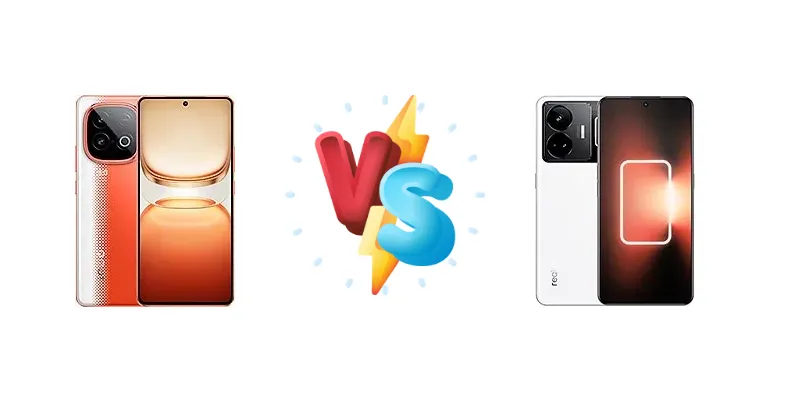
The iQOO Neo 10 and Realme GT3 represent compelling options in the increasingly competitive mid-to-high range smartphone market. The GT3, while older, boasts a headline-grabbing 240W charging speed. The Neo 10 counters with a newer Snapdragon 8s Gen 4 chipset. This comparison dissects these key differences to determine which device best suits your needs.
🏆 Quick Verdict
For most users, the iQOO Neo 10 emerges as the stronger choice. Its Snapdragon 8s Gen 4 offers a performance edge over the GT3’s Snapdragon 8+ Gen 1, and while the charging isn’t *as* fast, 120W is still incredibly quick. The newer chipset also promises better long-term software support.
| Network |
|---|
| 2G bands | GSM 850 / 900 / 1800 / 1900 | GSM 850 / 900 / 1800 / 1900 |
| 3G bands | HSDPA 800 / 850 / 900 / 2100 | HSDPA 850 / 900 / 1700(AWS) / 1900 / 2100 |
| 4G bands | 1, 3, 5, 7, 8, 18, 19, 20, 26, 28, 38, 40, 41, 42, 48 | LTE |
| 5G bands | 1, 3, 5, 7, 8, 18, 20, 26, 28, 38, 40, 41, 48, 77, 78 SA/NSA | SA/NSA |
| Speed | HSPA, LTE, 5G | HSPA, LTE, 5G |
| Technology | GSM / HSPA / LTE / 5G | GSM / HSPA / LTE / 5G |
| Launch |
|---|
| Announced | 2025, May 26 | 2023, February 28 |
| Status | Available. Released 2025, June 02 | Available. Released 2023, July 08 |
| Body |
|---|
| Build | Glass front, plastic back, plastic frame | Glass front, plastic frame, glass back |
| Dimensions | 163.7 x 75.9 x 8.1 mm (6.44 x 2.99 x 0.32 in) | 163.9 x 75.8 x 8.9 mm (6.45 x 2.98 x 0.35 in) |
| SIM | Nano-SIM + Nano-SIM | Nano-SIM + Nano-SIM |
| Weight | 206 g (7.27 oz) | 199 g (7.02 oz) |
| | - | Illuminated RGB (on the back) |
| Display |
|---|
| Protection | Shield Glass | - |
| Resolution | 1260 x 2800 pixels, 20:9 ratio (~453 ppi density) | 1240 x 2772 pixels, 20:9 ratio (~451 ppi density) |
| Size | 6.78 inches, 111.0 cm2 (~89.3% screen-to-body ratio) | 6.74 inches, 109.2 cm2 (~87.9% screen-to-body ratio) |
| Type | AMOLED, 1B colors, 144Hz, 4320Hz PWM, HDR, 2000 nits (HBM), 4400 nits (peak) | AMOLED, 1B colors, 144Hz, HDR10+, 500 nits (typ), 1100 nits (HBM), 1400 nits (peak) |
| Platform |
|---|
| CPU | Octa-core (1x3.21 GHz Cortex-X4 & 3x3.0 GHz Cortex-A720 & 2x2.8 GHz Cortex-A720 & 2x2.0 GHz Cortex-A720) | Octa-core (1x3.0 GHz Cortex-X2 & 3x2.5 GHz Cortex-A710 & 4x1.80 GHz Cortex-A510) |
| Chipset | Qualcomm SM8735 Snapdragon 8s Gen 4 (4 nm) | Qualcomm SM8475 Snapdragon 8+ Gen 1 (4 nm) |
| GPU | Adreno 825 | Adreno 730 |
| OS | Android 15, up to 3 major Android upgrades, Funtouch 15 | Android 13, upgradable to Android 14, Realme UI 5.0 |
| Memory |
|---|
| Card slot | No | No |
| Internal | 128GB 8GB RAM, 256GB 8GB RAM, 256GB 12GB RAM, 512GB 16GB RAM | 128GB 8GB RAM, 256GB 12GB RAM, 256GB 16GB RAM, 512GB 16GB RAM, 1TB 16GB RAM |
| | - | UFS 3.1 |
| Main Camera |
|---|
| Dual | 50 MP, f/1.8, (wide), 1/1.95", 0.8µm, multi-directional PDAF, OIS
8 MP, f/2.2, (ultrawide) | - |
| Features | LED flash, HDR, panorama | Dual-LED dual-tone flash, HDR, panorama |
| Single | - | 16 MP, f/2.5, 25mm (wide), 1/3.09", 1.0µm |
| Triple | - | 50 MP, f/1.9, 24mm (wide), 1/1.56", 1.0µm, PDAF, OIS
8 MP, f/2.2, 16mm, 112˚ (ultrawide), 1/4.0", 1.12µm
2 MP, f/3.3, 20mm (microscope) |
| Video | 4K@30/60fps, 1080p, gyro-EIS, OIS | 4K@30/60fps, 1080p@30/60fps, gyro-EIS |
| Selfie camera |
|---|
| Features | - | HDR, panorama |
| Single | 32 MP, f/2.5, (wide) | 16 MP, f/2.5, 25mm (wide), 1/3.09", 1.0µm |
| Video | 4K@30/60fps, 1080p, gyro-EIS | 1080p@30fps, gyro-EIS |
| Sound |
|---|
| 3.5mm jack | - | No |
| 35mm jack | No | No |
| Loudspeaker | Yes, with stereo speakers | Yes, with stereo speakers |
| | - | 24-bit/192kHz audio |
| Comms |
|---|
| Bluetooth | 5.4, A2DP, LE | 5.3, A2DP, LE, aptX HD |
| Infrared port | Yes | Yes |
| NFC | Yes | Yes (dual side) |
| Positioning | GPS (L1+L5), GLONASS, GALILEO, BDS, QZSS, NavIC | GPS (L1+L5), GLONASS, BDS, GALILEO, QZSS |
| Radio | No | No |
| USB | USB Type-C 2.0, OTG | USB Type-C 2.0 |
| WLAN | Wi-Fi 802.11 a/b/g/n/ac/6/7, dual-band | Wi-Fi 802.11 a/b/g/n/ac, dual-band |
| Features |
|---|
| Sensors | Fingerprint (under display, optical), accelerometer, gyro, proximity, compass | Fingerprint (under display, optical), accelerometer, gyro, proximity, compass |
| Battery |
|---|
| Charging | 120W wired, 100W PD, 100W PPS, 50% in 15 min, 100% in 36 min
Reverse wired
Bypass Charging | 240W wired, PD, 50% in 4 min, 100% in 10 min |
| Type | Si/C Li-Ion 7000 mAh | 4600 mAh |
| Misc |
|---|
| Colors | Inferno Red, Titanium Chrome, Blaze Orange, Onyx Black | Pulse White, Booster Black |
| Models | - | RMX3709 |
| Price | ₹ 31,998 | About 600 EUR |
| Tests |
|---|
| Battery life | - |
Endurance rating 117h
|
| Camera | - |
Photo / Video |
| Display | - |
Contrast ratio: Infinite (nominal) |
| Loudspeaker | - |
-26.9 LUFS (Good)
|
| Performance | - |
AnTuTu: 1074427 (v9)
GeekBench: 3898 (v5.1), 3980 (v6)
GFXBench: 59fps (ES 3.1 onscreen) |
vivo iQOO Neo 10
- Newer Snapdragon 8s Gen 4 chipset for superior performance
- More efficient power management
- Supports 100W PD/PPS for wider charger compatibility
- Reverse wired charging
- Slower charging speed compared to the GT3
- Display specifications currently unknown
Realme GT3
- Blazing-fast 240W charging
- High peak display brightness (974 nits)
- Proven Snapdragon 8+ Gen 1 performance
- Good battery endurance (117h)
- Older chipset with potentially shorter software support
- Extremely fast charging may impact long-term battery health
Display Comparison
The Realme GT3 boasts a measured peak brightness of 974 nits, a strong figure indicating excellent outdoor visibility. However, the iQOO Neo 10’s display specifications are currently unavailable, making a direct comparison difficult. Given iQOO’s focus on gaming, we anticipate a high refresh rate panel. The GT3’s ‘Infinite’ contrast ratio is a marketing term; real-world contrast performance will depend on the panel technology used. Without further details on the Neo 10’s panel type (AMOLED vs LCD, LTPO support), the GT3 currently holds an advantage in confirmed display brightness.
Camera Comparison
Both devices are listed as having Photo/Video capabilities, but specific details are lacking. Without sensor size, aperture, or OIS information, a meaningful comparison is impossible. It’s reasonable to assume both phones will offer a versatile camera system, but the iQOO Neo 10’s newer image signal processor (ISP) within the Snapdragon 8s Gen 4 could provide advantages in image processing, dynamic range, and low-light performance. We’ll need detailed camera samples to draw definitive conclusions. The absence of details suggests neither phone is positioning itself as a camera-centric flagship.
Performance
The iQOO Neo 10’s Snapdragon 8s Gen 4 (4nm) represents a significant architectural leap over the Realme GT3’s Snapdragon 8+ Gen 1 (4nm). The 8s Gen 4 features the newer Cortex-X4 prime core clocked at 3.21 GHz, promising superior single-core performance compared to the GT3’s 3.0 GHz Cortex-X2. The 8s Gen 4’s tri-cluster configuration (3x A720, 2x A720, 2x A720) also offers a more balanced approach to multi-core tasks. While both chips are fabricated on a 4nm process, the newer architecture of the 8s Gen 4 should translate to improved efficiency and sustained performance under load, reducing thermal throttling during extended gaming sessions. The GT3’s Adreno 730 GPU is still potent, but the 8s Gen 4’s Adreno GPU will likely offer a performance uplift.
Battery Life
The Realme GT3’s 240W charging is its standout feature, achieving 100% charge in just 10 minutes and 50% in 4 minutes. This is significantly faster than the iQOO Neo 10’s 120W charging (36 minutes to 100%, 15 minutes to 50%). However, both phones share an endurance rating of 117 hours, suggesting similar real-world battery life despite the charging speed disparity. The iQOO Neo 10 also supports 100W PD and PPS, offering broader compatibility with chargers. The GT3’s extreme charging speed may degrade battery health faster over the long term, while the Neo 10’s more moderate approach could contribute to longevity. The Neo 10 also offers reverse wired charging, a feature absent from the GT3’s specifications.
Buying Guide
Buy the vivo iQOO Neo 10 if you prioritize future-proof performance, efficient power management, and a modern chipset with potential for longer software updates. Buy the Realme GT3 if your absolute top priority is the fastest possible charging speeds and you're comfortable with a slightly older, though still capable, processor. Gamers who value minimal charging downtime will lean towards the GT3.
Frequently Asked Questions
❓ Will the Snapdragon 8s Gen 4 in the iQOO Neo 10 handle demanding games like Genshin Impact at max settings?
Yes, the Snapdragon 8s Gen 4 is designed for high-end gaming. Its Cortex-X4 prime core and improved Adreno GPU should provide a smooth experience even with graphically intensive titles like Genshin Impact at maximum settings. The 4nm process also helps manage thermals, minimizing throttling during prolonged gaming sessions.
❓ Is the 240W charging on the Realme GT3 safe for the battery in the long run?
While 240W charging is incredibly fast, it does raise concerns about long-term battery health. Extremely fast charging generates more heat, which can accelerate battery degradation. Realme likely incorporates safety mechanisms to mitigate this, but the iQOO Neo 10’s 120W charging offers a more conservative approach that may preserve battery capacity over time.
❓ Does the iQOO Neo 10 support wireless charging?
The provided specifications do not mention wireless charging support for the iQOO Neo 10. Given its positioning as a performance-focused device, wireless charging may have been omitted to prioritize other features or reduce costs.
❓ What kind of cooling system does the Realme GT3 employ to handle the heat generated during 240W charging and gaming?
The specifications don't detail the cooling system. However, given the high charging wattage and the Snapdragon 8+ Gen 1's potential for heat generation, it's likely the GT3 utilizes a vapor chamber or other advanced cooling solution to prevent overheating and maintain performance.