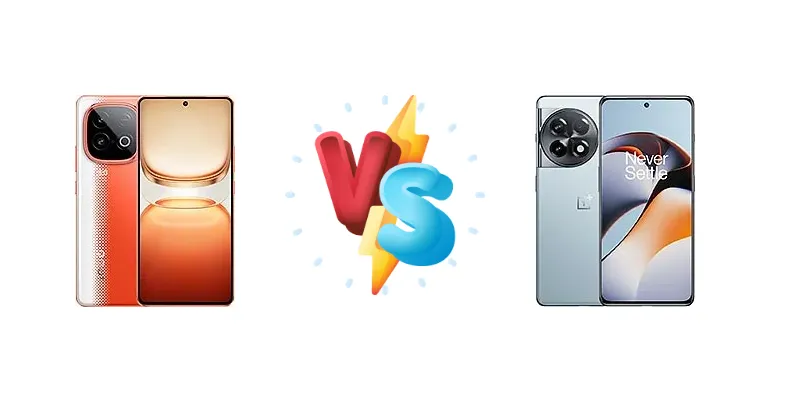
The iQOO Neo 10 and OnePlus 11R represent compelling options in the increasingly competitive mid-range smartphone market. The Neo 10 arrives with Qualcomm’s latest Snapdragon 8s Gen 4, promising a leap in efficiency and performance, while the 11R leverages the well-established Snapdragon 8+ Gen 1, known for its balance of power and thermal management. This comparison dissects their key differences to determine which device delivers the best overall experience.
🏆 Quick Verdict
For most users, the iQOO Neo 10 emerges as the stronger contender. Its Snapdragon 8s Gen 4 offers a noticeable performance advantage, particularly in sustained workloads, and the 120W charging is significantly faster than the 11R’s 100W. While the 11R remains a capable device, the Neo 10’s newer chipset and faster charging justify the potential price difference.
| Network |
|---|
| 2G bands | GSM 850 / 900 / 1800 / 1900 | GSM 850 / 900 / 1800 / 1900 |
| 3G bands | HSDPA 800 / 850 / 900 / 2100 | HSDPA 850 / 900 / 1700(AWS) / 2100 |
| 4G bands | 1, 3, 5, 7, 8, 18, 19, 20, 26, 28, 38, 40, 41, 42, 48 | 1, 3, 4, 5, 8, 28, 34, 38, 39, 40, 41 |
| 5G bands | 1, 3, 5, 7, 8, 18, 20, 26, 28, 38, 40, 41, 48, 77, 78 SA/NSA | 1, 3, 5, 8, 28, 40, 41, 77, 78 SA/NSA |
| Speed | HSPA, LTE, 5G | HSPA, LTE (3CA), 5G |
| Technology | GSM / HSPA / LTE / 5G | GSM / CDMA / HSPA / LTE / 5G |
| | - | CDMA 800 |
| Launch |
|---|
| Announced | 2025, May 26 | 2023, February 07 |
| Status | Available. Released 2025, June 02 | Available. Released 2023, February 21 |
| Body |
|---|
| Build | Glass front, plastic back, plastic frame | Glass front, glass back (Gorilla Glass 5), plastic frame |
| Dimensions | 163.7 x 75.9 x 8.1 mm (6.44 x 2.99 x 0.32 in) | 163.4 x 74.3 x 8.7 mm (6.43 x 2.93 x 0.34 in) |
| SIM | Nano-SIM + Nano-SIM | Nano-SIM + Nano-SIM |
| Weight | 206 g (7.27 oz) | 204 g (7.20 oz) |
| Display |
|---|
| Protection | Shield Glass | - |
| Resolution | 1260 x 2800 pixels, 20:9 ratio (~453 ppi density) | 1240 x 2772 pixels, 20:9 ratio (~451 ppi density) |
| Size | 6.78 inches, 111.0 cm2 (~89.3% screen-to-body ratio) | 6.74 inches, 109.2 cm2 (~90.0% screen-to-body ratio) |
| Type | AMOLED, 1B colors, 144Hz, 4320Hz PWM, HDR, 2000 nits (HBM), 4400 nits (peak) | Fluid AMOLED, 1B colors, 120Hz, HDR10+, 1450 nits (peak) |
| Platform |
|---|
| CPU | Octa-core (1x3.21 GHz Cortex-X4 & 3x3.0 GHz Cortex-A720 & 2x2.8 GHz Cortex-A720 & 2x2.0 GHz Cortex-A720) | Octa-core (1x3.0 GHz Cortex-X2 & 3x2.5 GHz Cortex-A710 & 4x1.80 GHz Cortex-A510) |
| Chipset | Qualcomm SM8735 Snapdragon 8s Gen 4 (4 nm) | Qualcomm SM8475 Snapdragon 8+ Gen 1 (4 nm) |
| GPU | Adreno 825 | Adreno 730 |
| OS | Android 15, up to 3 major Android upgrades, Funtouch 15 | Android 13, upgradable to Android 15, OxygenOS 15 |
| Memory |
|---|
| Card slot | No | No |
| Internal | 128GB 8GB RAM, 256GB 8GB RAM, 256GB 12GB RAM, 512GB 16GB RAM | 128GB 8GB RAM, 256GB 16GB RAM, 512GB 18GB RAM |
| | - | UFS 3.1 |
| Main Camera |
|---|
| Dual | 50 MP, f/1.8, (wide), 1/1.95", 0.8µm, multi-directional PDAF, OIS
8 MP, f/2.2, (ultrawide) | - |
| Features | LED flash, HDR, panorama | Color spectrum sensor, LED flash, HDR, panorama |
| Single | - | 16 MP, f/2.4, 24mm (wide), 1/3.09", 1.0µm |
| Triple | - | 50 MP, f/1.8, 24mm (wide), 1/1.56", 1.0µm, multi-directional PDAF, OIS
8 MP, f/2.2, 120˚ (ultrawide), 1/4.0", 1.12µm
2 MP (macro) |
| Video | 4K@30/60fps, 1080p, gyro-EIS, OIS | 4K@30/60fps, 1080p@30/60/240fps, gyro-EIS |
| Selfie camera |
|---|
| Features | - | HDR |
| Single | 32 MP, f/2.5, (wide) | 16 MP, f/2.4, 24mm (wide), 1/3.09", 1.0µm |
| Video | 4K@30/60fps, 1080p, gyro-EIS | 1080p@30fps |
| Sound |
|---|
| 3.5mm jack | - | No |
| 35mm jack | No | No |
| Loudspeaker | Yes, with stereo speakers | Yes, with stereo speakers |
| | - | 24-bit/192kHz audio |
| Comms |
|---|
| Bluetooth | 5.4, A2DP, LE | 5.3, A2DP, LE, aptX HD |
| Infrared port | Yes | Yes |
| NFC | Yes | Yes |
| Positioning | GPS (L1+L5), GLONASS, GALILEO, BDS, QZSS, NavIC | GPS (L1+L5), GLONASS (G1), BDS (B1I+B1c+B2a), GALILEO (E1+E5a), QZSS (L1+L5) |
| Radio | No | No |
| USB | USB Type-C 2.0, OTG | USB Type-C 2.0 |
| WLAN | Wi-Fi 802.11 a/b/g/n/ac/6/7, dual-band | Wi-Fi 802.11 a/b/g/n/ac/6, dual-band |
| Features |
|---|
| Sensors | Fingerprint (under display, optical), accelerometer, gyro, proximity, compass | Fingerprint (under display, optical), accelerometer, gyro, proximity, compass |
| Battery |
|---|
| Charging | 120W wired, 100W PD, 100W PPS, 50% in 15 min, 100% in 36 min
Reverse wired
Bypass Charging | 100W wired |
| Type | Si/C Li-Ion 7000 mAh | Li-Po 5000 mAh |
| Misc |
|---|
| Colors | Inferno Red, Titanium Chrome, Blaze Orange, Onyx Black | Galactic Silver, Sonic Black, Solar Red |
| Models | - | CPH2487 |
| Price | ₹ 31,998 | About 600 EUR |
| SAR | - | 1.16 W/kg (head) 0.61 W/kg (body) |
vivo iQOO Neo 10
- Newer Snapdragon 8s Gen 4 chipset for superior performance
- Ultra-fast 120W wired charging
- Supports 100W PD/PPS and reverse wired charging
- Software experience may be less refined than OnePlus
- Potential for higher price compared to the 11R
OnePlus 11R
- Proven Snapdragon 8+ Gen 1 chipset with good thermal management
- Well-regarded OnePlus software experience
- Potentially lower price point
- Slower 100W charging compared to the iQOO Neo 10
- Older chipset with less efficient architecture
Display Comparison
Neither device boasts a standout display, focusing on delivering solid performance rather than pushing boundaries. While specific display specs (resolution, refresh rate, peak brightness) are not provided, both likely feature AMOLED panels given their market segment. The iQOO Neo 10’s potential advantage lies in its newer chipset’s display processing capabilities, potentially leading to smoother animations. However, without detailed display specifications, a definitive winner is difficult to declare.
Camera Comparison
Without detailed camera specifications, a direct comparison is limited. However, both phones likely employ similar sensor configurations targeting the mid-range market. The iQOO Neo 10’s image signal processor (ISP) integrated within the Snapdragon 8s Gen 4 may offer improved image processing capabilities, potentially resulting in better dynamic range and low-light performance. The OnePlus 11R benefits from OnePlus’s established camera software tuning, which is generally well-regarded. The absence of information regarding sensor size and OIS makes it impossible to definitively declare a camera winner.
Performance
The core difference lies in the chipsets. The iQOO Neo 10’s Snapdragon 8s Gen 4 (4nm) features a unique CPU configuration – 1x3.21 GHz Cortex-X4, 3x3.0 GHz Cortex-A720, 2x2.8 GHz Cortex-A720, and 2x2.0 GHz Cortex-A720 – designed for optimized performance and efficiency. This contrasts with the OnePlus 11R’s Snapdragon 8+ Gen 1 (4nm) with its 1x3.0 GHz Cortex-X2, 3x2.5 GHz Cortex-A710, and 4x1.80 GHz Cortex-A510. The 8s Gen 4’s newer Cortex-X4 prime core should deliver superior single-core performance, while the architectural improvements across all cores contribute to better multi-core scores. The 8+ Gen 1 is still a very capable chip, but the 8s Gen 4 represents a generational leap. The iQOO Neo 10’s advantage is further amplified by the potential for more efficient thermal management due to the newer node and architecture.
Battery Life
The iQOO Neo 10’s 120W wired charging is a significant advantage, achieving 50% charge in 15 minutes and 100% in 36 minutes. This is considerably faster than the OnePlus 11R’s 100W charging. While battery capacity isn’t specified for either device, the faster charging of the iQOO Neo 10 mitigates any potential disadvantage from a slightly smaller battery. The iQOO Neo 10 also supports 100W PD and PPS, offering wider compatibility with chargers, and includes reverse wired charging and bypass charging, features absent in the 11R.
Buying Guide
Buy the vivo iQOO Neo 10 if you prioritize raw performance, especially for gaming and demanding applications, and value the fastest possible charging speeds. Buy the OnePlus 11R if you prefer a proven chipset with a strong track record for stability and are looking for a slightly more mature software experience, potentially at a lower price point.
Frequently Asked Questions
❓ Will the Snapdragon 8s Gen 4 in the iQOO Neo 10 overheat during prolonged gaming sessions?
The Snapdragon 8s Gen 4’s 4nm process and optimized architecture are designed to mitigate thermal throttling. While sustained gaming will inevitably generate heat, the 8s Gen 4 is expected to maintain higher clock speeds for longer periods compared to the 8+ Gen 1, offering a more consistent gaming experience. However, real-world performance will depend on the phone’s cooling system, which isn’t detailed in the provided specifications.
❓ Does the OnePlus 11R support features like DC Dimming to reduce screen flicker?
The provided specifications do not mention DC Dimming for the OnePlus 11R. However, OnePlus typically implements PWM dimming with a relatively high frequency to minimize flicker. Users sensitive to screen flicker should research independent reviews to determine if the 11R’s PWM frequency is comfortable for their eyes. The iQOO Neo 10’s specifications do not mention this either, so it's a similar situation.
❓ Can the iQOO Neo 10 charge other devices wirelessly?
No, the iQOO Neo 10 only supports reverse *wired* charging. This means you can use it to charge other devices via a USB-C cable, but it does not offer wireless power sharing.