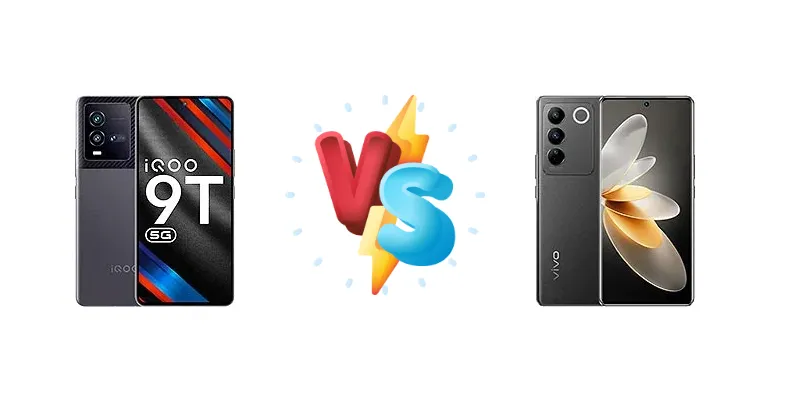
vivo continues to deliver compelling smartphones, and the iQOO 9T and V27 Pro are prime examples. Both offer impressive features, but cater to slightly different users. This comprehensive comparison will help you decide which device best fits your priorities.
🏆 Quick Verdict
The iQOO 9T takes the crown for raw performance thanks to its Snapdragon 8+ Gen 1 chipset and blazing-fast 120W charging. However, the V27 Pro boasts slightly better battery endurance and a potentially more refined camera experience, making it a strong contender for everyday users.
| Network |
|---|
| 2G bands | GSM 850 / 900 / 1800 / 1900 | GSM 850 / 900 / 1800 / 1900 |
| 3G bands | HSDPA 800 / 850 / 900 / 1700 / 1800 / 1900 / 2100 | HSDPA 850 / 900 / 1700(AWS) / 2100 |
| 4G bands | 1, 2, 3, 4, 5, 7, 8, 12, 17, 18, 19, 20, 25, 26, 28, 34, 38, 39, 40, 41, 66 | 1, 3, 4, 5, 8, 28, 38, 40, 41 |
| 5G bands | 1, 3, 5, 8, 28, 40, 41, 77, 78 | 1, 3, 5, 8, 28, 77, 78 SA/NSA |
| Speed | HSPA, LTE, 5G | HSPA, LTE, 5G |
| Technology | GSM / HSPA / LTE / 5G | GSM / HSPA / LTE / 5G |
| Launch |
|---|
| Announced | 2022, August 02 | 2023, March 01 |
| Status | Available. Released 2022, August 02 | Available. Released 2023, March 01 |
| Body |
|---|
| Build | Glass front (Gorilla Glass 5), aluminum frame, glass back | Glass front, plastic frame, glass back |
| Dimensions | 165 x 77 x 8 mm (6.50 x 3.03 x 0.31 in) | 164.1 x 74.8 x 7.4 mm (6.46 x 2.94 x 0.29 in) |
| SIM | Nano-SIM + Nano-SIM | Nano-SIM + Nano-SIM |
| Weight | 206 g (7.27 oz) | 182 g (6.42 oz) |
| | Dust and dripping water resistant | Color changing back panel color |
| Display |
|---|
| Protection | Corning Gorilla Glass 5 | - |
| Resolution | 1080 x 2400 pixels, 20:9 ratio (~388 ppi density) | 1080 x 2400 pixels, 20:9 ratio (~388 ppi density) |
| Size | 6.78 inches, 111.0 cm2 (~87.4% screen-to-body ratio) | 6.78 inches, 111.0 cm2 (~90.4% screen-to-body ratio) |
| Type | AMOLED, 1B colors, 120Hz, HDR10+, 1500 nits (peak) | AMOLED, 1B colors, 120Hz, HDR10+ |
| Platform |
|---|
| CPU | Octa-core (1x3.19 GHz Cortex-X2 & 3x2.75 GHz Cortex-A710 & 4x1.80 GHz Cortex-A510) | Octa-core (1x3.1 GHz Cortex-A78 & 3x3.0 GHz Cortex-A78 & 4x2.0 GHz Cortex-A55) |
| Chipset | Qualcomm SM8475 Snapdragon 8+ Gen 1 (4 nm) | Mediatek Dimensity 8200 (4 nm) |
| GPU | Adreno 730 | Mali-G610 MC6 |
| OS | Android 12, upgradable to Android 14, Funtouch 14 | Android 13, Funtouch 13 |
| Memory |
|---|
| Card slot | No | No |
| Internal | 128GB 8GB RAM, 256GB 12GB RAM | 128GB 8GB RAM, 256GB 8GB RAM, 256GB 12GB RAM |
| | UFS 3.1 | UFS 3.1 |
| Main Camera |
|---|
| Features | Dual-LED dual-tone flash, HDR, panorama | Ring-LED flash, panorama, HDR |
| Single | 16 MP, f/2.5, (wide) | 50 MP, f/2.5, (wide), AF |
| Triple | 50 MP, f/1.9, (wide), 1/1.57", 1.0µm, PDAF, OIS
12 MP, f/2.0, 47mm (telephoto), PDAF, 2x optical zoom
13 MP, f/2.2, 16mm, 120˚ (ultrawide), AF | 50 MP, f/1.9, (wide), 1/1.56", 1.0µm, PDAF, OIS
8 MP, f/2.2, 16mm, 120˚ (ultrawide), 1/4.0", 1.12µm
2 MP (macro) |
| Video | 4K@30/60fps, 1080p@30/60fps, gyro-EIS | 4K@30/60fps, 1080p@30fps, gyro-EIS |
| Selfie camera |
|---|
| Features | HDR | Dual-LED flash, HDR |
| Single | 16 MP, f/2.5, (wide) | 50 MP, f/2.5, (wide), AF |
| Video | 1080p@30fps, gyro-EIS | 4K@30/60fps, 1080p@30fps, gyro-EIS |
| Sound |
|---|
| 3.5mm jack | No | No |
| 35mm jack | No | No |
| Loudspeaker | Yes, with stereo speakers | Yes |
| | 24-bit/192kHz audio | 24-bit/192kHz audio |
| Comms |
|---|
| Bluetooth | 5.2, A2DP, LE, aptX HD, aptX Adaptive | 5.3, A2DP, LE |
| Infrared port | Yes | - |
| NFC | Yes | Yes |
| Positioning | GPS, GLONASS, GALILEO, BDS, QZSS | GPS, GLONASS, GALILEO, BDS, NavIC |
| Radio | FM radio | No |
| USB | USB Type-C 2.0, OTG | USB Type-C 2.0, OTG |
| WLAN | Wi-Fi 802.11 a/b/g/n/ac/6, dual-band, Wi-Fi Direct | Wi-Fi 802.11 a/b/g/n/ac/6, dual-band, Wi-Fi Direct |
| Features |
|---|
| Sensors | Fingerprint (under display, optical), accelerometer, gyro, proximity, compass | Fingerprint (under display, optical), accelerometer, gyro, proximity, compass |
| Battery |
|---|
| Charging | 120W wired, 50% in 8 min, 100% in 19 min | 66W wired, 50% in 19 min, 72% in 30 min |
| Type | 4700 mAh | 4600 mAh |
| Misc |
|---|
| Colors | Alpha, Legend (BMW M branding) | Magic Blue, Noble Black |
| Models | - | V2230 |
| Price | About 600 EUR | About 440 EUR |
| SAR | - | 1.22 W/kg (head) 0.89 W/kg (body) |
| Tests |
|---|
| Battery life |
Endurance rating 117h
|
Endurance rating 121h
|
| Camera |
Photo / Video |
Photo / Video |
| Display |
Contrast ratio: Infinite (nominal) |
Contrast ratio: Infinite (nominal) |
| Loudspeaker |
-28.8 LUFS (Average)
|
-29.1 LUFS (Average)
|
| Performance | - |
AnTuTu: 846767 (v9)
GeekBench: 3933 (v5.1), 3421 (v6)
GFXBench: 57fps (ES 3.1 onscreen) |
vivo iQOO 9T
- Blazing-fast 120W charging
- Flagship Snapdragon 8+ Gen 1 performance
- Brighter display
- Excellent value for performance
- Camera potentially not as refined as V27 Pro
- Design might be less premium than V27 Pro
vivo V27 Pro
- Slightly better battery endurance
- Potentially better camera system
- More refined design
- Good overall performance
- Slower charging speed
- Less powerful chipset than iQOO 9T
- Lower max brightness
Display Comparison
The iQOO 9T boasts a significantly brighter display at 1033 nits compared to the V27 Pro's 978 nits. Both feature excellent contrast ratios (Infinite nominal), but the iQOO 9T's higher brightness will be noticeable in outdoor conditions. Both likely use AMOLED panels with vibrant colors and smooth refresh rates (likely 120Hz, though not explicitly stated).
Camera Comparison
While both phones offer 'Photo / Video' capabilities, the V27 Pro is generally expected to have a more refined camera system, potentially with better image processing and low-light performance. The iQOO 9T's camera is still good, but the V27 Pro likely prioritizes camera quality more. Specific sensor details are missing, but the V27 Pro often features a strong selfie camera.
Performance
Here's where the iQOO 9T truly shines. The Snapdragon 8+ Gen 1 is a flagship chipset, offering substantially more processing power than the Dimensity 8200 in the V27 Pro. Expect smoother gaming, faster app loading, and overall snappier performance on the iQOO 9T. The Dimensity 8200 is still a capable chip, but it's a tier below.
Battery Life
The V27 Pro edges out the iQOO 9T slightly in battery endurance with an 121h rating versus 117h. However, the iQOO 9T's 120W charging is a game-changer, allowing for incredibly fast top-ups. While the V27 Pro's 66W charging is still fast, it takes considerably longer to reach full charge.
Buying Guide
The vivo iQOO 9T is ideal for gamers and power users who prioritize speed and charging. The vivo V27 Pro is a better choice for those seeking a well-rounded experience with a focus on photography and longer battery life, without sacrificing performance.
Frequently Asked Questions
❓ Is the iQOO 9T good for gaming?
Absolutely! The Snapdragon 8+ Gen 1 chipset makes the iQOO 9T an excellent choice for mobile gaming, offering smooth frame rates and responsive performance.
❓ Which phone has better camera quality?
While both have capable cameras, the vivo V27 Pro is generally expected to offer a more refined camera experience, particularly in terms of image processing and low-light performance.