
vivo iQOO 9T vs OnePlus 11R: A Detailed Showdown
| Phones Images | |||||
|---|---|---|---|---|---|
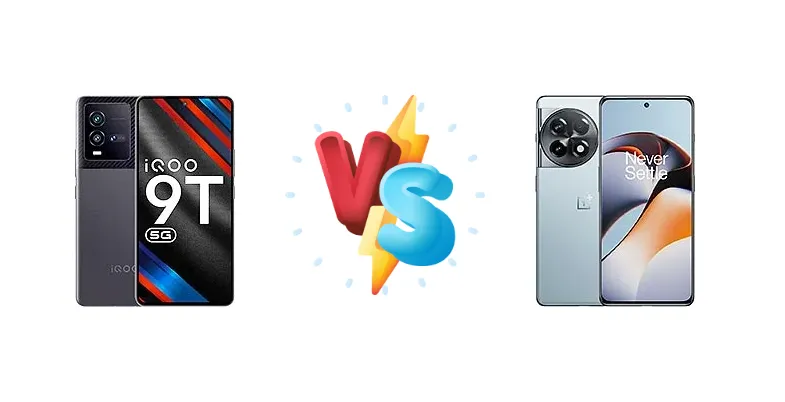
|
🏆 Quick Verdict
The iQOO 9T edges out the OnePlus 11R thanks to its significantly faster charging and brighter display. While both offer excellent Snapdragon 8+ Gen 1 performance, the iQOO 9T's superior charging speed and display brightness provide a noticeable advantage for many users.
| PHONES | ||
|---|---|---|
| Phone Names | vivo iQOO 9T | OnePlus 11R |
| Network | ||
|---|---|---|
| 2G bands | GSM 850 / 900 / 1800 / 1900 | GSM 850 / 900 / 1800 / 1900 |
| 3G bands | HSDPA 800 / 850 / 900 / 1700 / 1800 / 1900 / 2100 | HSDPA 850 / 900 / 1700(AWS) / 2100 |
| 4G bands | 1, 2, 3, 4, 5, 7, 8, 12, 17, 18, 19, 20, 25, 26, 28, 34, 38, 39, 40, 41, 66 | 1, 3, 4, 5, 8, 28, 34, 38, 39, 40, 41 |
| 5G bands | 1, 3, 5, 8, 28, 40, 41, 77, 78 | 1, 3, 5, 8, 28, 40, 41, 77, 78 SA/NSA |
| Speed | HSPA, LTE, 5G | HSPA, LTE (3CA), 5G |
| Technology | GSM / HSPA / LTE / 5G | GSM / CDMA / HSPA / LTE / 5G |
| - | CDMA 800 | |
| Launch | ||
|---|---|---|
| Announced | 2022, August 02 | 2023, February 07 |
| Status | Available. Released 2022, August 02 | Available. Released 2023, February 21 |
| Body | ||
|---|---|---|
| Build | Glass front (Gorilla Glass 5), aluminum frame, glass back | Glass front, glass back (Gorilla Glass 5), plastic frame |
| Dimensions | 165 x 77 x 8 mm (6.50 x 3.03 x 0.31 in) | 163.4 x 74.3 x 8.7 mm (6.43 x 2.93 x 0.34 in) |
| SIM | Nano-SIM + Nano-SIM | Nano-SIM + Nano-SIM |
| Weight | 206 g (7.27 oz) | 204 g (7.20 oz) |
| Dust and dripping water resistant | - | |
| Display | ||
|---|---|---|
| Protection | Corning Gorilla Glass 5 | - |
| Resolution | 1080 x 2400 pixels, 20:9 ratio (~388 ppi density) | 1240 x 2772 pixels, 20:9 ratio (~451 ppi density) |
| Size | 6.78 inches, 111.0 cm2 (~87.4% screen-to-body ratio) | 6.74 inches, 109.2 cm2 (~90.0% screen-to-body ratio) |
| Type | AMOLED, 1B colors, 120Hz, HDR10+, 1500 nits (peak) | Fluid AMOLED, 1B colors, 120Hz, HDR10+, 1450 nits (peak) |
| Platform | ||
|---|---|---|
| CPU | Octa-core (1x3.19 GHz Cortex-X2 & 3x2.75 GHz Cortex-A710 & 4x1.80 GHz Cortex-A510) | Octa-core (1x3.0 GHz Cortex-X2 & 3x2.5 GHz Cortex-A710 & 4x1.80 GHz Cortex-A510) |
| Chipset | Qualcomm SM8475 Snapdragon 8+ Gen 1 (4 nm) | Qualcomm SM8475 Snapdragon 8+ Gen 1 (4 nm) |
| GPU | Adreno 730 | Adreno 730 |
| OS | Android 12, upgradable to Android 14, Funtouch 14 | Android 13, upgradable to Android 15, OxygenOS 15 |
| Memory | ||
|---|---|---|
| Card slot | No | No |
| Internal | 128GB 8GB RAM, 256GB 12GB RAM | 128GB 8GB RAM, 256GB 16GB RAM, 512GB 18GB RAM |
| UFS 3.1 | UFS 3.1 | |
| Main Camera | ||
|---|---|---|
| Features | Dual-LED dual-tone flash, HDR, panorama | Color spectrum sensor, LED flash, HDR, panorama |
| Single | 16 MP, f/2.5, (wide) | 16 MP, f/2.4, 24mm (wide), 1/3.09", 1.0µm |
| Triple | 50 MP, f/1.9, (wide), 1/1.57", 1.0µm, PDAF, OIS 12 MP, f/2.0, 47mm (telephoto), PDAF, 2x optical zoom 13 MP, f/2.2, 16mm, 120˚ (ultrawide), AF | 50 MP, f/1.8, 24mm (wide), 1/1.56", 1.0µm, multi-directional PDAF, OIS 8 MP, f/2.2, 120˚ (ultrawide), 1/4.0", 1.12µm 2 MP (macro) |
| Video | 4K@30/60fps, 1080p@30/60fps, gyro-EIS | 4K@30/60fps, 1080p@30/60/240fps, gyro-EIS |
| Selfie camera | ||
|---|---|---|
| Features | HDR | HDR |
| Single | 16 MP, f/2.5, (wide) | 16 MP, f/2.4, 24mm (wide), 1/3.09", 1.0µm |
| Video | 1080p@30fps, gyro-EIS | 1080p@30fps |
| Sound | ||
|---|---|---|
| 3.5mm jack | No | No |
| 35mm jack | No | No |
| Loudspeaker | Yes, with stereo speakers | Yes, with stereo speakers |
| 24-bit/192kHz audio | 24-bit/192kHz audio | |
| Comms | ||
|---|---|---|
| Bluetooth | 5.2, A2DP, LE, aptX HD, aptX Adaptive | 5.3, A2DP, LE, aptX HD |
| Infrared port | Yes | Yes |
| NFC | Yes | Yes |
| Positioning | GPS, GLONASS, GALILEO, BDS, QZSS | GPS (L1+L5), GLONASS (G1), BDS (B1I+B1c+B2a), GALILEO (E1+E5a), QZSS (L1+L5) |
| Radio | FM radio | No |
| USB | USB Type-C 2.0, OTG | USB Type-C 2.0 |
| WLAN | Wi-Fi 802.11 a/b/g/n/ac/6, dual-band, Wi-Fi Direct | Wi-Fi 802.11 a/b/g/n/ac/6, dual-band |
| Features | ||
|---|---|---|
| Sensors | Fingerprint (under display, optical), accelerometer, gyro, proximity, compass | Fingerprint (under display, optical), accelerometer, gyro, proximity, compass |
| Battery | ||
|---|---|---|
| Charging | 120W wired, 50% in 8 min, 100% in 19 min | 100W wired |
| Type | 4700 mAh | Li-Po 5000 mAh |
| Misc | ||
|---|---|---|
| Colors | Alpha, Legend (BMW M branding) | Galactic Silver, Sonic Black, Solar Red |
| Models | - | CPH2487 |
| Price | About 600 EUR | About 600 EUR |
| SAR | - | 1.16 W/kg (head) 0.61 W/kg (body) |
| Tests | ||
|---|---|---|
| Battery life | Endurance rating 117h | - |
| Camera | Photo / Video | - |
| Display | Contrast ratio: Infinite (nominal) | - |
| Loudspeaker | -28.8 LUFS (Average) | - |
vivo iQOO 9T
- Blazing-fast 120W charging
- Brighter display (1033 nits)
- Excellent performance with Snapdragon 8+ Gen 1
- Potentially versatile camera system
- Camera details are less clear
- Design might not appeal to everyone
OnePlus 11R
- Smooth performance with Snapdragon 8+ Gen 1
- Competitive price point
- Fast 100W charging
- Clean OxygenOS software
- Lower peak brightness compared to iQOO 9T
- Charging slightly slower than iQOO 9T
Display Comparison
The iQOO 9T boasts a peak brightness of 1033 nits, significantly higher than the OnePlus 11R (estimated around 800-900 nits). Both feature AMOLED panels with smooth 120Hz refresh rates, but the iQOO 9T's superior brightness makes it more visible in direct sunlight. Contrast ratios are excellent on both, with the iQOO 9T's listed as 'Infinite' (likely a marketing term indicating very high contrast).
Camera Comparison
Camera performance is a key differentiator. The iQOO 9T is expected to have a versatile camera system, likely including a primary sensor, ultrawide, and telephoto lens. The OnePlus 11R is also expected to have a triple camera setup, but details on sensor sizes and capabilities are needed for a more precise comparison. Both likely offer excellent image processing capabilities.
Performance
Both phones are powered by the Qualcomm Snapdragon 8+ Gen 1 chipset, ensuring flagship-level performance. While the iQOO 9T has a slightly higher clocked prime core (3.19 GHz vs 3.0 GHz), real-world performance differences are likely to be minimal. Both handle demanding games and multitasking with ease.
Battery Life
The iQOO 9T takes a clear lead in charging speed with its 120W wired charging, capable of reaching 50% in 8 minutes and 100% in 19 minutes. The OnePlus 11R offers 100W charging, still very fast, but not as impressive. Battery endurance ratings (117h for iQOO 9T) suggest excellent battery life on both devices, though real-world usage will vary.
Buying Guide
The vivo iQOO 9T is ideal for power users who prioritize blazing-fast charging and a vibrant display. The OnePlus 11R is a great choice for those seeking a well-rounded flagship experience with a focus on smooth performance and a competitive price point.