
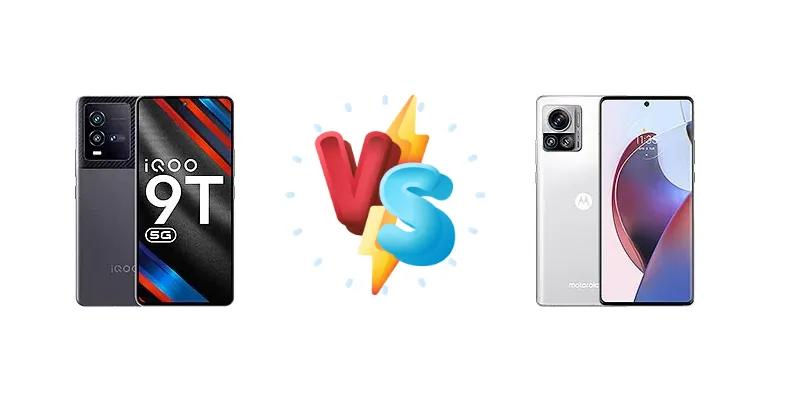
vivo iQOO 9T vs Motorola Edge 30 Ultra: A Detailed Showdown
| Phones Images | |||||
|---|---|---|---|---|---|
|
🏆 Quick Verdict
The iQOO 9T edges out the Edge 30 Ultra thanks to its slightly superior battery endurance and blazing-fast 120W charging. However, the Edge 30 Ultra offers wireless charging and reverse wireless charging, providing added versatility. Ultimately, the choice depends on your priorities.
| PHONES | ||
|---|---|---|
| Phone Names | vivo iQOO 9T | Motorola Edge 30 Ultra |
| Network | ||
|---|---|---|
| 2G bands | GSM 850 / 900 / 1800 / 1900 | GSM 850 / 900 / 1800 / 1900 |
| 3G bands | HSDPA 800 / 850 / 900 / 1700 / 1800 / 1900 / 2100 | HSDPA 850 / 900 / 1700(AWS) / 1900 / 2100 |
| 4G bands | 1, 2, 3, 4, 5, 7, 8, 12, 17, 18, 19, 20, 25, 26, 28, 34, 38, 39, 40, 41, 66 | 1, 2, 3, 4, 5, 7, 8, 12, 13, 17, 18, 19, 20, 25, 26, 28, 32, 34, 38, 39, 40, 41, 42, 43, 48, 66 |
| 5G bands | 1, 3, 5, 8, 28, 40, 41, 77, 78 | 1, 2, 3, 5, 7, 8, 20, 28, 38, 40, 41, 66, 77, 78 SA/NSA/Sub6 |
| Speed | HSPA, LTE, 5G | HSPA, LTE, 5G |
| Technology | GSM / HSPA / LTE / 5G | GSM / HSPA / LTE / 5G |
| Launch | ||
|---|---|---|
| Announced | 2022, August 02 | 2022, September 08 |
| Status | Available. Released 2022, August 02 | Available. Released 2022, September 08 |
| Body | ||
|---|---|---|
| Build | Glass front (Gorilla Glass 5), aluminum frame, glass back | Glass front (Gorilla Glass 5), glass back (Gorilla Glass 5), aluminum frame |
| Dimensions | 165 x 77 x 8 mm (6.50 x 3.03 x 0.31 in) | 161.8 x 73.5 x 8.4 mm (6.37 x 2.89 x 0.33 in) |
| SIM | Nano-SIM + Nano-SIM | · Nano-SIM· Nano-SIM + Nano-SIM |
| Weight | 206 g (7.27 oz) | 198.5 g (7.02 oz) |
| Dust and dripping water resistant | - | |
| Display | ||
|---|---|---|
| Protection | Corning Gorilla Glass 5 | Corning Gorilla Glass 5 |
| Resolution | 1080 x 2400 pixels, 20:9 ratio (~388 ppi density) | 1080 x 2400 pixels, 20:9 ratio (~395 ppi density) |
| Size | 6.78 inches, 111.0 cm2 (~87.4% screen-to-body ratio) | 6.67 inches, 107.4 cm2 (~90.3% screen-to-body ratio) |
| Type | AMOLED, 1B colors, 120Hz, HDR10+, 1500 nits (peak) | P-OLED, 1B colors, 144Hz, HDR10+, 1250 nits (peak) |
| Platform | ||
|---|---|---|
| CPU | Octa-core (1x3.19 GHz Cortex-X2 & 3x2.75 GHz Cortex-A710 & 4x1.80 GHz Cortex-A510) | Octa-core (1x3.19 GHz Cortex-X2 & 3x2.75 GHz Cortex-A710 & 4x1.80 GHz Cortex-A510) |
| Chipset | Qualcomm SM8475 Snapdragon 8+ Gen 1 (4 nm) | Qualcomm SM8475 Snapdragon 8+ Gen 1 (4 nm) |
| GPU | Adreno 730 | Adreno 730 |
| OS | Android 12, upgradable to Android 14, Funtouch 14 | Android 12, upgradable to Android 15 |
| Memory | ||
|---|---|---|
| Card slot | No | No |
| Internal | 128GB 8GB RAM, 256GB 12GB RAM | 128GB 8GB RAM, 256GB 8GB RAM, 256GB 12GB RAM, 512GB 12GB RAM |
| UFS 3.1 | UFS 3.1 | |
| Main Camera | ||
|---|---|---|
| Features | Dual-LED dual-tone flash, HDR, panorama | Dual-LED dual-tone flash, panorama, HDR |
| Single | 16 MP, f/2.5, (wide) | - |
| Triple | 50 MP, f/1.9, (wide), 1/1.57", 1.0µm, PDAF, OIS 12 MP, f/2.0, 47mm (telephoto), PDAF, 2x optical zoom 13 MP, f/2.2, 16mm, 120˚ (ultrawide), AF | 200 MP, f/1.9, (wide), 1/1.22", 0.64µm, PDAF, OIS 12 MP, f/1.6, (telephoto), 1.22µm, PDAF, 2x optical zoom 50 MP, f/2.2, 114˚ (ultrawide), 1/2.76", 0.64µm |
| Video | 4K@30/60fps, 1080p@30/60fps, gyro-EIS | 8K@30fps, 4K@30/60fps, 1080p@30/60/120/320/960fps, gyro-EIS, HDR10+ |
| Selfie camera | ||
|---|---|---|
| Features | HDR | HDR |
| Single | 16 MP, f/2.5, (wide) | 60 MP, f/2.2, (wide), 1/2.8", 0.61µm |
| Video | 1080p@30fps, gyro-EIS | 4K@30fps, 1080p@30fps |
| Sound | ||
|---|---|---|
| 3.5mm jack | No | No |
| 35mm jack | No | No |
| Loudspeaker | Yes, with stereo speakers | Yes, with stereo speakers |
| 24-bit/192kHz audio | - | |
| Comms | ||
|---|---|---|
| Bluetooth | 5.2, A2DP, LE, aptX HD, aptX Adaptive | 5.2, A2DP, LE |
| Infrared port | Yes | - |
| NFC | Yes | Yes |
| Positioning | GPS, GLONASS, GALILEO, BDS, QZSS | GPS (L1+L5), GLONASS, BDS, GALILEO |
| Radio | FM radio | No |
| USB | USB Type-C 2.0, OTG | USB Type-C 3.1, OTG, DisplayPort 1.4 |
| WLAN | Wi-Fi 802.11 a/b/g/n/ac/6, dual-band, Wi-Fi Direct | Wi-Fi 802.11 a/b/g/n/ac/6e, tri-band, Wi-Fi Direct - InternationalWi-Fi 802.11 a/b/g/n/ac/6, dual-band, Wi-Fi Direct - PRC |
| Features | ||
|---|---|---|
| Sensors | Fingerprint (under display, optical), accelerometer, gyro, proximity, compass | Fingerprint (under display, optical), accelerometer, gyro, proximity, compass |
| - | Ready For support | |
| Battery | ||
|---|---|---|
| Charging | 120W wired, 50% in 8 min, 100% in 19 min | 125W wired 50W wireless 10W reverse wireless |
| Type | 4700 mAh | Li-Po 4610 mAh |
| Misc | ||
|---|---|---|
| Colors | Alpha, Legend (BMW M branding) | Interstellar Black, Starlight White |
| Models | - | XT-2201 |
| Price | About 600 EUR | € 238.91 |
| Tests | ||
|---|---|---|
| Battery life | Endurance rating 117h | Endurance rating 92h |
| Camera | Photo / Video | Photo / Video |
| Display | Contrast ratio: Infinite (nominal) | Contrast ratio: Infinite (nominal) |
| Loudspeaker | -28.8 LUFS (Average) | -23.4 LUFS (Very good) |
| Performance | - | AnTuTu: 1074722 (v9) GeekBench: 4265 (v5.1) GFXBench: 73fps (ES 3.1 onscreen) |
vivo iQOO 9T
- Blazing-fast 120W charging
- Excellent battery life (117h endurance)
- Powerful Snapdragon 8+ Gen 1
- Smooth 144Hz display
- Camera not as impressive as Edge 30 Ultra
- No wireless charging
Motorola Edge 30 Ultra
- 200MP main camera
- Wireless charging (50W)
- Reverse wireless charging (10W)
- Slightly brighter display (1047 nits)
- Shorter battery life (92h endurance)
- Slower charging compared to iQOO 9T
Display Comparison
Both phones feature stunning AMOLED displays with a 144Hz refresh rate, offering smooth scrolling and vibrant visuals. The Motorola Edge 30 Ultra boasts a marginally higher peak brightness of 1047 nits compared to the iQOO 9T's 1033 nits, making it slightly better in direct sunlight. Both have excellent contrast ratios (Infinite nominal).
Camera Comparison
The Motorola Edge 30 Ultra features a 200MP main camera, a significant upgrade over the iQOO 9T's camera setup. While megapixels aren't everything, the Edge 30 Ultra's larger sensor should capture more detail and perform better in low-light conditions. Both phones offer capable video recording capabilities.
Performance
Powered by the Snapdragon 8+ Gen 1, both devices deliver exceptional performance for demanding tasks and gaming. Real-world performance differences are likely to be minimal, with both handling apps and games with ease. The iQOO 9T's cooling system might offer a slight edge in sustained performance during extended gaming sessions.
Battery Life
The iQOO 9T takes the lead in battery life, boasting an endurance rating of 117 hours compared to the Edge 30 Ultra's 92 hours. The iQOO 9T's 120W wired charging is significantly faster than the Edge 30 Ultra's 125W wired charging, allowing for incredibly quick top-ups. The Edge 30 Ultra's inclusion of 50W wireless charging and 10W reverse wireless charging adds convenience.
Buying Guide
The vivo iQOO 9T is ideal for gamers and power users who prioritize charging speed and long battery life. The Motorola Edge 30 Ultra is a great choice for those who value a versatile camera system, wireless charging capabilities, and a slightly brighter display.