
iQOO 9 vs Xiaomi 12T Pro: A Deep Dive into Performance and Fast Charging
| Phones Images | |||||
|---|---|---|---|---|---|
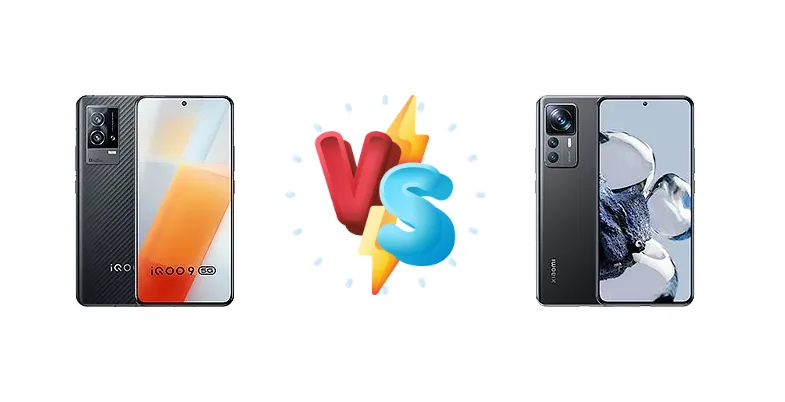
|
🏆 Quick Verdict
For most users, the Xiaomi 12T Pro emerges as the stronger choice. Its Snapdragon 8+ Gen 1 chipset, built on a more efficient 4nm process, delivers superior performance and thermal management compared to the iQOO 9’s Snapdragon 888+. While the iQOO 9 charges slightly faster, the 12T Pro’s overall package offers a more refined experience.
| PHONES | ||
|---|---|---|
| Phone Names | vivo iQOO 9 | Xiaomi 12T Pro |
| Network | ||
|---|---|---|
| 2G bands | GSM 850 / 900 / 1800 / 1900 | GSM 850 / 900 / 1800 / 1900 |
| 3G bands | HSDPA 850 / 900 / 1700(AWS) / 1900 / 2100 | HSDPA 800 / 850 / 900 / 1700(AWS) / 1900 / 2100 |
| 4G bands | 1, 2, 3, 4, 5, 7, 8, 12, 17, 18, 19, 20, 25, 26, 28, 34, 38, 39, 40, 41 | 1, 2, 3, 4, 5, 7, 8, 12, 13, 17, 18, 19, 20, 25, 26, 28, 32, 38, 39, 40, 41, 42, 48, 66 |
| 5G bands | 1, 3, 5, 8, 28, 41, 77, 78 SA/NSA | 1, 3, 5, 7, 8, 20, 28, 38, 40, 41, 66, 77, 78, 75 SA/NSA |
| Speed | HSPA, LTE, 5G | HSPA, LTE, 5G |
| Technology | GSM / HSPA / LTE / 5G | GSM / HSPA / LTE / 5G |
| Launch | ||
|---|---|---|
| Announced | 2022, February 23 | 2022, October 04 |
| Status | Available. Released 2022, March 02 | Available. Released 2022, October 06 |
| Body | ||
|---|---|---|
| Build | Glass front (Panda Glass), aluminum frame, glass back | - |
| Dimensions | 159.1 x 75.1 x 8.6 or 8.7 mm | 163.1 x 75.9 x 8.6 mm (6.42 x 2.99 x 0.34 in) |
| SIM | Nano-SIM + Nano-SIM | · Nano-SIM + eSIM· Nano-SIM + Nano-SIM |
| Weight | 200 g / 202 g (7.05 oz) | 205 g (7.23 oz) |
| Splash and dust resistant | IP53, dust and splash resistant | |
| Display | ||
|---|---|---|
| Protection | Panda Glass | Corning Gorilla Glass 5 |
| Resolution | 1080 x 2376 pixels (~398 ppi density) | 1220 x 2712 pixels, 20:9 ratio (~446 ppi density) |
| Size | 6.56 inches, 104.6 cm2 (~87.5% screen-to-body ratio) | 6.67 inches, 107.4 cm2 (~86.7% screen-to-body ratio) |
| Type | AMOLED, 1B colors, 120Hz, HDR10+, 1200 nits (peak) | AMOLED, 68B colors, 120Hz, Dolby Vision, HDR10+, 500 nits (typ), 900 nits (peak) |
| Monster Touch support | - | |
| Platform | ||
|---|---|---|
| CPU | Octa-core (1x2.99 GHz Cortex-X1 & 3x2.42 GHz Cortex-A78 & 4x1.80 GHz Cortex-A55) | Octa-core (1x3.19 GHz Cortex-X2 & 3x2.75 GHz Cortex-A710 & 4x2.0 GHz Cortex-A510) |
| Chipset | Qualcomm SM8350 Snapdragon 888+ 5G (5 nm) | Qualcomm SM8475 Snapdragon 8+ Gen 1 (4 nm) |
| GPU | Adreno 660 | Adreno 730 |
| OS | Android 12, Funtouch 12 | Android 12, upgradable to Android 14, HyperOS |
| Memory | ||
|---|---|---|
| Card slot | No | No |
| Internal | 128GB 8GB RAM, 256GB 12GB RAM | 128GB 8GB RAM, 256GB 8GB RAM, 256GB 12GB RAM |
| UFS 3.1 | UFS 3.1 | |
| Main Camera | ||
|---|---|---|
| Dual | 48 MP, f/1.8, 25mm (wide), 1/2.0", 0.8µm, PDAF, gimbal OIS 13 MP, f/2.5, 50mm (telephoto), PDAF, 2x optical zoom 13 MP, f/2.2, 16mm, 120˚ (ultrawide) | - |
| Features | Dual-LED dual-tone flash, HDR, panorama | Color spectrum sensor, Dual-LED dual-tone flash, HDR, panorama |
| Single | 16 MP, f/2.5, (wide), 1/3.1", 1.0µm | - |
| Triple | - | 200 MP, f/1.7, (wide), 1/1.22", 0.64µm, PDAF, OIS 8 MP, f/2.2, 120˚ (ultrawide), 1/4.0", 1.12µm 2 MP (macro) |
| Video | 4K@24/30/60fps, 1080p@30/60fps | 8K@24fps, 4K@30/60fps, 1080p@30/60/120/240fps, HDR10+ |
| Selfie camera | ||
|---|---|---|
| Features | HDR | HDR, panorama |
| Single | 16 MP, f/2.5, (wide), 1/3.1", 1.0µm | 20 MP, f/2.2, (wide), 1/3.47", 0.8µm |
| Video | 1080p@30fps | 1080p@30/60fps, HDR |
| Sound | ||
|---|---|---|
| 3.5mm jack | No | No |
| 35mm jack | No | No |
| Loudspeaker | Yes, with stereo speakers | Yes, with stereo speakers |
| 24-bit/192kHz audio | Tuned by Harman Kardon 24-bit/192kHz audio | |
| Comms | ||
|---|---|---|
| Bluetooth | 5.2, A2DP, LE, aptX HD, aptX Adaptive, aptX Lossless | 5.2, A2DP, LE, aptX HD |
| Infrared port | - | Yes |
| NFC | Yes | Yes (market/region dependent) |
| Positioning | GPS, GLONASS | GPS (L1+L5), GLONASS (L1), BDS (B1I+B1c+B2a), GALILEO (E1+E5a), QZSS (L1+L5), NavIC (L5) |
| Radio | No | No |
| USB | USB Type-C 2.0, OTG | USB Type-C 2.0, OTG |
| WLAN | Wi-Fi 802.11 a/b/g/n/ac, dual-band, Wi-Fi Direct | Wi-Fi 802.11 a/b/g/n/ac/6, dual-band, Wi-Fi Direct |
| Features | ||
|---|---|---|
| Sensors | Fingerprint (under display, optical), accelerometer, gyro, proximity, compass | Fingerprint (under display, optical), accelerometer, gyro, proximity, compass |
| Battery | ||
|---|---|---|
| Charging | 120W wired, 50% in 6 min, 100% in 18 min | 120W wired, 100% in 19 min |
| Type | 4350 mAh | Li-Po 5000 mAh |
| Misc | ||
|---|---|---|
| Colors | Legend, Alpha, Phoenix Orange | Black, Silver, Blue |
| Models | - | 22081212UG, 22081212G |
| Price | About 510 EUR | $ 208.76 / € 167.62 |
| SAR | - | 1.08 W/kg (head) 1.07 W/kg (body) |
| SAR EU | - | 1.00 W/kg (head) 1.00 W/kg (body) |
| Tests | ||
|---|---|---|
| Battery life | Endurance rating 105h | Endurance rating 91h |
| Camera | Photo / Video | Photo / Video |
| Display | Contrast ratio: Infinite (nominal) | Contrast ratio: Infinite (nominal) |
| Loudspeaker | -25.5 LUFS (Very good) | -24.1 LUFS (Very good) |
| Performance | AnTuTu: 745168 (v8), 852898 (v9) GeekBench: 3503 (v5.1) GFXBench: 65fps (ES 3.1 onscreen) | AnTuTu: 1032185 (v9) GeekBench: 4081 (v5.1) GFXBench: 65fps (ES 3.1 onscreen) |
vivo iQOO 9
- Slightly faster 50% charge time
- Higher battery endurance rating (though marginal)
- Potentially lower price point (depending on region)
- Older Snapdragon 888+ chipset
- Less efficient 5nm process
- Dimmer display
Xiaomi 12T Pro
- More powerful Snapdragon 8+ Gen 1 chipset
- Brighter display for better outdoor visibility
- More efficient 4nm process for sustained performance
- Slightly slower full charge time
- Lower battery endurance rating
- Potentially higher price point
Display Comparison
The Xiaomi 12T Pro boasts a significantly brighter display, reaching 913 nits measured, compared to the iQOO 9’s 749 nits. This translates to better visibility outdoors under direct sunlight. Both displays share an 'Infinite' (nominal) contrast ratio, typical of AMOLED panels. While neither specification details refresh rate or panel technology (LTPO), the brightness difference is a clear win for the 12T Pro, benefiting users who consume a lot of media outdoors or in brightly lit environments.
Camera Comparison
Both phones are listed as having 'Photo / Video' capabilities, lacking specific details. Without sensor size, aperture, or OIS information, a direct comparison is impossible. However, given Xiaomi’s history of focusing on camera features, it’s reasonable to assume the 12T Pro may offer more advanced image processing algorithms and potentially a more versatile camera system. The absence of detail suggests neither phone is a standout camera performer in this segment.
Performance
The core difference lies in the chipsets. The Xiaomi 12T Pro utilizes the Snapdragon 8+ Gen 1 (4nm), while the iQOO 9 features the Snapdragon 888+ 5G (5nm). The 8+ Gen 1’s smaller 4nm node provides a substantial efficiency advantage, leading to less heat generation under load. This is reflected in the CPU architecture: the 12T Pro’s Cortex-X2 core clocks higher at 3.19 GHz versus the iQOO 9’s 2.99 GHz Cortex-X1. The newer Cortex-A710 cores in the 12T Pro also offer improved performance per watt. Gamers and power users will notice the difference in sustained performance, with less throttling on the 12T Pro.
Battery Life
The iQOO 9 has an endurance rating of 105 hours, while the Xiaomi 12T Pro scores 91 hours. However, this doesn’t tell the whole story. Both support 120W wired charging, but the 12T Pro reaches 100% in 19 minutes, while the iQOO 9 takes 18 minutes. The iQOO 9 gets to 50% in 6 minutes, slightly faster than the 12T Pro. The iQOO 9’s slightly better endurance is likely due to the less power-hungry chipset, but the difference is offset by the 12T Pro’s more efficient processor and brighter display.
Buying Guide
Buy the vivo iQOO 9 if you prioritize the absolute fastest charging speeds and are a casual user who doesn't heavily tax the processor with demanding games or applications. Buy the Xiaomi 12T Pro if you value sustained performance during gaming, video editing, or multitasking, and appreciate a brighter, more vibrant display. The 12T Pro is the better choice for power users.