
vivo iQOO 9 vs iQOO 9T: The Ultimate Showdown
| Phones Images | |||||
|---|---|---|---|---|---|
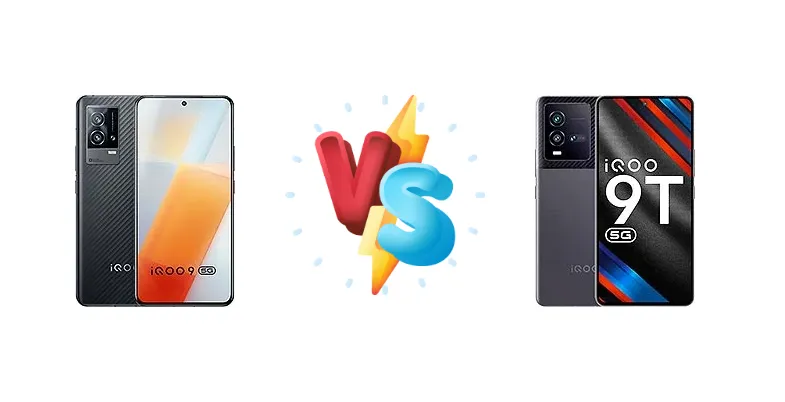
|
🏆 Quick Verdict
The iQOO 9T edges out the iQOO 9 thanks to its newer Snapdragon 8+ Gen 1 chipset, brighter display, and slightly improved battery endurance. However, the iQOO 9 remains a compelling option, especially if you can find it at a lower price.
| PHONES | ||
|---|---|---|
| Phone Names | vivo iQOO 9 | vivo iQOO 9T |
| Network | ||
|---|---|---|
| 2G bands | GSM 850 / 900 / 1800 / 1900 | GSM 850 / 900 / 1800 / 1900 |
| 3G bands | HSDPA 850 / 900 / 1700(AWS) / 1900 / 2100 | HSDPA 800 / 850 / 900 / 1700 / 1800 / 1900 / 2100 |
| 4G bands | 1, 2, 3, 4, 5, 7, 8, 12, 17, 18, 19, 20, 25, 26, 28, 34, 38, 39, 40, 41 | 1, 2, 3, 4, 5, 7, 8, 12, 17, 18, 19, 20, 25, 26, 28, 34, 38, 39, 40, 41, 66 |
| 5G bands | 1, 3, 5, 8, 28, 41, 77, 78 SA/NSA | 1, 3, 5, 8, 28, 40, 41, 77, 78 |
| Speed | HSPA, LTE, 5G | HSPA, LTE, 5G |
| Technology | GSM / HSPA / LTE / 5G | GSM / HSPA / LTE / 5G |
| Launch | ||
|---|---|---|
| Announced | 2022, February 23 | 2022, August 02 |
| Status | Available. Released 2022, March 02 | Available. Released 2022, August 02 |
| Body | ||
|---|---|---|
| Build | Glass front (Panda Glass), aluminum frame, glass back | Glass front (Gorilla Glass 5), aluminum frame, glass back |
| Dimensions | 159.1 x 75.1 x 8.6 or 8.7 mm | 165 x 77 x 8 mm (6.50 x 3.03 x 0.31 in) |
| SIM | Nano-SIM + Nano-SIM | Nano-SIM + Nano-SIM |
| Weight | 200 g / 202 g (7.05 oz) | 206 g (7.27 oz) |
| Splash and dust resistant | Dust and dripping water resistant | |
| Display | ||
|---|---|---|
| Protection | Panda Glass | Corning Gorilla Glass 5 |
| Resolution | 1080 x 2376 pixels (~398 ppi density) | 1080 x 2400 pixels, 20:9 ratio (~388 ppi density) |
| Size | 6.56 inches, 104.6 cm2 (~87.5% screen-to-body ratio) | 6.78 inches, 111.0 cm2 (~87.4% screen-to-body ratio) |
| Type | AMOLED, 1B colors, 120Hz, HDR10+, 1200 nits (peak) | AMOLED, 1B colors, 120Hz, HDR10+, 1500 nits (peak) |
| Monster Touch support | - | |
| Platform | ||
|---|---|---|
| CPU | Octa-core (1x2.99 GHz Cortex-X1 & 3x2.42 GHz Cortex-A78 & 4x1.80 GHz Cortex-A55) | Octa-core (1x3.19 GHz Cortex-X2 & 3x2.75 GHz Cortex-A710 & 4x1.80 GHz Cortex-A510) |
| Chipset | Qualcomm SM8350 Snapdragon 888+ 5G (5 nm) | Qualcomm SM8475 Snapdragon 8+ Gen 1 (4 nm) |
| GPU | Adreno 660 | Adreno 730 |
| OS | Android 12, Funtouch 12 | Android 12, upgradable to Android 14, Funtouch 14 |
| Memory | ||
|---|---|---|
| Card slot | No | No |
| Internal | 128GB 8GB RAM, 256GB 12GB RAM | 128GB 8GB RAM, 256GB 12GB RAM |
| UFS 3.1 | UFS 3.1 | |
| Main Camera | ||
|---|---|---|
| Dual | 48 MP, f/1.8, 25mm (wide), 1/2.0", 0.8µm, PDAF, gimbal OIS 13 MP, f/2.5, 50mm (telephoto), PDAF, 2x optical zoom 13 MP, f/2.2, 16mm, 120˚ (ultrawide) | - |
| Features | Dual-LED dual-tone flash, HDR, panorama | Dual-LED dual-tone flash, HDR, panorama |
| Single | 16 MP, f/2.5, (wide), 1/3.1", 1.0µm | 16 MP, f/2.5, (wide) |
| Triple | - | 50 MP, f/1.9, (wide), 1/1.57", 1.0µm, PDAF, OIS 12 MP, f/2.0, 47mm (telephoto), PDAF, 2x optical zoom 13 MP, f/2.2, 16mm, 120˚ (ultrawide), AF |
| Video | 4K@24/30/60fps, 1080p@30/60fps | 4K@30/60fps, 1080p@30/60fps, gyro-EIS |
| Selfie camera | ||
|---|---|---|
| Features | HDR | HDR |
| Single | 16 MP, f/2.5, (wide), 1/3.1", 1.0µm | 16 MP, f/2.5, (wide) |
| Video | 1080p@30fps | 1080p@30fps, gyro-EIS |
| Sound | ||
|---|---|---|
| 3.5mm jack | No | No |
| 35mm jack | No | No |
| Loudspeaker | Yes, with stereo speakers | Yes, with stereo speakers |
| 24-bit/192kHz audio | 24-bit/192kHz audio | |
| Comms | ||
|---|---|---|
| Bluetooth | 5.2, A2DP, LE, aptX HD, aptX Adaptive, aptX Lossless | 5.2, A2DP, LE, aptX HD, aptX Adaptive |
| Infrared port | - | Yes |
| NFC | Yes | Yes |
| Positioning | GPS, GLONASS | GPS, GLONASS, GALILEO, BDS, QZSS |
| Radio | No | FM radio |
| USB | USB Type-C 2.0, OTG | USB Type-C 2.0, OTG |
| WLAN | Wi-Fi 802.11 a/b/g/n/ac, dual-band, Wi-Fi Direct | Wi-Fi 802.11 a/b/g/n/ac/6, dual-band, Wi-Fi Direct |
| Features | ||
|---|---|---|
| Sensors | Fingerprint (under display, optical), accelerometer, gyro, proximity, compass | Fingerprint (under display, optical), accelerometer, gyro, proximity, compass |
| Battery | ||
|---|---|---|
| Charging | 120W wired, 50% in 6 min, 100% in 18 min | 120W wired, 50% in 8 min, 100% in 19 min |
| Type | 4350 mAh | 4700 mAh |
| Misc | ||
|---|---|---|
| Colors | Legend, Alpha, Phoenix Orange | Alpha, Legend (BMW M branding) |
| Price | About 510 EUR | About 600 EUR |
| Tests | ||
|---|---|---|
| Battery life | Endurance rating 105h | Endurance rating 117h |
| Camera | Photo / Video | Photo / Video |
| Display | Contrast ratio: Infinite (nominal) | Contrast ratio: Infinite (nominal) |
| Loudspeaker | -25.5 LUFS (Very good) | -28.8 LUFS (Average) |
| Performance | AnTuTu: 745168 (v8), 852898 (v9) GeekBench: 3503 (v5.1) GFXBench: 65fps (ES 3.1 onscreen) | - |
vivo iQOO 9
- Blazing-fast 120W charging
- Excellent performance for the price
- Smooth 120Hz display
- Good camera system
- Display not as bright as the 9T
- Older chipset compared to the 9T
vivo iQOO 9T
- Even faster Snapdragon 8+ Gen 1 chipset
- Brighter display for better outdoor visibility
- Slightly improved battery life
- Fast 120W charging
- Potentially higher price
- Camera performance likely similar to the iQOO 9
Display Comparison
The iQOO 9T boasts a significantly brighter display at 1033 nits peak brightness compared to the iQOO 9's 749 nits. Both feature excellent contrast ratios (Infinite nominal), but the increased brightness of the 9T makes it noticeably better for outdoor use and HDR content. Both likely use AMOLED panels with 120Hz refresh rates for smooth visuals.
Camera Comparison
Both phones feature similar camera setups, likely including a primary wide-angle lens, an ultrawide lens, and a telephoto lens (specifications are missing, but this is typical for the series). Image quality is expected to be comparable, with both capable of capturing detailed photos and videos. Low-light performance should be decent, but the 9T's more powerful processor might offer slightly better image processing.
Performance
The iQOO 9T's Snapdragon 8+ Gen 1 is a substantial upgrade over the iQOO 9's Snapdragon 888+. The 8+ Gen 1 offers improved CPU and GPU performance, resulting in smoother gameplay and faster app loading times. While both phones handle demanding tasks with ease, the 9T provides a more future-proofed experience.
Battery Life
The iQOO 9T demonstrates a slight advantage in battery endurance, achieving an 117h rating compared to the iQOO 9's 105h. Both phones support 120W wired charging, allowing for incredibly fast charging speeds (50% in around 6-8 minutes and 100% in 18-19 minutes). However, the 9T's slightly larger battery capacity contributes to its longer endurance.
Buying Guide
The vivo iQOO 9 is ideal for gamers and power users seeking excellent performance and incredibly fast charging without breaking the bank. The iQOO 9T is the better choice for those prioritizing the absolute best performance, a brighter screen for outdoor visibility, and a bit more battery life, willing to pay a slight premium.