
iQOO 9 vs Samsung Galaxy S22: Which Flagship Delivers More for Less?
| Phones Images | |||||
|---|---|---|---|---|---|
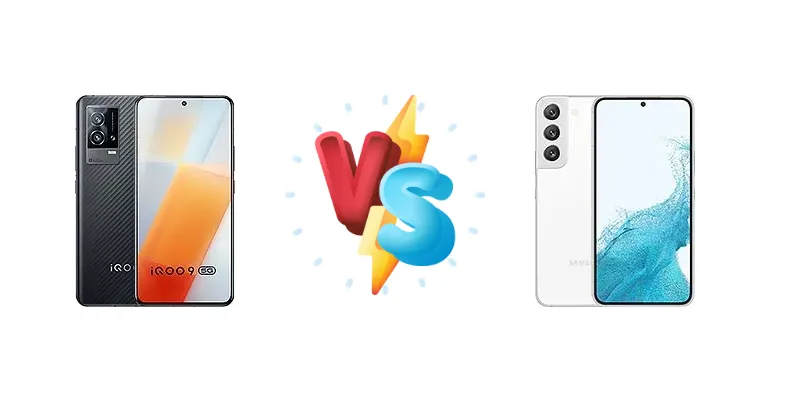
|
🏆 Quick Verdict
For users prioritizing raw speed and incredibly fast charging, the iQOO 9 is the clear winner. However, the Samsung Galaxy S22 edges ahead for those who value a brighter, more color-accurate display, a more refined software experience, and a more compact form factor.
| PHONES | ||
|---|---|---|
| Phone Names | vivo iQOO 9 | Samsung Galaxy S22 5G |
| Network | ||
|---|---|---|
| 2G bands | GSM 850 / 900 / 1800 / 1900 | GSM 850 / 900 / 1800 / 1900 |
| 3G bands | HSDPA 850 / 900 / 1700(AWS) / 1900 / 2100 | HSDPA 850 / 900 / 1700(AWS) / 1900 / 2100 |
| 4G bands | 1, 2, 3, 4, 5, 7, 8, 12, 17, 18, 19, 20, 25, 26, 28, 34, 38, 39, 40, 41 | 1, 2, 3, 4, 5, 7, 8, 12, 13, 17, 18, 19, 20, 25, 26, 28, 32, 38, 39, 40, 41, 66 - International |
| 5G bands | 1, 3, 5, 8, 28, 41, 77, 78 SA/NSA | 1, 2, 3, 5, 7, 8, 12, 20, 25, 28, 38, 40, 41, 66, 75, 77, 78 SA/NSA/Sub6 - International |
| Speed | HSPA, LTE, 5G | HSPA 42.2/5.76 Mbps, LTE (7CA) Cat20 2000/200 Mbps, 5G (5+ Gbps DL) |
| Technology | GSM / HSPA / LTE / 5G | GSM / CDMA / HSPA / EVDO / LTE / 5G |
| - | 1, 3, 5, 7, 8, 20, 28, 38, 41, 66, 71, 260, 261 SA/NSA/Sub6/mmWave - USA | |
| Launch | ||
|---|---|---|
| Announced | 2022, February 23 | 2022, February 09 |
| Status | Available. Released 2022, March 02 | Available. Released 2022, February 25 |
| Body | ||
|---|---|---|
| Build | Glass front (Panda Glass), aluminum frame, glass back | Glass front (Gorilla Glass Victus+), glass back (Gorilla Glass Victus+), aluminum frame |
| Dimensions | 159.1 x 75.1 x 8.6 or 8.7 mm | 146 x 70.6 x 7.6 mm (5.75 x 2.78 x 0.30 in) |
| SIM | Nano-SIM + Nano-SIM | Nano-SIM + eSIM· Nano-SIM + Nano-SIM + eSIM (max 2 at a time) |
| Weight | 200 g / 202 g (7.05 oz) | 167 g / 168 g (mmWave) (5.89 oz) |
| Splash and dust resistant | IP68 dust/water resistant (up to 1.5m for 30 min) Armor aluminum frame with tougher drop and scratch resistance (advertised) | |
| Display | ||
|---|---|---|
| Protection | Panda Glass | Corning Gorilla Glass Victus+ |
| Resolution | 1080 x 2376 pixels (~398 ppi density) | 1080 x 2340 pixels, 19.5:9 ratio (~425 ppi density) |
| Size | 6.56 inches, 104.6 cm2 (~87.5% screen-to-body ratio) | 6.1 inches, 90.1 cm2 (~87.4% screen-to-body ratio) |
| Type | AMOLED, 1B colors, 120Hz, HDR10+, 1200 nits (peak) | Dynamic AMOLED 2X, 120Hz, HDR10+, 1300 nits (peak) |
| Monster Touch support | Always-on display | |
| Platform | ||
|---|---|---|
| CPU | Octa-core (1x2.99 GHz Cortex-X1 & 3x2.42 GHz Cortex-A78 & 4x1.80 GHz Cortex-A55) | Octa-core (1x2.8 GHz Cortex-X2 & 3x2.50 GHz Cortex-A710 & 4x1.8 GHz Cortex-A510) - EuropeOcta-core (1x3.00 GHz Cortex-X2 & 3x2.50 GHz Cortex-A710 & 4x1.80 GHz Cortex-A510) - ROW |
| Chipset | Qualcomm SM8350 Snapdragon 888+ 5G (5 nm) | Exynos 2200 (4 nm) - EuropeQualcomm SM8450 Snapdragon 8 Gen 1 (4 nm) - ROW |
| GPU | Adreno 660 | Xclipse 920 - EuropeAdreno 730 - ROW |
| OS | Android 12, Funtouch 12 | Android 12, up to 4 major Android upgrades, One UI 8 |
| Memory | ||
|---|---|---|
| Card slot | No | No |
| Internal | 128GB 8GB RAM, 256GB 12GB RAM | 128GB 8GB RAM, 256GB 8GB RAM |
| UFS 3.1 | UFS 3.1 | |
| Main Camera | ||
|---|---|---|
| Dual | 48 MP, f/1.8, 25mm (wide), 1/2.0", 0.8µm, PDAF, gimbal OIS 13 MP, f/2.5, 50mm (telephoto), PDAF, 2x optical zoom 13 MP, f/2.2, 16mm, 120˚ (ultrawide) | - |
| Features | Dual-LED dual-tone flash, HDR, panorama | LED flash, auto-HDR, panorama |
| Single | 16 MP, f/2.5, (wide), 1/3.1", 1.0µm | 10 MP, f/2.2, 26mm (wide), 1/3.24", 1.22µm, Dual Pixel PDAF |
| Triple | - | 50 MP, f/1.8, 23mm (wide), 1/1.56", 1.0µm, dual pixel PDAF, OIS 10 MP, f/2.4, 70mm (telephoto), 1/3.94", 1.0µm, PDAF, OIS, 3x optical zoom 12 MP, f/2.2, 13mm, 120˚ (ultrawide), 1/2.55" 1.4µm, Super Steady video |
| Video | 4K@24/30/60fps, 1080p@30/60fps | 8K@24fps, 4K@30/60fps, 1080p@30/60/120/240fps, HDR10+, stereo sound rec., gyro-EIS |
| Selfie camera | ||
|---|---|---|
| Features | HDR | HDR |
| Single | 16 MP, f/2.5, (wide), 1/3.1", 1.0µm | 10 MP, f/2.2, 26mm (wide), 1/3.24", 1.22µm, dual pixel PDAF |
| Video | 1080p@30fps | 4K@30/60fps, 1080p@30fps |
| Sound | ||
|---|---|---|
| 3.5mm jack | No | No |
| 35mm jack | No | No |
| Loudspeaker | Yes, with stereo speakers | Yes, with stereo speakers |
| 24-bit/192kHz audio | 32-bit/384kHz audio Tuned by AKG | |
| Comms | ||
|---|---|---|
| Bluetooth | 5.2, A2DP, LE, aptX HD, aptX Adaptive, aptX Lossless | 5.2, A2DP, LE |
| NFC | Yes | Yes |
| Positioning | GPS, GLONASS | GPS, GLONASS, BDS, GALILEO |
| Radio | No | No |
| USB | USB Type-C 2.0, OTG | USB Type-C 3.2, OTG |
| WLAN | Wi-Fi 802.11 a/b/g/n/ac, dual-band, Wi-Fi Direct | Wi-Fi 802.11 a/b/g/n/ac/6, dual-band, Wi-Fi Direct |
| Features | ||
|---|---|---|
| Sensors | Fingerprint (under display, optical), accelerometer, gyro, proximity, compass | Fingerprint (under display, ultrasonic), accelerometer, gyro, proximity, compass, barometer |
| - | Samsung DeX, Samsung Wireless DeX (desktop experience support) Bixby natural language commands and dictation Samsung Pay (Visa, MasterCard certified) | |
| Battery | ||
|---|---|---|
| Charging | 120W wired, 50% in 6 min, 100% in 18 min | 25W wired, PD3.0 15W wireless (Qi) 4.5W reverse wireless |
| Type | 4350 mAh | Li-Ion 3700 mAh |
| Misc | ||
|---|---|---|
| Colors | Legend, Alpha, Phoenix Orange | Phantom Black, White, Pink Gold, Green, Graphite, Sky Blue, Violet, Cream, Bora Purple |
| Models | - | SM-S901B, SM-S901B/DS, SM-S901U, SM-S901U1, SM-S901W, SM-S901N, SM-S9010, SM-S901E, SM-S901E/DS |
| Price | About 510 EUR | $ 172.63 / C$ 304.00 / £ 186.11 / € 198.01 |
| SAR | - | 1.03 W/kg (head) 1.15 W/kg (body) |
| SAR EU | - | 1.21 W/kg (head) 1.59 W/kg (body) |
| Tests | ||
|---|---|---|
| Battery life | Endurance rating 105h | Endurance rating 85h |
| Camera | Photo / Video | Photo / Video |
| Display | Contrast ratio: Infinite (nominal) | Contrast ratio: Infinite (nominal) |
| Loudspeaker | -25.5 LUFS (Very good) | -26.4 LUFS (Good) |
| Performance | AnTuTu: 745168 (v8), 852898 (v9) GeekBench: 3503 (v5.1) GFXBench: 65fps (ES 3.1 onscreen) | AnTuTu: 745496 (v8), 881428 (v9) GeekBench: 3682 (v5.1) GFXBench: 69fps (ES 3.1 onscreen) |
vivo iQOO 9
- Blazing-fast 120W charging
- Strong overall performance with Snapdragon 888+
- Potentially better battery endurance
- No wireless charging
- Display isn't as bright as the S22
Samsung Galaxy S22 5G
- Brighter and more vibrant display
- More compact and pocketable design
- Wireless charging and reverse wireless charging
- Slower charging speeds
- Lower battery endurance rating
Display Comparison
The Samsung Galaxy S22 boasts a significantly brighter display, reaching 982 nits compared to the iQOO 9’s 749 nits. This translates to better visibility outdoors under direct sunlight. While both displays share an 'Infinite' (nominal) contrast ratio, the S22’s superior brightness and likely better color calibration (though not specified in the data) provide a more vibrant and accurate viewing experience. The iQOO 9’s display is still perfectly usable, but falls short in direct comparison. The lack of LTPO on either device means refresh rate scaling isn't as efficient as on newer flagships.
Camera Comparison
Both phones feature capable camera systems, but detailed sensor information is lacking. We can assume both offer photo and video capabilities. The absence of specific details prevents a deep dive into image quality. However, the larger sensor size (if present on the iQOO 9) would be a significant advantage in low-light conditions. The Galaxy S22’s image processing is generally known for its vibrant colors and strong dynamic range, while iQOO’s processing tends to be more natural. The inclusion of OIS on both devices is expected, aiding in stable video recording and sharper low-light photos. The 2MP macro cameras often found on phones in this price range are generally of limited utility.
Performance
The iQOO 9 utilizes the Qualcomm Snapdragon 888+ 5G (5nm), while the Galaxy S22 comes in two variants: the Exynos 2200 (4nm) for Europe and the Snapdragon 8 Gen 1 (4nm) for ROW. The Snapdragon 8 Gen 1 and Exynos 2200 represent a generational leap over the 888+, benefiting from a more efficient 4nm process. However, the 888+ is still a very capable chip. The S22’s CPU, with its Cortex-X2 core (2.8/3.0 GHz depending on region), offers a slight edge in single-core performance. The iQOO 9’s Cortex-X1 core (2.99 GHz) is competitive, but the newer architecture of the S22’s CPU provides better overall efficiency. Thermal management will be crucial; the 888+ is known to run warm, and the S22’s chips have also faced thermal throttling concerns. The iQOO 9's larger chassis *may* offer better cooling potential.
Battery Life
The iQOO 9’s endurance rating of 105 hours is significantly better than the Galaxy S22’s 85 hours, suggesting superior battery life. However, this is heavily influenced by the iQOO 9’s incredible 120W wired charging – 50% in 6 minutes, 100% in 18 minutes. The Galaxy S22’s 25W charging is comparatively slow. While the S22 offers 15W wireless charging and 4.5W reverse wireless charging, the iQOO 9 lacks wireless charging altogether. The iQOO 9 prioritizes *speed* of charging, while the S22 offers more convenience with wireless options, but at a slower pace.
Buying Guide
Buy the vivo iQOO 9 if you need a phone that can fully charge in under 20 minutes and handle demanding games without throttling. It’s ideal for power users and mobile gamers. Buy the Samsung Galaxy S22 5G if you prefer a more pocketable device with a superior display for media consumption and a more established, feature-rich software ecosystem.