
iQOO 9 vs. Oppo Find X5 Pro: Which Flagship Delivers More?
| Phones Images | |||||
|---|---|---|---|---|---|
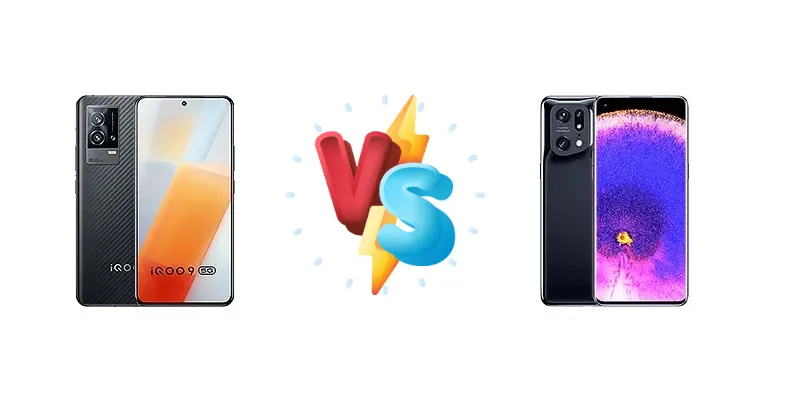
|
🏆 Quick Verdict
For users prioritizing gaming and rapid charging, the iQOO 9 is the clear winner. Its Snapdragon 888+ and 120W charging offer unmatched speed for the price. However, the Oppo Find X5 Pro edges ahead for those valuing a more refined camera system and the convenience of wireless charging.
| PHONES | ||
|---|---|---|
| Phone Names | vivo iQOO 9 | Oppo Find X5 Pro |
| Network | ||
|---|---|---|
| 2G bands | GSM 850 / 900 / 1800 / 1900 | GSM 850 / 900 / 1800 / 1900 |
| 3G bands | HSDPA 850 / 900 / 1700(AWS) / 1900 / 2100 | HSDPA 800 / 850 / 900 / 1700(AWS) / 1900 / 2100 |
| 4G bands | 1, 2, 3, 4, 5, 7, 8, 12, 17, 18, 19, 20, 25, 26, 28, 34, 38, 39, 40, 41 | 1, 2, 3, 4, 5, 7, 8, 12, 13, 17, 18, 19, 20, 25, 26, 28, 32, 34, 38, 39, 40, 41, 42, 66 - Global |
| 5G bands | 1, 3, 5, 8, 28, 41, 77, 78 SA/NSA | 1, 2, 3, 5, 7, 8, 12, 13, 18, 20, 25, 26, 28, 38, 40, 41, 66, 77, 78, 79 SA/NSA - Global |
| Speed | HSPA, LTE, 5G | HSPA, LTE, 5G |
| Technology | GSM / HSPA / LTE / 5G | GSM / CDMA / HSPA / CDMA2000 / LTE / 5G |
| - | 1, 2, 3, 5, 8, 20, 28, 38, 41, 66, 77, 78, 79 SA/NSA - China | |
| Launch | ||
|---|---|---|
| Announced | 2022, February 23 | 2022, February 24 |
| Status | Available. Released 2022, March 02 | Available. Released 2022, March 14 |
| Body | ||
|---|---|---|
| Build | Glass front (Panda Glass), aluminum frame, glass back | Glass front (Gorilla Glass Victus), ceramic back or eco leather back, aluminum frame |
| Dimensions | 159.1 x 75.1 x 8.6 or 8.7 mm | 163.7 x 73.9 x 8.5 or 8.8 mm |
| SIM | Nano-SIM + Nano-SIM | Nano-SIM + eSIM |
| Weight | 200 g / 202 g (7.05 oz) | 218 g or 195 g (6.88 oz) |
| Splash and dust resistant | IP68 dust/water resistant (up to 1.5m for 30 min) | |
| Display | ||
|---|---|---|
| Protection | Panda Glass | Corning Gorilla Glass Victus |
| Resolution | 1080 x 2376 pixels (~398 ppi density) | 1440 x 3216 pixels, 20:9 ratio (~525 ppi density) |
| Size | 6.56 inches, 104.6 cm2 (~87.5% screen-to-body ratio) | 6.7 inches, 108.4 cm2 (~89.6% screen-to-body ratio) |
| Type | AMOLED, 1B colors, 120Hz, HDR10+, 1200 nits (peak) | LTPO2 AMOLED, 1B colors, 120Hz, HDR10+, BT.2020, 500 nits (typ), 800 nits (HBM), 1300 nits (peak) |
| Monster Touch support | - | |
| Platform | ||
|---|---|---|
| CPU | Octa-core (1x2.99 GHz Cortex-X1 & 3x2.42 GHz Cortex-A78 & 4x1.80 GHz Cortex-A55) | Octa-core (1x3.00 GHz Cortex-X2 & 3x2.50 GHz Cortex-A710 & 4x1.80 GHz Cortex-A510) - GlobalOcta-core (1x3.05 GHz Cortex-X2 & 3x2.85 GHz Cortex-A710 & 4x1.80 GHz Cortex-A510) - China |
| Chipset | Qualcomm SM8350 Snapdragon 888+ 5G (5 nm) | Qualcomm SM8450 Snapdragon 8 Gen 1 (4 nm) - GlobalMediatek Dimensity 9000 (4 nm) - China |
| GPU | Adreno 660 | Adreno 730 - GlobalMali-G710 MC10 - China |
| OS | Android 12, Funtouch 12 | Android 12, upgradable to Android 14, ColorOS 14 |
| Memory | ||
|---|---|---|
| Card slot | No | No |
| Internal | 128GB 8GB RAM, 256GB 12GB RAM | 256GB 8GB RAM, 256GB 12GB RAM, 512GB 12GB RAM |
| UFS 3.1 | UFS 3.1 | |
| Main Camera | ||
|---|---|---|
| Dual | 48 MP, f/1.8, 25mm (wide), 1/2.0", 0.8µm, PDAF, gimbal OIS 13 MP, f/2.5, 50mm (telephoto), PDAF, 2x optical zoom 13 MP, f/2.2, 16mm, 120˚ (ultrawide) | - |
| Features | Dual-LED dual-tone flash, HDR, panorama | Hasselblad Color Calibration, color spectrum sensor, LED flash, HDR, panorama |
| Single | 16 MP, f/2.5, (wide), 1/3.1", 1.0µm | 32 MP, f/2.4, 21mm (wide), 1/2.74", 0.8µm |
| Triple | - | 50 MP, f/1.7, 25mm (wide), 1/1.56", 1.0µm, multi-directional PDAF, OIS (3-axis sensor-shift, 2-axis lens-shift) 13 MP, f/2.4, 52mm (telephoto), 1/3.4", 2x optical zoom, PDAF 50 MP, f/2.2, 15mm, 110˚ (ultrawide), 1/1.56", 1.0µm, multi-directional PDAF |
| Video | 4K@24/30/60fps, 1080p@30/60fps | 4K@30/60fps, 1080p@30/60/240fps; gyro-EIS; HDR, 10‑bit video |
| Selfie camera | ||
|---|---|---|
| Features | HDR | Panorama |
| Single | 16 MP, f/2.5, (wide), 1/3.1", 1.0µm | 32 MP, f/2.4, 21mm (wide), 1/2.74", 0.8µm |
| Video | 1080p@30fps | 1080p@30fps, gyro-EIS |
| Sound | ||
|---|---|---|
| 3.5mm jack | No | No |
| 35mm jack | No | No |
| Loudspeaker | Yes, with stereo speakers | Yes, with stereo speakers |
| 24-bit/192kHz audio | - | |
| Comms | ||
|---|---|---|
| Bluetooth | 5.2, A2DP, LE, aptX HD, aptX Adaptive, aptX Lossless | 5.2, A2DP, LE, aptX HD |
| NFC | Yes | Yes |
| Positioning | GPS, GLONASS | GPS (L1), GLONASS (L1), BDS (B1I+B1c), GALILEO (E1+E5a), QZSS (L1) |
| Radio | No | No |
| USB | USB Type-C 2.0, OTG | USB Type-C 3.1, OTG |
| WLAN | Wi-Fi 802.11 a/b/g/n/ac, dual-band, Wi-Fi Direct | Wi-Fi 802.11 a/b/g/n/ac/6e, dual-band, Wi-Fi Direct |
| Features | ||
|---|---|---|
| Sensors | Fingerprint (under display, optical), accelerometer, gyro, proximity, compass | Fingerprint (under display, optical), accelerometer, gyro, proximity, compass |
| - | Oppo Find X5 Pro Dimensity model has no MariSilicon X image chip, 5-axis OIS and Hasselblad’s color calibration | |
| Battery | ||
|---|---|---|
| Charging | 120W wired, 50% in 6 min, 100% in 18 min | 80W wired, PD, 50% in 12 min 50W wireless, 100% in 47 min 10W reverse wireless |
| Type | 4350 mAh | Li-Po 5000 mAh |
| Misc | ||
|---|---|---|
| Colors | Legend, Alpha, Phoenix Orange | Ceramic Black, Ceramic White, Blue (eco leather) |
| Models | - | PFEM10, CPH2305, PFFM20 |
| Price | About 510 EUR | € 449.00 / $ 430.24 / £ 1,049.00 |
| Tests | ||
|---|---|---|
| Battery life | Endurance rating 105h | Endurance rating 101h |
| Camera | Photo / Video | Photo / Video |
| Display | Contrast ratio: Infinite (nominal) | Contrast ratio: Infinite (nominal) |
| Loudspeaker | -25.5 LUFS (Very good) | -24.7 LUFS (Very good) |
| Performance | AnTuTu: 745168 (v8), 852898 (v9) GeekBench: 3503 (v5.1) GFXBench: 65fps (ES 3.1 onscreen) | AnTuTu: 1012896 (v9) GeekBench: 3433 (v5.1) GFXBench: 44fps (ES 3.1 onscreen) |
vivo iQOO 9
- Incredibly fast 120W wired charging
- Powerful Snapdragon 888+ processor
- Competitive price point
- Older chipset may show its age in demanding tasks
- Less refined camera system compared to the Find X5 Pro
Oppo Find X5 Pro
- More powerful Snapdragon 8 Gen 1 or Dimensity 9000 chipset
- Superior camera system with advanced image processing
- Convenient wireless and reverse wireless charging
- Snapdragon 8 Gen 1 can be prone to throttling
- Higher price tag
Display Comparison
Both the iQOO 9 and Oppo Find X5 Pro feature 'Infinite' contrast ratio displays, typical of OLED panels. However, the Find X5 Pro boasts a slightly higher peak brightness of 762 nits compared to the iQOO 9’s 749 nits, translating to marginally better visibility in direct sunlight. While both offer excellent viewing experiences, the Find X5 Pro’s panel has a slight edge in outdoor readability. Neither specification details refresh rate, but both are expected to be 120Hz, a standard for this class of device.
Camera Comparison
Both phones offer photo and video capabilities, but details are sparse. The Oppo Find X5 Pro likely benefits from Oppo’s established camera expertise and image processing algorithms. While sensor sizes aren’t specified, the Find X5 Pro’s positioning as a premium device suggests a larger, more capable main sensor. The iQOO 9, while capable, likely prioritizes speed and affordability over cutting-edge camera technology. The absence of details on features like OIS or lens apertures makes a definitive comparison difficult, but the Find X5 Pro is expected to deliver superior image quality, particularly in low-light conditions.
Performance
The core difference lies in the chipsets. The iQOO 9 utilizes the Snapdragon 888+ (5nm), while the Find X5 Pro comes with either the Snapdragon 8 Gen 1 (4nm) or the Dimensity 9000 (4nm) depending on the region. The Snapdragon 8 Gen 1 and Dimensity 9000, built on a smaller 4nm process, theoretically offer improved power efficiency and performance over the 5nm Snapdragon 888+. The Find X5 Pro’s CPU configuration – Cortex-X2, A710, and A510 cores – represents a generational leap over the iQOO 9’s Cortex-X1, A78, and A55 cores. This translates to faster application loading and smoother multitasking. However, the Snapdragon 8 Gen 1 is known to throttle under sustained load, a potential issue the iQOO 9’s older, but well-managed, chipset might avoid.
Battery Life
The iQOO 9 and Oppo Find X5 Pro both achieve endurance ratings of 105 and 101 hours respectively, suggesting comparable overall battery life. However, their charging capabilities are drastically different. The iQOO 9’s 120W wired charging is a game-changer, achieving 50% charge in just 6 minutes and a full charge in 18 minutes. The Find X5 Pro offers 80W wired charging (50% in 12 minutes) alongside 50W wireless charging (100% in 47 minutes) and 10W reverse wireless charging. While the Find X5 Pro provides wireless charging convenience, the iQOO 9’s wired charging speed is unmatched.
Buying Guide
Buy the vivo iQOO 9 if you need a powerhouse for mobile gaming, demand the fastest possible wired charging, and are comfortable with a slightly less refined software experience. Buy the Oppo Find X5 Pro if you prefer a premium build quality, a versatile and capable camera system, and the convenience of wireless charging, even if it comes at a higher price point.