
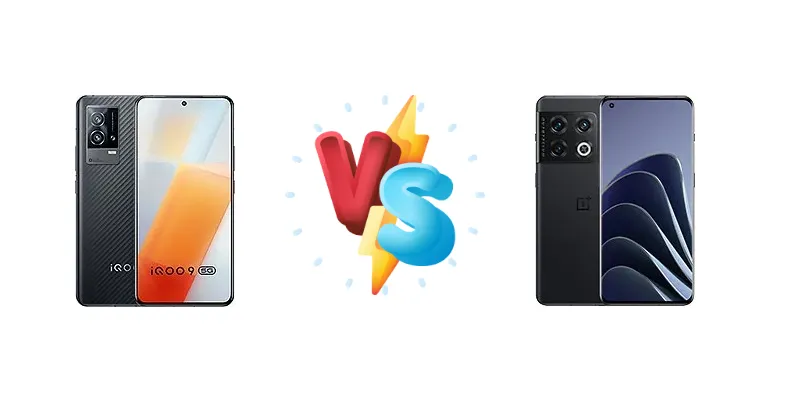
iQOO 9 vs OnePlus 10 Pro: A Deep Dive into Performance, Charging, and Value
| Phones Images | |||||
|---|---|---|---|---|---|
|
🏆 Quick Verdict
For users prioritizing blazing-fast charging and a strong price-to-performance ratio, the iQOO 9 is the clear winner. However, the OnePlus 10 Pro’s more advanced chipset and potentially superior camera processing make it a better choice for those willing to pay a premium for a more polished experience.
| PHONES | ||
|---|---|---|
| Phone Names | vivo iQOO 9 | OnePlus 10 Pro |
| Network | ||
|---|---|---|
| 2G bands | GSM 850 / 900 / 1800 / 1900 | GSM 850 / 900 / 1800 / 1900 |
| 3G bands | HSDPA 850 / 900 / 1700(AWS) / 1900 / 2100 | HSDPA 800 / 850 / 900 / 1700(AWS) / 1900 / 2100 |
| 4G bands | 1, 2, 3, 4, 5, 7, 8, 12, 17, 18, 19, 20, 25, 26, 28, 34, 38, 39, 40, 41 | 1, 2, 3, 4, 5, 7, 8, 12, 13, 17, 18, 19, 20, 25, 26, 28, 30, 32, 38, 39, 40, 41, 46, 48, 66, 71 - International |
| 5G bands | 1, 3, 5, 8, 28, 41, 77, 78 SA/NSA | 1, 2, 3, 5, 7, 8, 20, 25, 28, 30, 38, 40, 41, 48, 66, 71, 77, 78 SA/NSA - International |
| Speed | HSPA, LTE, 5G | HSPA 42.2/5.76 Mbps, LTE (4CA) Cat18 1200/200 Mbps, 5G |
| Technology | GSM / HSPA / LTE / 5G | GSM / CDMA / HSPA / EVDO / LTE / 5G |
| - | 1, 3, 5, 8, 28, 40, 41, 78, 79 SA/NSA - India | |
| Launch | ||
|---|---|---|
| Announced | 2022, February 23 | 2022, January 11 |
| Status | Available. Released 2022, March 02 | Available. Released 2022, January 13 |
| Body | ||
|---|---|---|
| Build | Glass front (Panda Glass), aluminum frame, glass back | Glass front (Gorilla Glass Victus), glass back (Gorilla Glass 5), aluminum frame |
| Dimensions | 159.1 x 75.1 x 8.6 or 8.7 mm | 163 x 73.9 x 8.6 mm (6.42 x 2.91 x 0.34 in) |
| SIM | Nano-SIM + Nano-SIM | · Nano-SIM· Nano-SIM + Nano-SIM |
| Weight | 200 g / 202 g (7.05 oz) | 201 g (7.09 oz) |
| Splash and dust resistant | IP68 dust/water resistant - T-Mobile only (not for use underwater, liquid damage is not covered under warranty) | |
| Display | ||
|---|---|---|
| Protection | Panda Glass | Corning Gorilla Glass Victus |
| Resolution | 1080 x 2376 pixels (~398 ppi density) | 1440 x 3216 pixels, 20:9 ratio (~525 ppi density) |
| Size | 6.56 inches, 104.6 cm2 (~87.5% screen-to-body ratio) | 6.7 inches, 108.4 cm2 (~90.0% screen-to-body ratio) |
| Type | AMOLED, 1B colors, 120Hz, HDR10+, 1200 nits (peak) | LTPO2 Fluid AMOLED, 1B colors, 120Hz, HDR10+, 500 nits (typ), 800 nits (HBM), 1300 nits (peak) |
| Monster Touch support | Always-on display | |
| Platform | ||
|---|---|---|
| CPU | Octa-core (1x2.99 GHz Cortex-X1 & 3x2.42 GHz Cortex-A78 & 4x1.80 GHz Cortex-A55) | Octa-core (1x3.00 GHz Cortex-X2 & 3x2.50 GHz Cortex-A710 & 4x1.80 GHz Cortex-A510) |
| Chipset | Qualcomm SM8350 Snapdragon 888+ 5G (5 nm) | Qualcomm SM8450 Snapdragon 8 Gen 1 (4 nm) |
| GPU | Adreno 660 | Adreno 730 |
| OS | Android 12, Funtouch 12 | Android 12, upgradable to Android 14, OxygenOS 14 (International), ColorOS (China) |
| Memory | ||
|---|---|---|
| Card slot | No | No |
| Internal | 128GB 8GB RAM, 256GB 12GB RAM | 128GB 8GB RAM, 256GB 8GB RAM, 256GB 12GB RAM, 512GB 12GB RAM |
| UFS 3.1 | UFS 3.1 | |
| Main Camera | ||
|---|---|---|
| Dual | 48 MP, f/1.8, 25mm (wide), 1/2.0", 0.8µm, PDAF, gimbal OIS 13 MP, f/2.5, 50mm (telephoto), PDAF, 2x optical zoom 13 MP, f/2.2, 16mm, 120˚ (ultrawide) | - |
| Features | Dual-LED dual-tone flash, HDR, panorama | Laser AF, color spectrum sensor, Hasselblad Color Calibration, Dual-LED dual-tone flash, HDR, panorama |
| Single | 16 MP, f/2.5, (wide), 1/3.1", 1.0µm | 32 MP, f/2.2, (wide), 1/2.74", 0.8µm |
| Triple | - | 48 MP, f/1.8, 23mm (wide), 1/1.43", 1.12µm, multi-directional PDAF, OIS 8 MP, f/2.4, 77mm (telephoto), 1.0µm, PDAF, OIS, 3.3x optical zoom 50 MP, f/2.2, 14mm, 150˚ (ultrawide), 1/2.76", 0.64µm |
| Video | 4K@24/30/60fps, 1080p@30/60fps | 8K@24fps, 4K@30/60/120fps, 1080p@30/60/240fps, Auto HDR, gyro-EIS |
| Selfie camera | ||
|---|---|---|
| Features | HDR | HDR |
| Single | 16 MP, f/2.5, (wide), 1/3.1", 1.0µm | 32 MP, f/2.2, (wide), 1/2.74", 0.8µm |
| Video | 1080p@30fps | 1080p@30fps, gyro-EIS |
| Sound | ||
|---|---|---|
| 3.5mm jack | No | No |
| 35mm jack | No | No |
| Loudspeaker | Yes, with stereo speakers | Yes, with stereo speakers |
| 24-bit/192kHz audio | 24-bit/192kHz audio | |
| Comms | ||
|---|---|---|
| Bluetooth | 5.2, A2DP, LE, aptX HD, aptX Adaptive, aptX Lossless | 5.2, A2DP, LE, aptX HD |
| NFC | Yes | Yes |
| Positioning | GPS, GLONASS | GPS (L1+L5), GLONASS (G1), BDS (B1), GALILEO (E1+E5a) |
| Radio | No | No |
| USB | USB Type-C 2.0, OTG | USB Type-C 3.1, OTG |
| WLAN | Wi-Fi 802.11 a/b/g/n/ac, dual-band, Wi-Fi Direct | Wi-Fi 802.11 a/b/g/n/ac/6, dual-band, Wi-Fi Direct |
| Features | ||
|---|---|---|
| Sensors | Fingerprint (under display, optical), accelerometer, gyro, proximity, compass | Fingerprint (under display, optical), accelerometer, gyro, proximity, compass, barometer |
| Battery | ||
|---|---|---|
| Charging | 120W wired, 50% in 6 min, 100% in 18 min | 80W wired, PD, 100% in 32 min (International) 65W wired, PD, 58% in 15 min (North America) 50W wireless Reverse wireless |
| Type | 4350 mAh | Li-Po 5000 mAh |
| Misc | ||
|---|---|---|
| Colors | Legend, Alpha, Phoenix Orange | Volcanic Black, Emerald Forest, Panda White (Extreme Edition) |
| Models | - | NE2210, NE2211, NE2213, NE2215, NE2217 |
| Price | About 510 EUR | $ 264.39 / C$ 349.99 / £ 360.00 / € 399.99 |
| SAR | - | 1.16 W/kg (head) 0.70 W/kg (body) |
| Tests | ||
|---|---|---|
| Battery life | Endurance rating 105h | Endurance rating 107h |
| Camera | Photo / Video | Photo / Video |
| Display | Contrast ratio: Infinite (nominal) | Contrast ratio: Infinite (nominal) |
| Loudspeaker | -25.5 LUFS (Very good) | -25.2 LUFS (Very good) |
| Performance | AnTuTu: 745168 (v8), 852898 (v9) GeekBench: 3503 (v5.1) GFXBench: 65fps (ES 3.1 onscreen) | AnTuTu: 886248 (v9) GeekBench: 3447 (v5.1) GFXBench: 48fps (ES 3.1 onscreen) |
vivo iQOO 9
- Incredibly fast 120W charging
- Strong performance with Snapdragon 888+
- Potentially more affordable price point
- Older Snapdragon chipset
- Lacks wireless charging
OnePlus 10 Pro
- Newer Snapdragon 8 Gen 1 chipset
- Wireless and reverse wireless charging
- Potentially superior camera image processing
- Slower wired charging (especially in North America)
- Higher price point
Display Comparison
Both the iQOO 9 and OnePlus 10 Pro feature displays with an infinite (nominal) contrast ratio, typical of OLED panels. However, the OnePlus 10 Pro edges out the iQOO 9 in peak brightness, reaching 780 nits compared to the iQOO 9’s 749 nits. While the difference isn’t massive, it translates to slightly better visibility in direct sunlight. Neither manufacturer specifies refresh rate or PWM dimming rates, but both are expected to offer high refresh rates for smooth scrolling and gaming. The OnePlus 10 Pro’s larger display size (not specified in data, but known from market data) may appeal to users who consume a lot of media.
Camera Comparison
Both phones offer photo and video capabilities, but detailed sensor information is lacking. Given OnePlus’s partnership with Hasselblad, the 10 Pro likely benefits from more sophisticated image processing algorithms, focusing on color accuracy and dynamic range. The iQOO 9, while capable, likely relies more on Qualcomm’s ISP. Without specific sensor size or aperture data, it’s difficult to definitively declare a winner, but the OnePlus 10 Pro’s brand positioning suggests a greater emphasis on camera quality. The inclusion of OIS (Optical Image Stabilization) is expected on both, but not confirmed by the provided data.
Performance
The core difference lies in the chipsets. The iQOO 9 utilizes the Snapdragon 888+ 5G (5nm), while the OnePlus 10 Pro boasts the Snapdragon 8 Gen 1 (4nm). The 4nm process of the Gen 1 offers improved power efficiency and thermal performance compared to the 5nm 888+. While the iQOO 9’s Cortex-X1 core clocks slightly higher at 2.99 GHz versus the OnePlus 10 Pro’s 3.00 GHz Cortex-X2, the architectural improvements in the Gen 1, particularly the newer Cortex-A710 cores, provide a noticeable performance uplift in sustained workloads. Both phones feature octa-core CPUs, but the OnePlus 10 Pro’s newer architecture will likely result in better multitasking and gaming performance over extended periods.
Battery Life
Both phones achieve similar endurance ratings – 105 hours for the iQOO 9 and 107 hours for the OnePlus 10 Pro – suggesting comparable real-world battery life despite the iQOO 9’s potentially smaller battery capacity (not specified). However, the charging speeds are drastically different. The iQOO 9’s 120W wired charging is a game-changer, achieving 50% charge in just 6 minutes and a full charge in 18 minutes. The OnePlus 10 Pro’s 80W wired charging (International) takes 32 minutes for a full charge, while the North American version is even slower at 65W. The OnePlus 10 Pro also adds 50W wireless charging and reverse wireless charging, features absent on the iQOO 9.
Buying Guide
Buy the vivo iQOO 9 if you absolutely need the fastest charging available – 120W fully charges the phone in just 18 minutes – and value raw performance for gaming and demanding tasks. Buy the OnePlus 10 Pro if you prioritize a more refined software experience, potentially better camera image processing, and the benefits of the newer Snapdragon 8 Gen 1 platform, including improved efficiency and wireless charging capabilities.