
vivo iQOO 9 vs Motorola Edge 40: A Detailed Showdown
| Phones Images | |||||
|---|---|---|---|---|---|
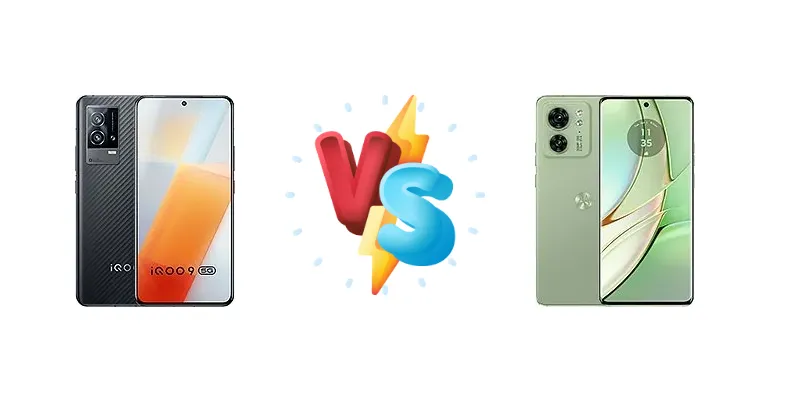
|
🏆 Quick Verdict
The iQOO 9 takes the lead with its significantly faster charging and powerful Snapdragon 888+ chipset. However, the Edge 40 boasts a brighter display and a more modern design. Ultimately, the iQOO 9 is for performance enthusiasts, while the Edge 40 appeals to those prioritizing display quality and aesthetics.
| PHONES | ||
|---|---|---|
| Phone Names | vivo iQOO 9 | Motorola Edge 40 |
| Network | ||
|---|---|---|
| 2G bands | GSM 850 / 900 / 1800 / 1900 | GSM 850 / 900 / 1800 / 1900 |
| 3G bands | HSDPA 850 / 900 / 1700(AWS) / 1900 / 2100 | HSDPA 850 / 900 / 1700(AWS) / 1900 / 2100 |
| 4G bands | 1, 2, 3, 4, 5, 7, 8, 12, 17, 18, 19, 20, 25, 26, 28, 34, 38, 39, 40, 41 | 1, 2, 3, 4, 5, 7, 8, 12, 13, 17, 20, 26, 28, 32, 38, 39, 40, 41, 42, 43, 66 |
| 5G bands | 1, 3, 5, 8, 28, 41, 77, 78 SA/NSA | 1, 2, 3, 5, 7, 8, 20, 28, 38, 40, 41, 66, 77, 78 SA/NSA/Sub6 |
| Speed | HSPA, LTE, 5G | HSPA, LTE, 5G |
| Technology | GSM / HSPA / LTE / 5G | GSM / HSPA / LTE / 5G |
| Launch | ||
|---|---|---|
| Announced | 2022, February 23 | 2023, May 04 |
| Status | Available. Released 2022, March 02 | Available. Released 2023, May 04 |
| Body | ||
|---|---|---|
| Build | Glass front (Panda Glass), aluminum frame, glass back | Glass front, aluminum frame, plastic back or eco leather back |
| Dimensions | 159.1 x 75.1 x 8.6 or 8.7 mm | 158.4 x 72 x 7.6 mm (6.24 x 2.83 x 0.30 in) |
| SIM | Nano-SIM + Nano-SIM | · Nano-SIM· Nano-SIM + eSIM· Nano-SIM + Nano-SIM |
| Weight | 200 g / 202 g (7.05 oz) | 167 g or 171 g (5.89 oz) |
| Splash and dust resistant | IP68 dust/water resistant (up to 1.5m for 30 min) | |
| Display | ||
|---|---|---|
| Protection | Panda Glass | - |
| Resolution | 1080 x 2376 pixels (~398 ppi density) | 1080 x 2400 pixels, 20:9 ratio (~402 ppi density) |
| Size | 6.56 inches, 104.6 cm2 (~87.5% screen-to-body ratio) | 6.55 inches, 103.6 cm2 (~90.8% screen-to-body ratio) |
| Type | AMOLED, 1B colors, 120Hz, HDR10+, 1200 nits (peak) | P-OLED, 144Hz, HDR10+, 1200 nits (peak) |
| Monster Touch support | - | |
| Platform | ||
|---|---|---|
| CPU | Octa-core (1x2.99 GHz Cortex-X1 & 3x2.42 GHz Cortex-A78 & 4x1.80 GHz Cortex-A55) | Octa-core (4x2.6 GHz Cortex-A78 & 4x2.0 GHz Cortex-A55) |
| Chipset | Qualcomm SM8350 Snapdragon 888+ 5G (5 nm) | Mediatek Dimensity 8020 (6 nm) |
| GPU | Adreno 660 | Mali-G77 MC9 |
| OS | Android 12, Funtouch 12 | Android 13, up to 2 major Android upgrades |
| Memory | ||
|---|---|---|
| Card slot | No | No |
| Internal | 128GB 8GB RAM, 256GB 12GB RAM | 128GB 8GB RAM, 256GB 8GB RAM |
| UFS 3.1 | UFS 3.1 | |
| Main Camera | ||
|---|---|---|
| Dual | 48 MP, f/1.8, 25mm (wide), 1/2.0", 0.8µm, PDAF, gimbal OIS 13 MP, f/2.5, 50mm (telephoto), PDAF, 2x optical zoom 13 MP, f/2.2, 16mm, 120˚ (ultrawide) | 50 MP, f/1.4, (wide), 1/1.55", 1.0µm, multi-directional PDAF, OIS 13 MP, f/2.2, 120˚ (ultrawide), 1/3.0", 1.12µm, AF |
| Features | Dual-LED dual-tone flash, HDR, panorama | Dual-LED flash, HDR, panorama |
| Single | 16 MP, f/2.5, (wide), 1/3.1", 1.0µm | - |
| Video | 4K@24/30/60fps, 1080p@30/60fps | 4K@30fps, 1080p@30/60/120fps, 720p@960fps, HDR10, gyro-EIS |
| Selfie camera | ||
|---|---|---|
| Features | HDR | HDR |
| Single | 16 MP, f/2.5, (wide), 1/3.1", 1.0µm | 32 MP, f/2.4, (wide), 1/3.0", 0.7µm |
| Video | 1080p@30fps | 4K@30fps, 1080p@30/120fps |
| Sound | ||
|---|---|---|
| 3.5mm jack | No | No |
| 35mm jack | No | No |
| Loudspeaker | Yes, with stereo speakers | Yes, with stereo speakers |
| 24-bit/192kHz audio | - | |
| Comms | ||
|---|---|---|
| Bluetooth | 5.2, A2DP, LE, aptX HD, aptX Adaptive, aptX Lossless | 5.2, A2DP, LE |
| NFC | Yes | Yes |
| Positioning | GPS, GLONASS | GPS, GLONASS, GALILEO, BDS |
| Radio | No | No |
| USB | USB Type-C 2.0, OTG | USB Type-C 2.0, OTG |
| WLAN | Wi-Fi 802.11 a/b/g/n/ac, dual-band, Wi-Fi Direct | Wi-Fi 802.11 a/b/g/n/ac/6e, tri-band, Wi-Fi Direct |
| Features | ||
|---|---|---|
| Sensors | Fingerprint (under display, optical), accelerometer, gyro, proximity, compass | Fingerprint (under display, optical), accelerometer, gyro, proximity, compass |
| - | Moto Ready For support | |
| Battery | ||
|---|---|---|
| Charging | 120W wired, 50% in 6 min, 100% in 18 min | 68W wired 15W wireless |
| Type | 4350 mAh | Li-Po 4400 mAh |
| Misc | ||
|---|---|---|
| Colors | Legend, Alpha, Phoenix Orange | Nebula Green, Lunar Blue, Eclipse Black, Viva Magenta |
| Models | - | XT2303-2 |
| Price | About 510 EUR | € 202.03 / $ 419.99 / £ 199.00 / ₹ 29,999 |
| Tests | ||
|---|---|---|
| Battery life | Endurance rating 105h | Endurance rating 98h |
| Camera | Photo / Video | Photo / Video |
| Display | Contrast ratio: Infinite (nominal) | Contrast ratio: Infinite (nominal) |
| Loudspeaker | -25.5 LUFS (Very good) | -24.2 LUFS (Very good) |
| Performance | AnTuTu: 745168 (v8), 852898 (v9) GeekBench: 3503 (v5.1) GFXBench: 65fps (ES 3.1 onscreen) | AnTuTu: 688347 (v9) GeekBench: 3320 (v5.1), 3603 (v6) GFXBench: 33fps (ES 3.1 onscreen) |
vivo iQOO 9
- Blazing-fast 120W charging
- Powerful Snapdragon 888+ chipset
- Excellent battery life
- Good performance for gaming
- Design may not appeal to everyone
- Camera processing could be improved
Motorola Edge 40
- Brighter display (1043 nits)
- Sleek and modern design
- Wireless charging support
- Good camera performance
- Slower charging speeds
- Less powerful chipset compared to iQOO 9
Display Comparison
The Motorola Edge 40 shines here. Its measured peak brightness of 1043 nits significantly outpaces the iQOO 9's 749 nits, resulting in better outdoor visibility. Both offer excellent contrast ratios (infinite nominal), but the Edge 40's brightness gives it a noticeable edge. The Edge 40 also often features a smoother 144Hz refresh rate, enhancing the user experience.
Camera Comparison
Both phones offer capable camera systems, but the Edge 40 often has a slight advantage in image processing and color accuracy. The iQOO 9's camera is generally good, but may sometimes produce slightly less natural-looking images. Video recording capabilities are comparable on both devices.
Performance
The iQOO 9's Snapdragon 888+ chipset is the clear winner in this category. While the Dimensity 8020 in the Edge 40 is a capable processor, the 888+ offers superior raw power, particularly beneficial for demanding games and multitasking. The iQOO 9's cooling system also contributes to sustained performance.
Battery Life
The iQOO 9 holds a slight advantage in battery endurance, boasting an endurance rating of 105h compared to the Edge 40's 98h. However, the iQOO 9's 120W wired charging is a game-changer, allowing for incredibly fast charging times (50% in 6 minutes, 100% in 18 minutes), far surpassing the Edge 40's 68W wired and 15W wireless charging.
Buying Guide
The vivo iQOO 9 is ideal for gamers and power users who demand top-tier performance and blazing-fast charging. The Motorola Edge 40 is a great choice for users who value a vibrant display, sleek design, and a more balanced overall experience, especially if wireless charging is a priority.