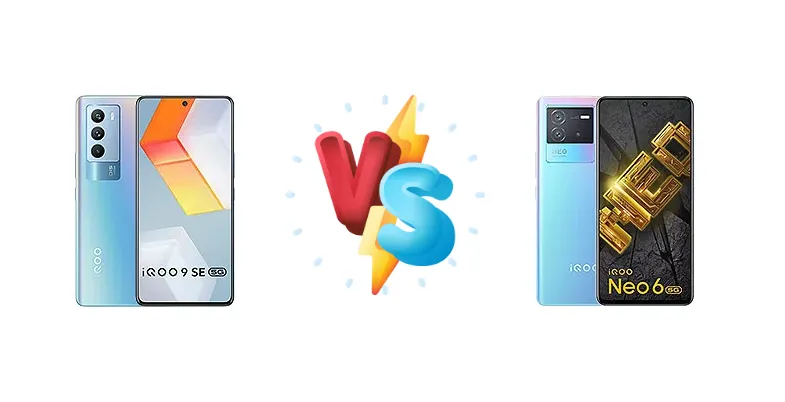
The vivo iQOO series is known for delivering impressive performance at competitive prices. Today, we're pitting two popular contenders against each other: the iQOO 9 SE and the iQOO Neo 6. Both offer compelling features for gamers and mobile enthusiasts, but which one comes out on top?
🏆 Quick Verdict
The iQOO Neo 6 edges out the iQOO 9 SE thanks to its faster charging, slightly better battery life, and the efficient Snapdragon 870 chipset. While the 9 SE boasts a Snapdragon 888, the Neo 6's overall package provides a more polished experience for most users.
| Network |
|---|
| 2G bands | GSM 850 / 900 / 1800 / 1900 | GSM 850 / 900 / 1800 / 1900 |
| 3G bands | HSDPA 850 / 900 / 1900 / 2100 | HSDPA 850 / 900 / 1700(AWS) / 2100 |
| 4G bands | 1, 3, 4, 5, 8, 28, 34, 38, 39, 40, 41 | 1, 3, 4, 5, 8, 38, 40, 41 |
| 5G bands | 1, 3, 5, 8, 28, 41, 77, 78 SA/NSA | 1, 41, 77, 78 SA/NSA |
| Speed | HSPA, LTE, 5G | HSPA, LTE, 5G |
| Technology | GSM / HSPA / LTE / 5G | GSM / HSPA / LTE / 5G |
| Launch |
|---|
| Announced | 2022, February 23 | 2022, May 31 |
| Status | Available. Released 2022, March 02 | Available. Released 2022, May 31 |
| Body |
|---|
| Build | - | Glass front, plastic frame, plastic back |
| Dimensions | 163.2 x 76.4 x 8.4 mm (6.43 x 3.01 x 0.33 in) | 163 x 76.2 x 8.5 mm (6.42 x 3.00 x 0.33 in) |
| SIM | Nano-SIM + Nano-SIM | Nano-SIM + Nano-SIM |
| Weight | 199 g (7.02 oz) | 190 g (6.70 oz) |
| | Splash and dust resistant | - |
| Display |
|---|
| Protection | Panda Glass | - |
| Resolution | 1080 x 2400 pixels, 20:9 ratio (~398 ppi density) | 1080 x 2400 pixels, 20:9 ratio (~398 ppi density) |
| Size | 6.62 inches, 105.8 cm2 (~84.9% screen-to-body ratio) | 6.62 inches, 105.8 cm2 (~85.2% screen-to-body ratio) |
| Type | Super AMOLED, 120Hz, HDR10+, 1200 nits (peak) | AMOLED, 120Hz, HDR10+, 500 nits (typ), 800 nits (HBM), 1300 nits (peak) |
| Platform |
|---|
| CPU | Octa-core (1x2.84 GHz Cortex-X1 & 3x2.42 GHz Cortex-A78 & 4x1.80 GHz Cortex-A55) | Octa-core (1x3.2 GHz Kryo 585 & 3x2.42 GHz Kryo 585 & 4x1.80 GHz Kryo 585) |
| Chipset | Qualcomm SM8350 Snapdragon 888 5G (5 nm) | Qualcomm SM8250-AC Snapdragon 870 5G (7 nm) |
| GPU | Adreno 660 | Adreno 650 |
| OS | Android 12, Funtouch 12 | Android 12, Funtouch 12 |
| Memory |
|---|
| Card slot | No | No |
| Internal | 128GB 8GB RAM, 256GB 12GB RAM | 128GB 8GB RAM, 256GB 12GB RAM |
| | UFS 3.1 | UFS 3.1 |
| Main Camera |
|---|
| Dual | 48 MP, f/1.8, 25mm (wide), 1/2.0", 0.8µm, PDAF, OIS
13 MP, f/2.2, 16mm, 120˚ (ultrawide), 1/3.1", 1.12µm, AF
Auxiliary lens | - |
| Features | Dual-LED dual-tone flash, HDR, panorama | LED flash, HDR, panorama |
| Single | 16 MP, f/2.0, (wide), 1/3.0", 1.0µm | 16 MP, f/2.0, (wide), 1/3.1", 1.0µm |
| Triple | - | 64 MP, f/1.9, (wide), 1/1.72", 0.8µm, PDAF, OIS
8 MP, f/2.2, 116˚ (ultrawide), 1/4.0", 1.12µm
2 MP (macro) |
| Video | 4K@24/30/60fps, 1080p@30/60fps | 4K@30/60fps, 1080p@30/60fps |
| Selfie camera |
|---|
| Features | HDR | HDR |
| Single | 16 MP, f/2.0, (wide), 1/3.0", 1.0µm | 16 MP, f/2.0, (wide), 1/3.1", 1.0µm |
| Video | 1080p@30fps | 1080p@30fps |
| Sound |
|---|
| 3.5mm jack | No | No |
| 35mm jack | No | No |
| Loudspeaker | Yes, with stereo speakers | Yes, with stereo speakers |
| | - | 24-bit/192kHz audio |
| Comms |
|---|
| Bluetooth | 5.2, A2DP, LE | 5.2, A2DP, LE, aptX HD, aptX Adaptive, aptX Lossless |
| Infrared port | - | Yes |
| NFC | Yes | No |
| Positioning | GPS, GLONASS, GALILEO, BDS | GPS, GLONASS, GALILEO, BDS, QZSS |
| Radio | No | No |
| USB | USB Type-C 2.0, OTG | USB Type-C 2.0, OTG |
| WLAN | Wi-Fi 802.11 a/b/g/n/ac, dual-band, Wi-Fi Direct | Wi-Fi 802.11 a/b/g/n/ac, dual-band, Wi-Fi Direct |
| Features |
|---|
| Sensors | Fingerprint (under display, optical), accelerometer, gyro, proximity, compass | Fingerprint (under display, optical), accelerometer, gyro, proximity, compass |
| Battery |
|---|
| Charging | 66W wired, 50% in 14 min, 100% in 39 min | 80W wired, 50% in 12 min, 100% in 32 min |
| Type | 4500 mAh | 4700 mAh |
| Misc |
|---|
| Colors | Space Fusion, Sunset Sierra | Dark Nova, Cyber Rage |
| Models | - | I2126 |
| Price | About 400 EUR | About 360 EUR |
| Tests |
|---|
| Battery life |
Endurance rating 87h
|
Endurance rating 97h
|
| Camera |
Photo / Video |
Photo / Video |
| Display |
Contrast ratio: Infinite (nominal) |
Contrast ratio: Infinite (nominal) |
| Loudspeaker |
-26.1 LUFS (Good)
|
-25.0 LUFS (Very good)
|
| Performance |
AnTuTu: 727771 (v8), 846231 (v9)
GeekBench: 3442 (v5.1)
GFXBench: 64fps (ES 3.1 onscreen) |
AnTuTu: 627246 (v8), 730223 (v9)
GeekBench: 3076 (v5.1)
GFXBench: 50fps (ES 3.1 onscreen) |
vivo iQOO 9 SE
- Potentially higher peak performance (Snapdragon 888)
- Slightly brighter display
- Slower charging speed
- Shorter battery life
- Potential for thermal throttling
vivo iQOO Neo 6
- Faster charging (80W)
- Longer battery life
- More efficient chipset (Snapdragon 870)
- Likely better sustained performance
- Slightly dimmer display
- Potentially slightly lower peak performance
Display Comparison
Both phones feature vibrant displays with infinite contrast ratios (nominal). However, the iQOO 9 SE takes a slight lead with a measured peak brightness of 863 nits compared to the Neo 6's 772 nits, resulting in better outdoor visibility. Both likely use AMOLED panels with 120Hz refresh rates, offering smooth scrolling and gaming.
Camera Comparison
Camera details are limited in the provided specs. Both phones likely offer versatile camera setups with a primary sensor, ultrawide lens, and potentially a macro lens. Image quality will likely be comparable, with vivo's software processing playing a significant role. Expect decent photo and video capabilities on both devices.
Performance
The iQOO 9 SE packs the Snapdragon 888, known for its raw power. The iQOO Neo 6 utilizes the Snapdragon 870, which, while slightly less powerful on paper, is more efficient and often delivers smoother sustained performance due to better thermal management. Real-world gaming performance will be excellent on both, but the Neo 6 might edge out the 9 SE in extended gaming sessions.
Battery Life
The iQOO Neo 6 holds a clear advantage in battery life, boasting an endurance rating of 97 hours compared to the iQOO 9 SE's 87 hours. Furthermore, the Neo 6's 80W charging is significantly faster than the 9 SE's 66W, allowing for quicker top-ups.
Buying Guide
The vivo iQOO 9 SE is ideal for those prioritizing raw processing power and don't mind slightly slower charging. The iQOO Neo 6 is a better choice for users who value faster charging speeds, longer battery life, and a more balanced overall performance profile.
Frequently Asked Questions
❓ Is the Snapdragon 888 in the iQOO 9 SE better than the Snapdragon 870 in the iQOO Neo 6?
While the Snapdragon 888 has a higher peak performance, the Snapdragon 870 is more efficient and often provides better sustained performance due to improved thermal management.
❓ Which phone is better for gaming?
Both are excellent for gaming. The iQOO Neo 6 might offer a slightly smoother experience in extended gaming sessions due to its better thermal performance.