
vivo iQOO 9 SE vs iQOO 9T: A Detailed Showdown
| Phones Images | |||||
|---|---|---|---|---|---|
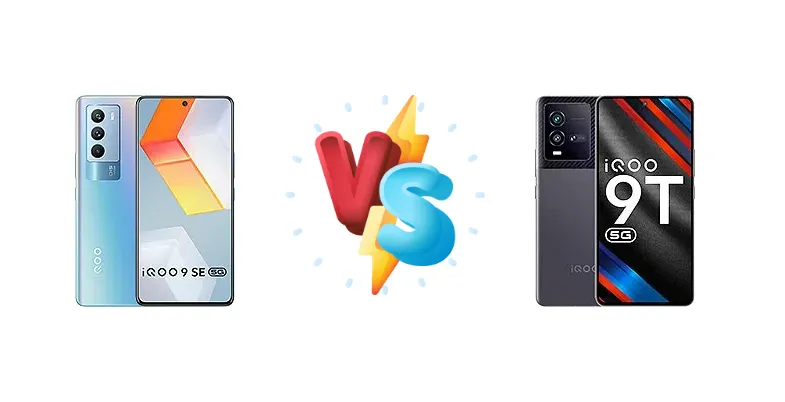
|
🏆 Quick Verdict
The iQOO 9T emerges as the clear winner thanks to its significantly faster charging, more powerful Snapdragon 8+ Gen 1 chipset, and brighter display. However, the iQOO 9 SE remains a strong contender, offering excellent battery life and a more budget-friendly price point.
| PHONES | ||
|---|---|---|
| Phone Names | vivo iQOO 9 SE | vivo iQOO 9T |
| Network | ||
|---|---|---|
| 2G bands | GSM 850 / 900 / 1800 / 1900 | GSM 850 / 900 / 1800 / 1900 |
| 3G bands | HSDPA 850 / 900 / 1900 / 2100 | HSDPA 800 / 850 / 900 / 1700 / 1800 / 1900 / 2100 |
| 4G bands | 1, 3, 4, 5, 8, 28, 34, 38, 39, 40, 41 | 1, 2, 3, 4, 5, 7, 8, 12, 17, 18, 19, 20, 25, 26, 28, 34, 38, 39, 40, 41, 66 |
| 5G bands | 1, 3, 5, 8, 28, 41, 77, 78 SA/NSA | 1, 3, 5, 8, 28, 40, 41, 77, 78 |
| Speed | HSPA, LTE, 5G | HSPA, LTE, 5G |
| Technology | GSM / HSPA / LTE / 5G | GSM / HSPA / LTE / 5G |
| Launch | ||
|---|---|---|
| Announced | 2022, February 23 | 2022, August 02 |
| Status | Available. Released 2022, March 02 | Available. Released 2022, August 02 |
| Body | ||
|---|---|---|
| Build | - | Glass front (Gorilla Glass 5), aluminum frame, glass back |
| Dimensions | 163.2 x 76.4 x 8.4 mm (6.43 x 3.01 x 0.33 in) | 165 x 77 x 8 mm (6.50 x 3.03 x 0.31 in) |
| SIM | Nano-SIM + Nano-SIM | Nano-SIM + Nano-SIM |
| Weight | 199 g (7.02 oz) | 206 g (7.27 oz) |
| Splash and dust resistant | Dust and dripping water resistant | |
| Display | ||
|---|---|---|
| Protection | Panda Glass | Corning Gorilla Glass 5 |
| Resolution | 1080 x 2400 pixels, 20:9 ratio (~398 ppi density) | 1080 x 2400 pixels, 20:9 ratio (~388 ppi density) |
| Size | 6.62 inches, 105.8 cm2 (~84.9% screen-to-body ratio) | 6.78 inches, 111.0 cm2 (~87.4% screen-to-body ratio) |
| Type | Super AMOLED, 120Hz, HDR10+, 1200 nits (peak) | AMOLED, 1B colors, 120Hz, HDR10+, 1500 nits (peak) |
| Platform | ||
|---|---|---|
| CPU | Octa-core (1x2.84 GHz Cortex-X1 & 3x2.42 GHz Cortex-A78 & 4x1.80 GHz Cortex-A55) | Octa-core (1x3.19 GHz Cortex-X2 & 3x2.75 GHz Cortex-A710 & 4x1.80 GHz Cortex-A510) |
| Chipset | Qualcomm SM8350 Snapdragon 888 5G (5 nm) | Qualcomm SM8475 Snapdragon 8+ Gen 1 (4 nm) |
| GPU | Adreno 660 | Adreno 730 |
| OS | Android 12, Funtouch 12 | Android 12, upgradable to Android 14, Funtouch 14 |
| Memory | ||
|---|---|---|
| Card slot | No | No |
| Internal | 128GB 8GB RAM, 256GB 12GB RAM | 128GB 8GB RAM, 256GB 12GB RAM |
| UFS 3.1 | UFS 3.1 | |
| Main Camera | ||
|---|---|---|
| Dual | 48 MP, f/1.8, 25mm (wide), 1/2.0", 0.8µm, PDAF, OIS 13 MP, f/2.2, 16mm, 120˚ (ultrawide), 1/3.1", 1.12µm, AF Auxiliary lens | - |
| Features | Dual-LED dual-tone flash, HDR, panorama | Dual-LED dual-tone flash, HDR, panorama |
| Single | 16 MP, f/2.0, (wide), 1/3.0", 1.0µm | 16 MP, f/2.5, (wide) |
| Triple | - | 50 MP, f/1.9, (wide), 1/1.57", 1.0µm, PDAF, OIS 12 MP, f/2.0, 47mm (telephoto), PDAF, 2x optical zoom 13 MP, f/2.2, 16mm, 120˚ (ultrawide), AF |
| Video | 4K@24/30/60fps, 1080p@30/60fps | 4K@30/60fps, 1080p@30/60fps, gyro-EIS |
| Selfie camera | ||
|---|---|---|
| Features | HDR | HDR |
| Single | 16 MP, f/2.0, (wide), 1/3.0", 1.0µm | 16 MP, f/2.5, (wide) |
| Video | 1080p@30fps | 1080p@30fps, gyro-EIS |
| Sound | ||
|---|---|---|
| 3.5mm jack | No | No |
| 35mm jack | No | No |
| Loudspeaker | Yes, with stereo speakers | Yes, with stereo speakers |
| - | 24-bit/192kHz audio | |
| Comms | ||
|---|---|---|
| Bluetooth | 5.2, A2DP, LE | 5.2, A2DP, LE, aptX HD, aptX Adaptive |
| Infrared port | - | Yes |
| NFC | Yes | Yes |
| Positioning | GPS, GLONASS, GALILEO, BDS | GPS, GLONASS, GALILEO, BDS, QZSS |
| Radio | No | FM radio |
| USB | USB Type-C 2.0, OTG | USB Type-C 2.0, OTG |
| WLAN | Wi-Fi 802.11 a/b/g/n/ac, dual-band, Wi-Fi Direct | Wi-Fi 802.11 a/b/g/n/ac/6, dual-band, Wi-Fi Direct |
| Features | ||
|---|---|---|
| Sensors | Fingerprint (under display, optical), accelerometer, gyro, proximity, compass | Fingerprint (under display, optical), accelerometer, gyro, proximity, compass |
| Battery | ||
|---|---|---|
| Charging | 66W wired, 50% in 14 min, 100% in 39 min | 120W wired, 50% in 8 min, 100% in 19 min |
| Type | 4500 mAh | 4700 mAh |
| Misc | ||
|---|---|---|
| Colors | Space Fusion, Sunset Sierra | Alpha, Legend (BMW M branding) |
| Price | About 400 EUR | About 600 EUR |
| Tests | ||
|---|---|---|
| Battery life | Endurance rating 87h | Endurance rating 117h |
| Camera | Photo / Video | Photo / Video |
| Display | Contrast ratio: Infinite (nominal) | Contrast ratio: Infinite (nominal) |
| Loudspeaker | -26.1 LUFS (Good) | -28.8 LUFS (Average) |
| Performance | AnTuTu: 727771 (v8), 846231 (v9) GeekBench: 3442 (v5.1) GFXBench: 64fps (ES 3.1 onscreen) | - |
vivo iQOO 9 SE
- Excellent battery life
- More affordable price
- Capable gaming performance
- Good display quality
- Older chipset
- Slower charging
- Lower peak brightness
vivo iQOO 9T
- Faster performance (Snapdragon 8+ Gen 1)
- Incredibly fast charging (120W)
- Brighter display
- Improved image processing (likely)
- Slightly shorter battery life
- Higher price
Display Comparison
The iQOO 9T boasts a significantly brighter display at 1033 nits compared to the iQOO 9 SE's 863 nits. Both offer excellent contrast ratios (infinite nominal), but the 9T's higher brightness provides better visibility in outdoor conditions. Both likely use AMOLED panels with 120Hz refresh rates, providing smooth scrolling and gaming.
Camera Comparison
While both phones are marketed as having 'Photo / Video' capabilities, detailed camera specifications are missing. Based on general knowledge, the iQOO 9T likely has a slightly improved camera system due to the newer chipset and potentially better image processing algorithms. Both likely feature a primary sensor around 50MP, an ultrawide lens, and a macro lens.
Performance
The iQOO 9T's Snapdragon 8+ Gen 1 chipset is a substantial upgrade over the iQOO 9 SE's Snapdragon 888. This translates to noticeably faster app loading times, smoother multitasking, and improved gaming performance, especially in demanding titles. The 9T's newer CPU architecture also contributes to better efficiency.
Battery Life
The iQOO 9 SE shines in battery life, boasting an impressive endurance rating of 87 hours. However, the iQOO 9T compensates with incredibly fast 120W charging, reaching 100% in just 19 minutes, compared to the 9 SE's 39 minutes. While the 9T has a lower endurance rating (117h), the rapid charging minimizes downtime.
Buying Guide
The vivo iQOO 9 SE is ideal for users prioritizing long battery life and a more affordable price tag, while still enjoying a capable gaming experience. The iQOO 9T is the better choice for power users and gamers who demand the fastest performance, quickest charging, and a brighter, more vibrant display.