
vivo iQOO 9 SE vs iQOO 9 Pro: A Detailed Showdown
| Phones Images | |||||
|---|---|---|---|---|---|
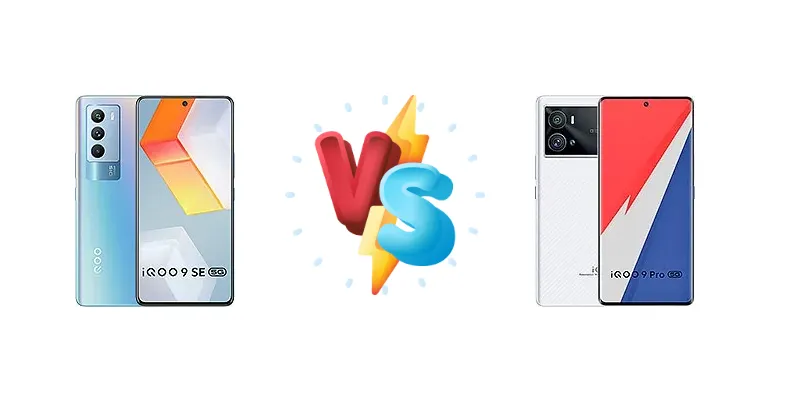
|
🏆 Quick Verdict
The iQOO 9 Pro is the clear winner, boasting a faster Snapdragon 8 Gen 1 chip, significantly quicker 120W charging, and a brighter display. However, the iQOO 9 SE remains a compelling option for budget-conscious users seeking solid performance and endurance.
| PHONES | ||
|---|---|---|
| Phone Names | vivo iQOO 9 SE | vivo iQOO 9 Pro |
| Network | ||
|---|---|---|
| 2G bands | GSM 850 / 900 / 1800 / 1900 | GSM 850 / 900 / 1800 / 1900 |
| 3G bands | HSDPA 850 / 900 / 1900 / 2100 | HSDPA 850 / 900 / 1700(AWS) / 1900 / 2100 |
| 4G bands | 1, 3, 4, 5, 8, 28, 34, 38, 39, 40, 41 | 1, 2, 3, 4, 5, 7, 8, 12, 17, 18, 19, 20, 25, 26, 28, 32, 34, 38, 39, 40, 41, 42, 66 |
| 5G bands | 1, 3, 5, 8, 28, 41, 77, 78 SA/NSA | 1, 3, 5, 7, 8, 20, 28, 38, 40, 41, 66, 77, 78, 79 SA/NSA |
| Speed | HSPA, LTE, 5G | HSPA, LTE, 5G |
| Technology | GSM / HSPA / LTE / 5G | GSM / CDMA / HSPA / CDMA2000 / LTE / 5G |
| - | CDMA2000 1x | |
| Launch | ||
|---|---|---|
| Announced | 2022, February 23 | 2022, January 05 |
| Status | Available. Released 2022, March 02 | Available. Released 2022, January 12 |
| Body | ||
|---|---|---|
| Build | - | Glass front (Panda Glass), aluminum frame, glass back or aramid fiber back |
| Dimensions | 163.2 x 76.4 x 8.4 mm (6.43 x 3.01 x 0.33 in) | 164.8 x 75.2 x 8.8 mm |
| SIM | Nano-SIM + Nano-SIM | Nano-SIM + Nano-SIM |
| Weight | 199 g (7.02 oz) | 204 g or 210 g (7.20 oz) |
| Splash and dust resistant | Splash and dust resistant | |
| Display | ||
|---|---|---|
| Protection | Panda Glass | Panda Glass |
| Resolution | 1080 x 2400 pixels, 20:9 ratio (~398 ppi density) | 1440 x 3200 pixels, 20:9 ratio (~518 ppi density) |
| Size | 6.62 inches, 105.8 cm2 (~84.9% screen-to-body ratio) | 6.78 inches, 111.0 cm2 (~89.6% screen-to-body ratio) |
| Type | Super AMOLED, 120Hz, HDR10+, 1200 nits (peak) | LTPO2 AMOLED, 1B colors, 120Hz, HDR10+, Dolby Vision, 500 nits (typ), 1000 nits (HBM), 1500 nits (peak) |
| Platform | ||
|---|---|---|
| CPU | Octa-core (1x2.84 GHz Cortex-X1 & 3x2.42 GHz Cortex-A78 & 4x1.80 GHz Cortex-A55) | Octa-core (1x3.00 GHz Cortex-X2 & 3x2.50 GHz Cortex-A710 & 4x1.80 GHz Cortex-A510) |
| Chipset | Qualcomm SM8350 Snapdragon 888 5G (5 nm) | Qualcomm SM8450 Snapdragon 8 Gen 1 (4 nm) |
| GPU | Adreno 660 | Adreno 730 |
| OS | Android 12, Funtouch 12 | Android 12, Funtouch 12 (International), OriginOS Ocean (China) |
| Memory | ||
|---|---|---|
| Card slot | No | No |
| Internal | 128GB 8GB RAM, 256GB 12GB RAM | 256GB 8GB RAM, 256GB 12GB RAM, 512GB 12GB RAM |
| UFS 3.1 | UFS 3.1 (V6) | |
| Main Camera | ||
|---|---|---|
| Dual | 48 MP, f/1.8, 25mm (wide), 1/2.0", 0.8µm, PDAF, OIS 13 MP, f/2.2, 16mm, 120˚ (ultrawide), 1/3.1", 1.12µm, AF Auxiliary lens | - |
| Features | Dual-LED dual-tone flash, HDR, panorama | Dual-LED lash, HDR, panorama |
| Single | 16 MP, f/2.0, (wide), 1/3.0", 1.0µm | 16 MP, f/2.5, (wide), 1/3.1", 1.0µm |
| Triple | - | 50 MP, f/1.8, (wide), 1/1.57", 1.0µm, PDAF, gimbal OIS 16 MP, f/2.2, 60mm (telephoto), 1/3.1", 1.0µm, PDAF, OIS, 2.5x optical zoom 50 MP, f/2.3, 15mm, 150˚ (ultrawide), 1/2.76", 0.64µm, AF |
| Video | 4K@24/30/60fps, 1080p@30/60fps | 8K@30fps, 4K@24/30/60fps, 1080p@30/60fps, gyro-EIS |
| Selfie camera | ||
|---|---|---|
| Features | HDR | HDR |
| Single | 16 MP, f/2.0, (wide), 1/3.0", 1.0µm | 16 MP, f/2.5, (wide), 1/3.1", 1.0µm |
| Video | 1080p@30fps | 1080p@30fps, gyro-EIS |
| Sound | ||
|---|---|---|
| 3.5mm jack | No | No |
| 35mm jack | No | No |
| Loudspeaker | Yes, with stereo speakers | Yes, with dual speakers |
| - | 32-bit/384kHz audio | |
| Comms | ||
|---|---|---|
| Bluetooth | 5.2, A2DP, LE | 5.2, A2DP, LE, aptX HD, aptX Adaptive, aptX Lossless |
| Infrared port | - | Yes |
| NFC | Yes | Yes |
| Positioning | GPS, GLONASS, GALILEO, BDS | GPS, GLONASS, GALILEO, BDS, QZSS |
| Radio | No | No |
| USB | USB Type-C 2.0, OTG | USB Type-C 2.0, OTG |
| WLAN | Wi-Fi 802.11 a/b/g/n/ac, dual-band, Wi-Fi Direct | Wi-Fi 802.11 a/b/g/n/ac/6, dual-band, Wi-Fi Direct |
| Features | ||
|---|---|---|
| Sensors | Fingerprint (under display, optical), accelerometer, gyro, proximity, compass | Fingerprint (under display, ultrasonic), accelerometer, gyro, proximity, compass |
| Battery | ||
|---|---|---|
| Charging | 66W wired, 50% in 14 min, 100% in 39 min | 120W wired, 50% in 8 min, 100% in 20 min 50W wireless 10W reverse wireless |
| Type | 4500 mAh | 4700 mAh |
| Misc | ||
|---|---|---|
| Colors | Space Fusion, Sunset Sierra | Legend (White w/ BMW M branding), Dark Cruise, Orange |
| Models | - | V2172A, I2022 |
| Price | About 400 EUR | About 630 EUR |
| Tests | ||
|---|---|---|
| Battery life | Endurance rating 87h | Endurance rating 97h |
| Camera | Photo / Video | Photo / Video |
| Display | Contrast ratio: Infinite (nominal) | Contrast ratio: Infinite (nominal) |
| Loudspeaker | -26.1 LUFS (Good) | -24.8 LUFS (Very good) |
| Performance | AnTuTu: 727771 (v8), 846231 (v9) GeekBench: 3442 (v5.1) GFXBench: 64fps (ES 3.1 onscreen) | AnTuTu: 862324 (v8), 997948 (v9) GeekBench: 3708 (v5.1) GFXBench: 46fps (ES 3.1 onscreen) |
vivo iQOO 9 SE
- Excellent battery life
- Smooth performance for the price
- Fast 66W charging
- Competitive price
- Older Snapdragon 888 chipset
- Lower peak brightness display
- Less advanced camera system (likely)
vivo iQOO 9 Pro
- Flagship Snapdragon 8 Gen 1 chipset
- Blazing-fast 120W charging
- Brighter and more vibrant display
- Wireless and reverse wireless charging
- Potentially superior camera system
- Higher price
- May experience slightly more heat under heavy load (typical of 8 Gen 1)
Display Comparison
The iQOO 9 Pro takes a commanding lead in the display department. Its 1000 nits of peak brightness significantly outshines the iQOO 9 SE's 863 nits, making it easier to view content outdoors. Both offer excellent contrast ratios (Infinite, nominally), but the Pro's brightness advantage is noticeable. Both likely use AMOLED panels with 120Hz refresh rates, providing smooth scrolling and animations.
Camera Comparison
Both phones feature capable camera systems, but detailed camera specs are missing. Generally, the iQOO 9 Pro is expected to have a more advanced camera setup with potentially larger sensors and improved image processing capabilities. Expect better low-light performance and more detailed photos from the Pro. Both likely offer a main wide-angle lens, an ultrawide lens, and a telephoto lens.
Performance
The Snapdragon 8 Gen 1 in the iQOO 9 Pro is a substantial upgrade over the Snapdragon 888 in the iQOO 9 SE. While the 888 is still a capable chip, the 8 Gen 1 offers improved CPU and GPU performance, resulting in faster app loading times, smoother multitasking, and better gaming performance. The 4nm process of the 8 Gen 1 also contributes to improved efficiency.
Battery Life
Both phones offer excellent battery life, with endurance ratings of 87h and 97h respectively. The iQOO 9 Pro's 120W wired charging is a game-changer, allowing for incredibly fast charging speeds (50% in 8 minutes, 100% in 20 minutes). The iQOO 9 SE's 66W charging is still fast, but not as impressive (50% in 14 minutes, 100% in 39 minutes). The Pro also includes 50W wireless and 10W reverse wireless charging, adding further convenience.
Buying Guide
The iQOO 9 SE is ideal for gamers and users on a tighter budget who prioritize battery life and a smooth experience. The iQOO 9 Pro is for power users who demand the absolute best performance, fastest charging, and a premium display experience, and are willing to pay a premium.